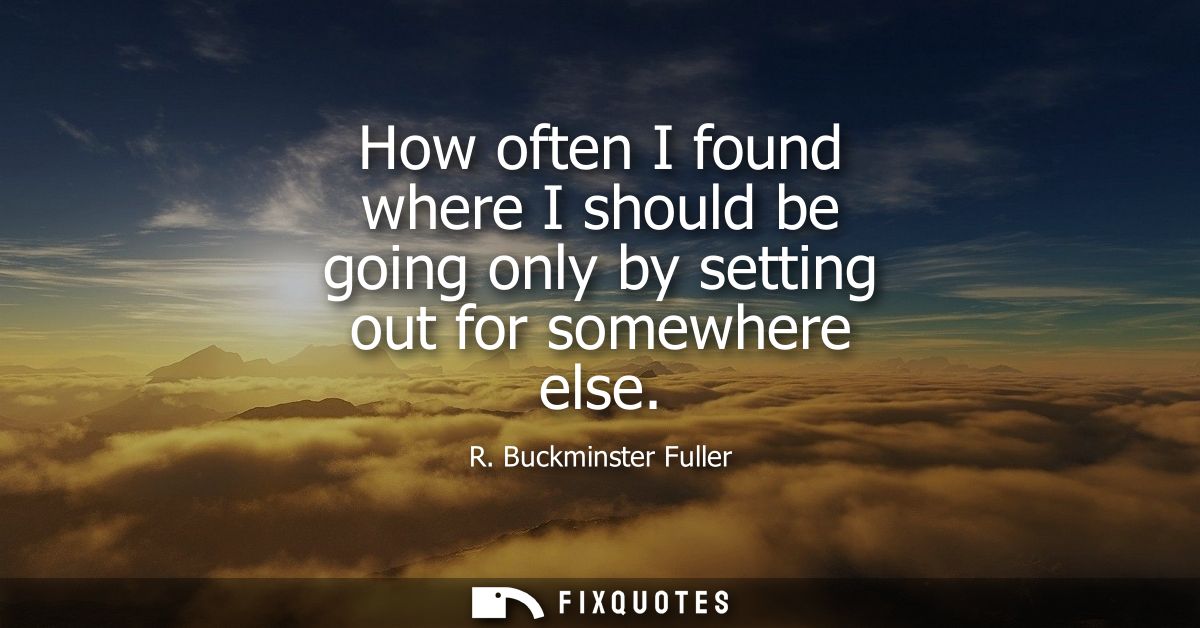
"How often I found where I should be going only by setting out for somewhere else"
About this Quote
That fits Fuller’s entire cultural posture as an inventor-philosopher of systems: someone obsessed with big designs (geodesic domes, “Spaceship Earth”) yet realistic about how innovation actually happens. Prototypes fail. Funding dries up. Collaborators shift. Real constraints force new questions. The quote frames that messy ecology as productive rather than embarrassing. “Setting out” suggests agency and risk - you commit resources and reputation - while “somewhere else” quietly acknowledges that goals are provisional, even when you think they’re fixed.
The subtext is also a critique of linear career logic. Fuller lived through an era that fetishized the straight path: industrial efficiency, managerial planning, progress as a staircase. His sentence argues for progress as a feedback loop. You don’t find the future by staring harder at a blueprint; you find it by moving through the world and letting reality edit you. It’s a permission slip for ambitious people: pursue the wrong thing earnestly enough, and it may reveal the right one.
Quote Details
| Topic | Journey |
|---|---|
| Source | Help us find the source |
| Cite |
Citation Formats
APA Style (7th ed.)
Fuller, R. Buckminster. (2026, January 18). How often I found where I should be going only by setting out for somewhere else. FixQuotes. https://fixquotes.com/quotes/how-often-i-found-where-i-should-be-going-only-by-22485/
Chicago Style
Fuller, R. Buckminster. "How often I found where I should be going only by setting out for somewhere else." FixQuotes. January 18, 2026. https://fixquotes.com/quotes/how-often-i-found-where-i-should-be-going-only-by-22485/.
MLA Style (9th ed.)
"How often I found where I should be going only by setting out for somewhere else." FixQuotes, 18 Jan. 2026, https://fixquotes.com/quotes/how-often-i-found-where-i-should-be-going-only-by-22485/. Accessed 3 Apr. 2026.