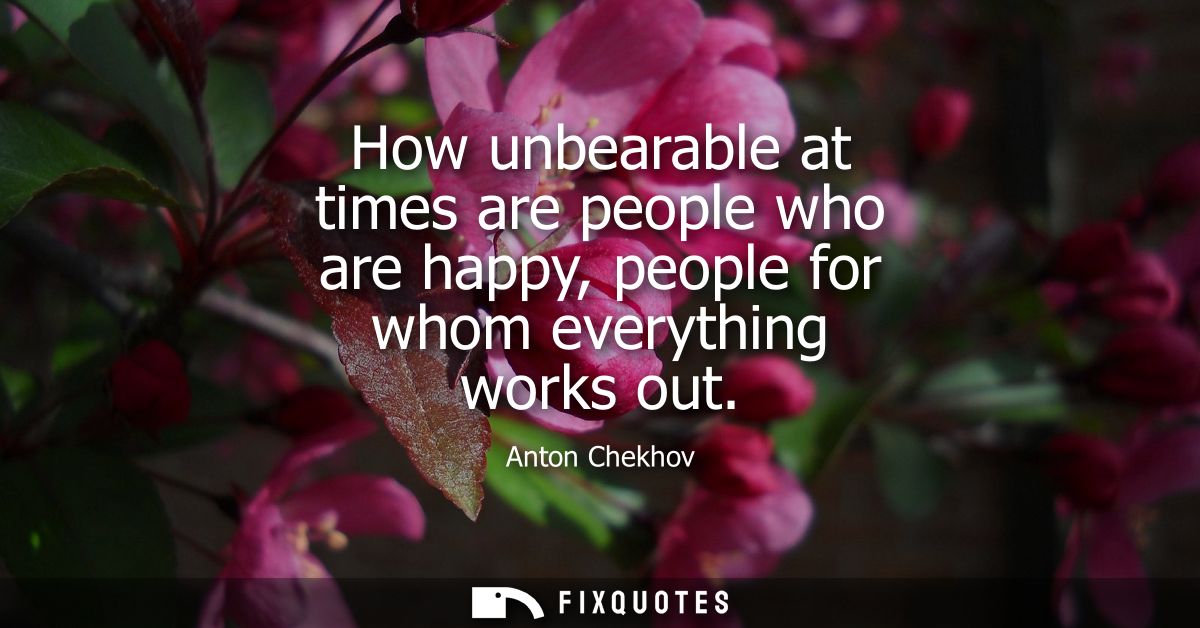
"How unbearable at times are people who are happy, people for whom everything works out"
About this Quote
The subtext is envy, yes, but also exhaustion. Chekhov wrote in an age of bureaucratic stagnation, class stratification, and private disappointments dressed up as public manners. His dramas are crowded with people stalled out in provincial life, craving meaning, love, money, mobility - and watching others glide past them, or imagining that others do. The “happy” here are less individuals than a type: the effortlessly functional, the ones who don’t seem to negotiate with regret.
What makes the sentence work is its honesty about a taboo emotion. We’re allowed to resent cruelty, not contentment. Chekhov flips that moral hierarchy and shows how discomfort can attach itself to the most “positive” spectacle. Happiness, in this view, isn’t just a feeling; it’s a status symbol, a narrative advantage. And like any advantage, it can be hard to sit next to.
Quote Details
| Topic | Happiness |
|---|---|
| Source | Help us find the source |
| Cite |
Citation Formats
APA Style (7th ed.)
Chekhov, Anton. (2026, January 16). How unbearable at times are people who are happy, people for whom everything works out. FixQuotes. https://fixquotes.com/quotes/how-unbearable-at-times-are-people-who-are-happy-110842/
Chicago Style
Chekhov, Anton. "How unbearable at times are people who are happy, people for whom everything works out." FixQuotes. January 16, 2026. https://fixquotes.com/quotes/how-unbearable-at-times-are-people-who-are-happy-110842/.
MLA Style (9th ed.)
"How unbearable at times are people who are happy, people for whom everything works out." FixQuotes, 16 Jan. 2026, https://fixquotes.com/quotes/how-unbearable-at-times-are-people-who-are-happy-110842/. Accessed 3 Apr. 2026.