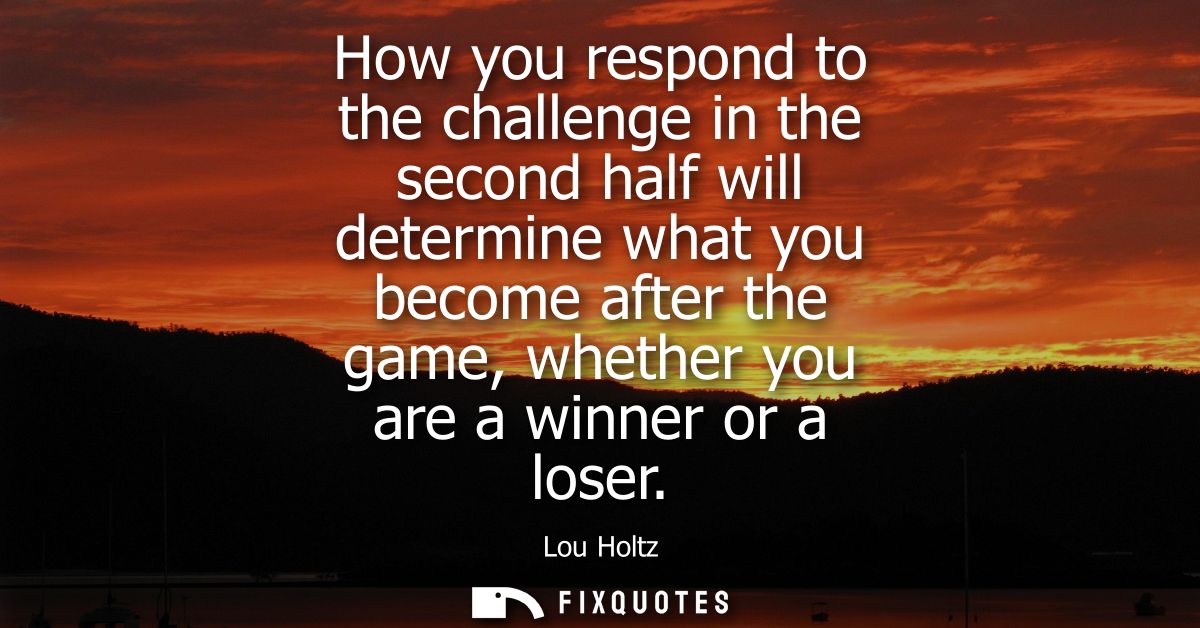
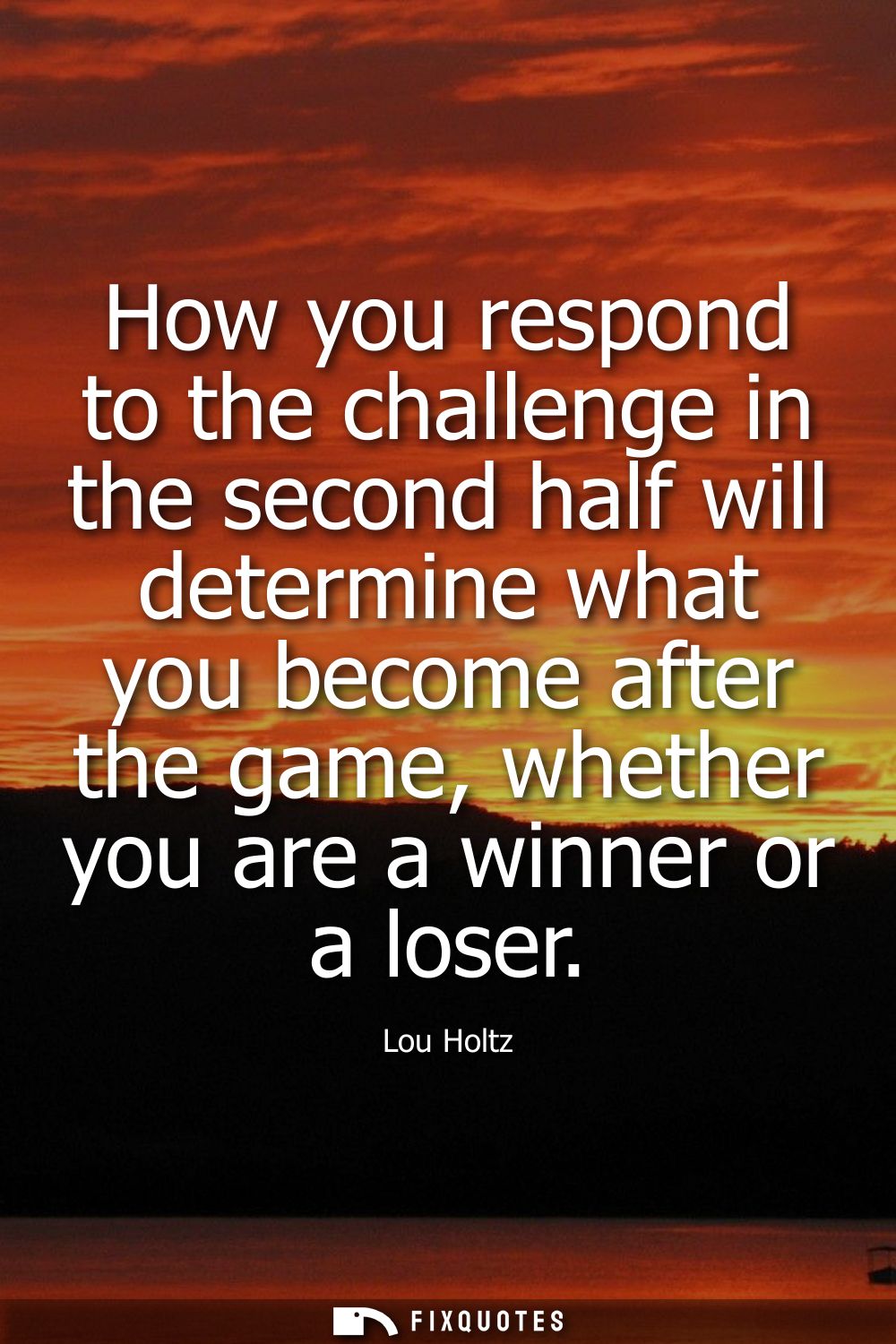
"How you respond to the challenge in the second half will determine what you become after the game, whether you are a winner or a loser"
About this Quote
Holtz isn’t talking about halftime adjustments; he’s talking about identity under stress. The “second half” is a coach’s clean metaphor for the moments when your first plan fails, your legs get heavy, and the scoreboard starts arguing with your self-image. By narrowing the drama to response rather than circumstance, he shifts control back to the person in the uniform: the challenge isn’t the opponent, it’s the temptation to mentally clock out.
The wording is quietly aggressive. “Determine what you become” treats character as something forged, not possessed. It’s less pep talk than conditional prophecy: you’re not a winner because you win; you win because you can stay coherent when the game turns hostile. Holtz smuggles in a moral hierarchy that sports culture loves - adversity as a sorting mechanism - and it flatters the listener with a bargain: your effort can rewrite the story, even if the first half didn’t.
Then he pulls the trick every great coach uses: he expands the stakes beyond the final whistle. “After the game” is doing extra work, suggesting that the real audit happens when the adrenaline drains and you still have to live with your decisions. Winners and losers become social categories, not just results. In a world that increasingly treats performance as personality, Holtz’s line lands because it offers a simple, demanding metric: resilience isn’t a vibe, it’s a choice you make when you’re tired and everyone’s watching.
The wording is quietly aggressive. “Determine what you become” treats character as something forged, not possessed. It’s less pep talk than conditional prophecy: you’re not a winner because you win; you win because you can stay coherent when the game turns hostile. Holtz smuggles in a moral hierarchy that sports culture loves - adversity as a sorting mechanism - and it flatters the listener with a bargain: your effort can rewrite the story, even if the first half didn’t.
Then he pulls the trick every great coach uses: he expands the stakes beyond the final whistle. “After the game” is doing extra work, suggesting that the real audit happens when the adrenaline drains and you still have to live with your decisions. Winners and losers become social categories, not just results. In a world that increasingly treats performance as personality, Holtz’s line lands because it offers a simple, demanding metric: resilience isn’t a vibe, it’s a choice you make when you’re tired and everyone’s watching.
Quote Details
| Topic | Perseverance |
|---|
More Quotes by Lou
Add to List