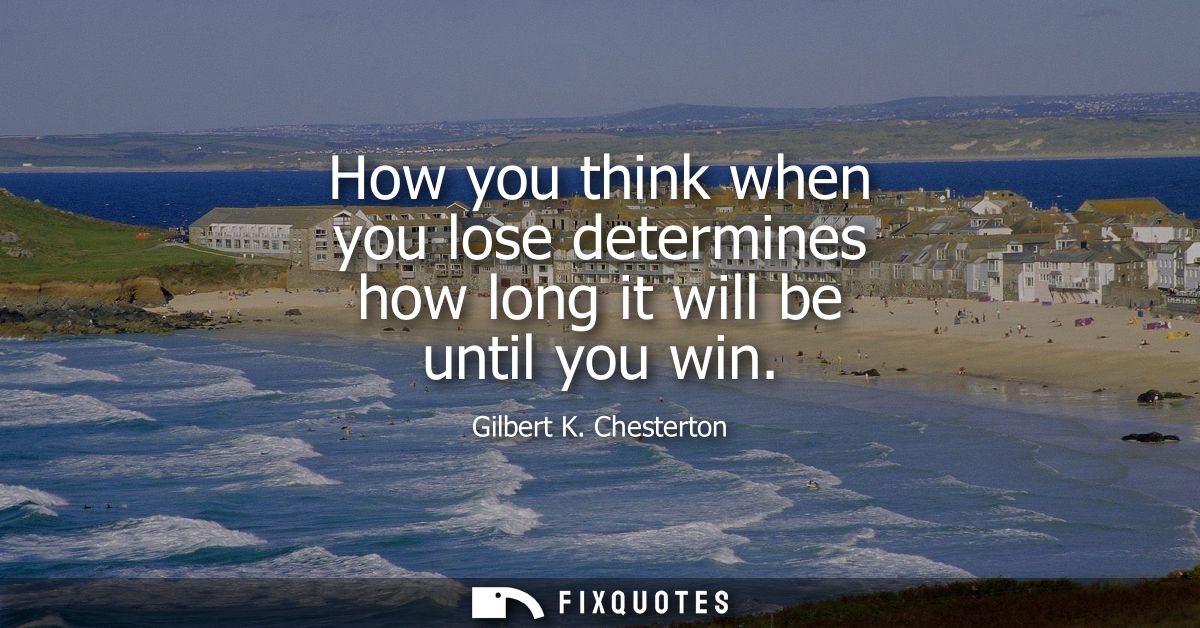
"How you think when you lose determines how long it will be until you win"
About this Quote
The line works because it shifts the timeline of victory away from luck and toward habit. “How long” implies a delay you can actively shorten or quietly extend. That’s Chesterton’s theological and social instinct peeking through: character is destiny, not in some mystical sense, but because character governs attention. A bitter loser will spend the aftermath hunting scapegoats; a reflective loser will spend it locating leverage.
Chesterton wrote in a Britain obsessed with competition, reputation, and the moral anxieties of modern life, and he often argued against the era’s fatalism and fashionable despair. The subtext is anti-cynical without being naive: the true punishment of losing is the worldview you might adopt to protect your ego. He’s saying defeat doesn’t merely happen to you; you can convert it into a temperament. And that temperament, not the scoreboard, decides whether the next round even begins.
Quote Details
| Topic | Never Give Up |
|---|---|
| Source | Help us find the source |
| Cite |
Citation Formats
APA Style (7th ed.)
Chesterton, Gilbert K. (2026, January 15). How you think when you lose determines how long it will be until you win. FixQuotes. https://fixquotes.com/quotes/how-you-think-when-you-lose-determines-how-long-7372/
Chicago Style
Chesterton, Gilbert K. "How you think when you lose determines how long it will be until you win." FixQuotes. January 15, 2026. https://fixquotes.com/quotes/how-you-think-when-you-lose-determines-how-long-7372/.
MLA Style (9th ed.)
"How you think when you lose determines how long it will be until you win." FixQuotes, 15 Jan. 2026, https://fixquotes.com/quotes/how-you-think-when-you-lose-determines-how-long-7372/. Accessed 11 Feb. 2026.