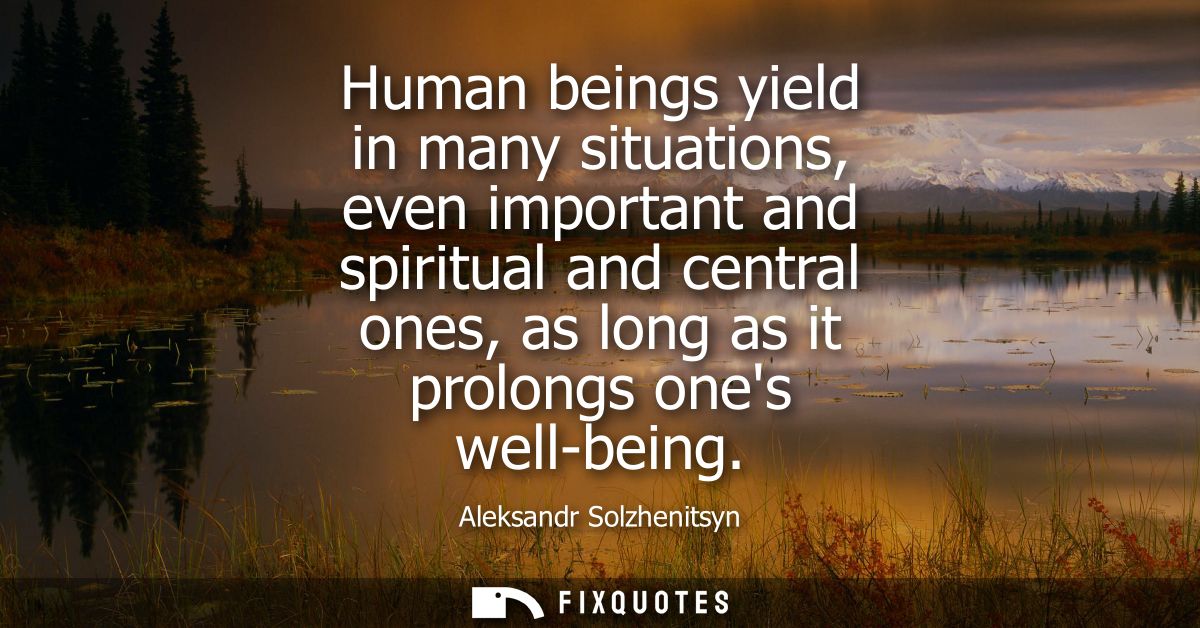
"Human beings yield in many situations, even important and spiritual and central ones, as long as it prolongs one's well-being"
About this Quote
Solzhenitsyn’s sentence lands like a cold diagnosis: surrender isn’t usually forced; it’s negotiated. The phrasing “yield in many situations” is deliberately broad, then sharpened by the unsettling escalation of “even important and spiritual and central ones.” He’s not talking about small compromises. He’s pointing at the moment a person trades away the core of themselves - faith, truth, solidarity, moral clarity - because comfort can be extended a little longer. The verb “prolongs” does heavy lifting: it suggests not happiness, not flourishing, just an extra stretch of tolerable living.
The subtext is a critique of modern survival logic, the kind that makes conformity feel like prudence. “Well-being” reads almost like a euphemism for safety: the warm apartment, the job, the absence of trouble. In a Soviet context - Solzhenitsyn’s lived reality of censorship, informants, labor camps, and social blacklisting - “yielding” often meant repeating lies you didn’t believe, staying silent when others were taken, letting the state define what was real. The bargain wasn’t always explicit. It was incremental, a series of small retreats disguised as “being reasonable.”
What makes the line work is its refusal to flatter the reader. It doesn’t cast capitulation as villainy; it frames it as an ordinary human reflex. That’s the sting: the moral collapse Solzhenitsyn worries about isn’t dramatic betrayal, but the slow conversion of conscience into a luxury item you can’t “afford” once comfort is at stake.
The subtext is a critique of modern survival logic, the kind that makes conformity feel like prudence. “Well-being” reads almost like a euphemism for safety: the warm apartment, the job, the absence of trouble. In a Soviet context - Solzhenitsyn’s lived reality of censorship, informants, labor camps, and social blacklisting - “yielding” often meant repeating lies you didn’t believe, staying silent when others were taken, letting the state define what was real. The bargain wasn’t always explicit. It was incremental, a series of small retreats disguised as “being reasonable.”
What makes the line work is its refusal to flatter the reader. It doesn’t cast capitulation as villainy; it frames it as an ordinary human reflex. That’s the sting: the moral collapse Solzhenitsyn worries about isn’t dramatic betrayal, but the slow conversion of conscience into a luxury item you can’t “afford” once comfort is at stake.
Quote Details
| Topic | Ethics & Morality |
|---|
More Quotes by Aleksandr
Add to List