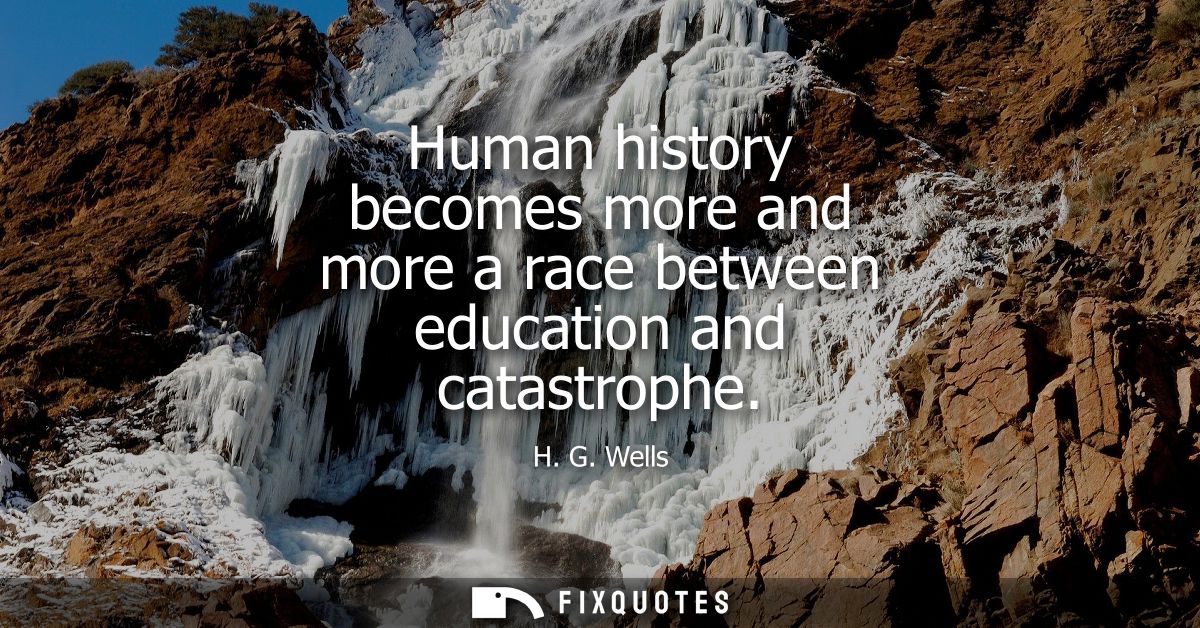
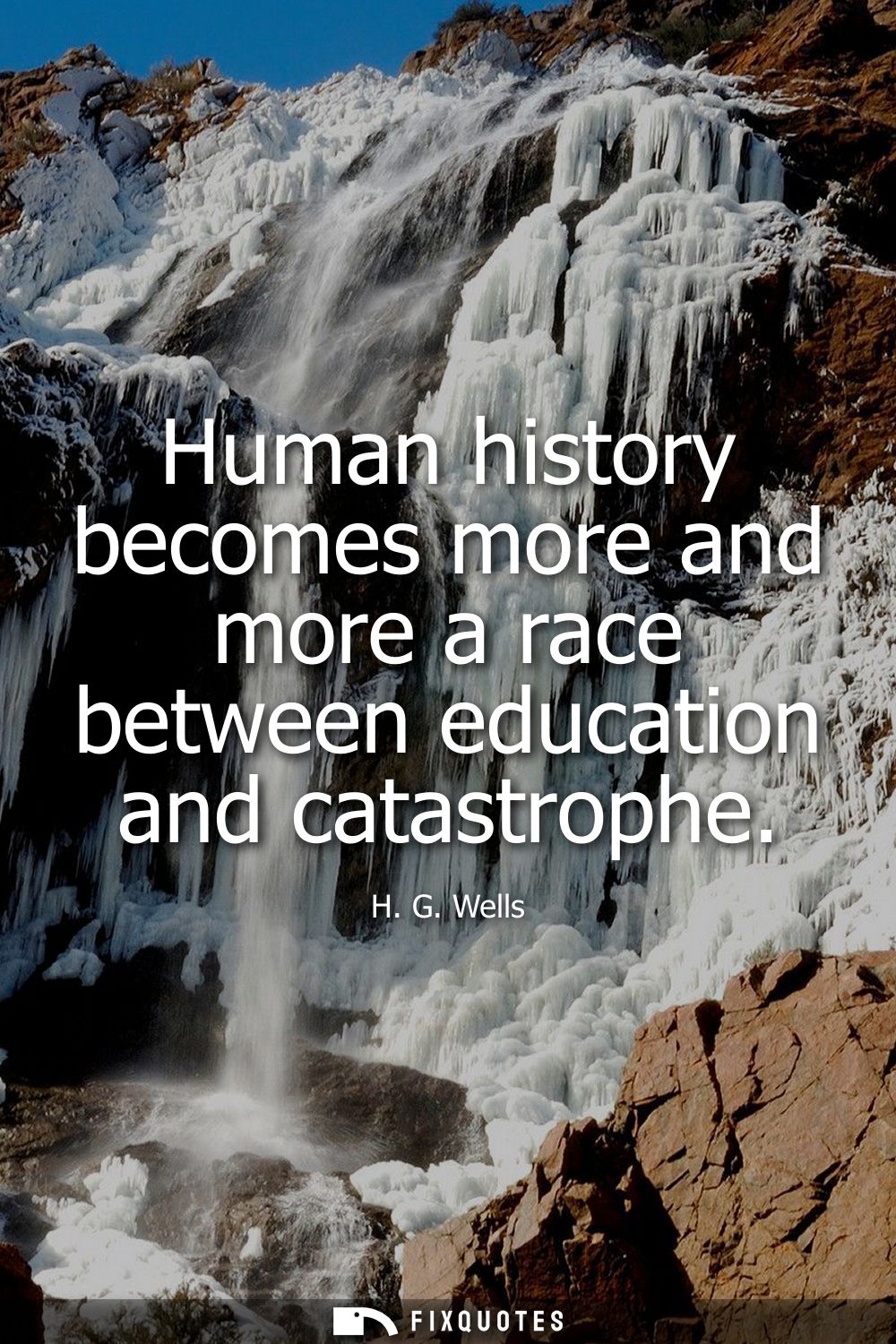
"Human history becomes more and more a race between education and catastrophe"
About this Quote
The intent is partly prophetic, partly prosecutorial. As a novelist steeped in the mechanics of cause and effect, Wells treats catastrophe not as divine punishment but as an engineering outcome: weapons improve, cities densify, empires overreach, misinformation spreads. If education doesn’t scale with those new powers, collapse isn’t a freak accident; it’s the default. The subtext bites: “education” isn’t just schooling, it’s collective literacy in science, politics, and ethics. It’s the capacity to understand systems, resist demagogues, and plan beyond the next quarter. Without that, technological brilliance becomes a multiplier for stupidity.
Context matters. Wells wrote in the shadow of world war and the propaganda state, when mass education and mass destruction were rising together. The sentence is also a rebuke to complacent liberalism: you can’t outsource survival to optimism. In Wells’s formulation, the future isn’t promised; it’s earned, and the deadline keeps moving closer.
Quote Details
| Topic | Learning |
|---|---|
| Source | Verified source: The Outline of History (H.G. Wells, 1920)
Evidence: Human history becomes more and more a race between education and catastrophe. (Introduction (also commonly indexed as Vol. 2, ch. 41, sec. 4 in some editions)). Primary-source location: in H. G. Wells’ own text of The Outline of History, in the Introduction passage that begins “One cannot foretell the surprises or disappointments the future has in store…”. Many secondary references cite it as “vol. 2, chapter 41” (and even give a page like “p. 594”), which varies by edition/printing; the Wikisource transcription confirms the sentence but is not itself the first publication. The work is widely dated to 1920 for first publication; at least one later reprint/edition is cited as Macmillan 1921 by secondary sources, so the exact ‘first appearance’ year depends on which edition you treat as the first publication of the complete book. Other candidates (1) H.G. Wells (W. Warren Wagar, 2004) compilation95.0% ... Human history becomes more and more a race between education and catastrophe . " This single sentence , appearing... |
| Cite |
Citation Formats
APA Style (7th ed.)
Wells, H.G. (2026, February 28). Human history becomes more and more a race between education and catastrophe. FixQuotes. https://fixquotes.com/quotes/human-history-becomes-more-and-more-a-race-23647/
Chicago Style
Wells, H.G. "Human history becomes more and more a race between education and catastrophe." FixQuotes. February 28, 2026. https://fixquotes.com/quotes/human-history-becomes-more-and-more-a-race-23647/.
MLA Style (9th ed.)
"Human history becomes more and more a race between education and catastrophe." FixQuotes, 28 Feb. 2026, https://fixquotes.com/quotes/human-history-becomes-more-and-more-a-race-23647/. Accessed 4 Apr. 2026.