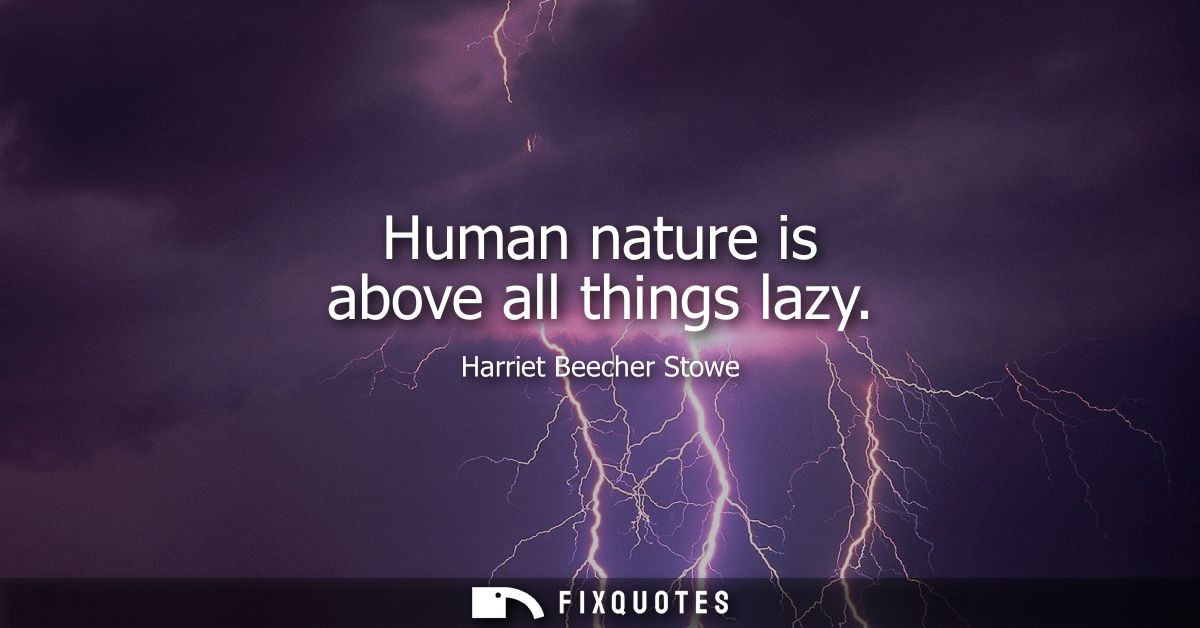
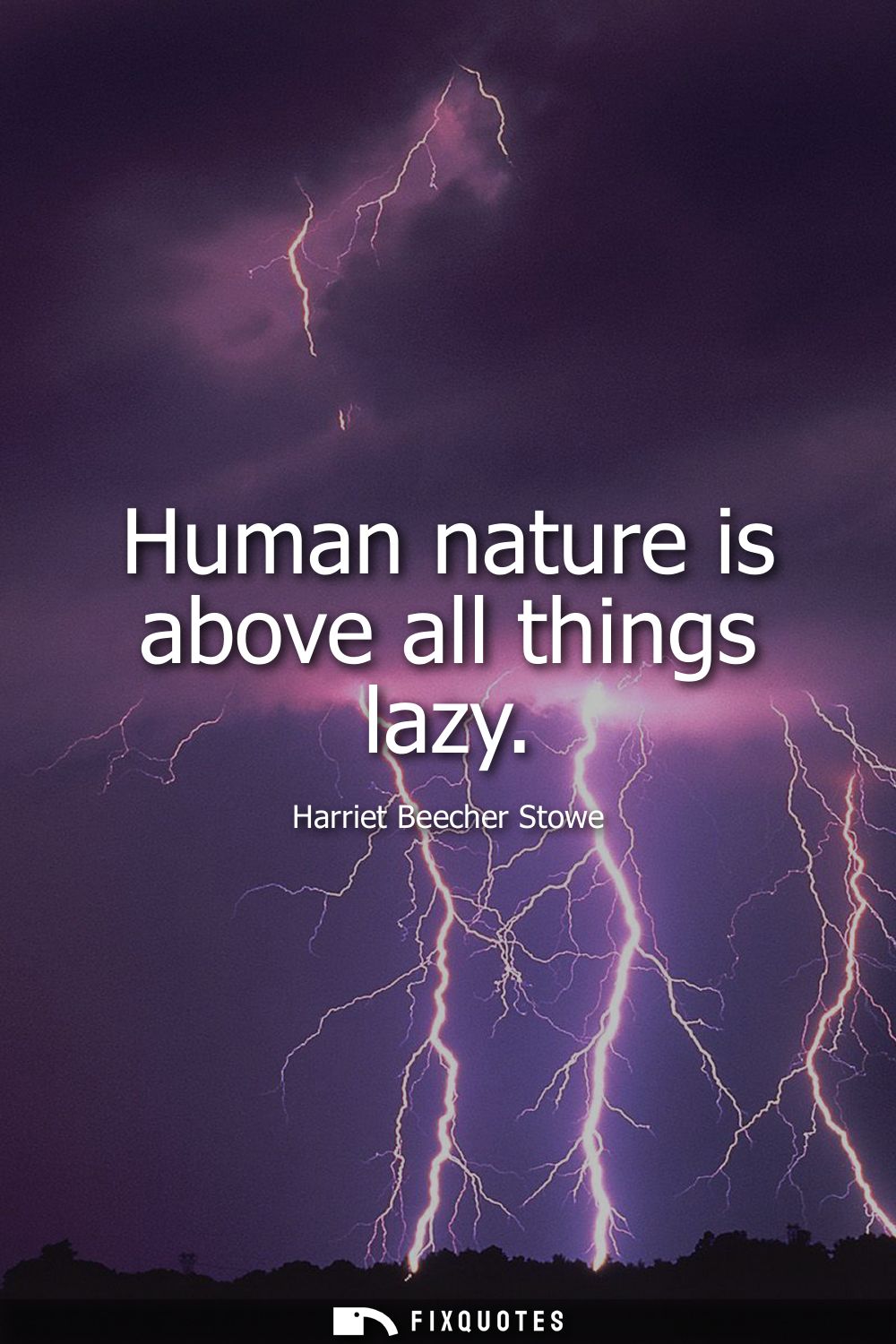
"Human nature is, above all things, lazy"
About this Quote
“Human nature is above all things lazy” lands with the brisk certainty of someone who has watched lofty principles buckle under the weight of everyday convenience. Stowe isn’t tossing off a cute insult; she’s making a practical diagnosis. Laziness here isn’t just idleness on a couch. It’s the gravitational pull toward the easiest moral, social, and political option: don’t get involved, don’t change, don’t look too closely. For an author whose work helped catalyze abolitionist feeling, that’s a loaded claim. The real enemy is not only cruelty but inertia.
The intent is double-edged. On one hand, it’s a rebuke to readers who prefer comfort over conscience, the kind who can condemn slavery in the abstract while enjoying the benefits of a system they won’t challenge. On the other, it’s a warning about how reform movements stall: not because arguments fail, but because action costs energy, reputation, and safety. Stowe’s subtext is that evil often persists less through villainy than through the quiet consensus of “this is just how things are.”
As rhetoric, the line works because it refuses the flattering story people like to tell about themselves. “Above all things” is the tell: she’s elevating laziness to a primary human motive, outranking reason, empathy, even faith. It’s a provocation designed to produce discomfort - and discomfort, in Stowe’s moral universe, is the first spark of responsibility.
The intent is double-edged. On one hand, it’s a rebuke to readers who prefer comfort over conscience, the kind who can condemn slavery in the abstract while enjoying the benefits of a system they won’t challenge. On the other, it’s a warning about how reform movements stall: not because arguments fail, but because action costs energy, reputation, and safety. Stowe’s subtext is that evil often persists less through villainy than through the quiet consensus of “this is just how things are.”
As rhetoric, the line works because it refuses the flattering story people like to tell about themselves. “Above all things” is the tell: she’s elevating laziness to a primary human motive, outranking reason, empathy, even faith. It’s a provocation designed to produce discomfort - and discomfort, in Stowe’s moral universe, is the first spark of responsibility.
Quote Details
| Topic | Work Ethic |
|---|---|
| Source | Help us find the source |
| Cite |
Citation Formats
APA Style (7th ed.)
Stowe, Harriet Beecher. (2026, February 17). Human nature is, above all things, lazy. FixQuotes. https://fixquotes.com/quotes/human-nature-is-above-all-things-lazy-101688/
Chicago Style
Stowe, Harriet Beecher. "Human nature is, above all things, lazy." FixQuotes. February 17, 2026. https://fixquotes.com/quotes/human-nature-is-above-all-things-lazy-101688/.
MLA Style (9th ed.)
"Human nature is, above all things, lazy." FixQuotes, 17 Feb. 2026, https://fixquotes.com/quotes/human-nature-is-above-all-things-lazy-101688/. Accessed 27 Mar. 2026.
More Quotes by Harriet
Add to List