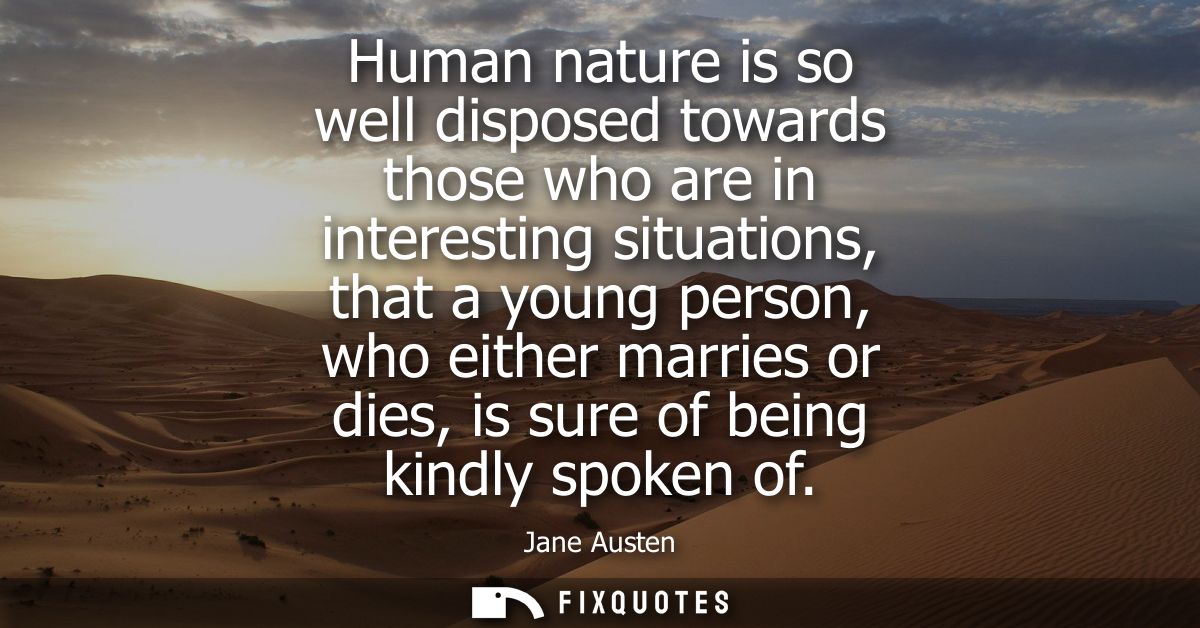
"Human nature is so well disposed towards those who are in interesting situations, that a young person, who either marries or dies, is sure of being kindly spoken of"
About this Quote
The subtext is a critique of polite society’s emotional economy. A young person doesn’t have to be virtuous to be valued; they have to be legible. Marriage provides a respectable storyline, death provides a sanctifying one, and both let observers perform decency without doing the harder work of knowing someone in the muddled middle. Austen’s “either marries or dies” lands as comic brutality because it collapses a supposed life spectrum into two endpoints, suggesting how little room the culture leaves for female adulthood outside matrimony - and how efficiently tragedy can launder gossip into praise.
Context matters: in Austen’s world, reputation is currency, courtship is a market, and conversation is both sport and surveillance. The line isn’t just cynical; it’s diagnostic. It anticipates the modern obsession with “relatable” arcs and public sympathy calibrated to milestones and catastrophes. Austen makes it funny so you’ll repeat it, then realize you’re implicated: kindness, she implies, often follows not goodness but good material.
Quote Details
| Topic | Marriage |
|---|---|
| Source | Help us find the source |
| Cite |
Citation Formats
APA Style (7th ed.)
Austen, Jane. (2026, January 17). Human nature is so well disposed towards those who are in interesting situations, that a young person, who either marries or dies, is sure of being kindly spoken of. FixQuotes. https://fixquotes.com/quotes/human-nature-is-so-well-disposed-towards-those-31830/
Chicago Style
Austen, Jane. "Human nature is so well disposed towards those who are in interesting situations, that a young person, who either marries or dies, is sure of being kindly spoken of." FixQuotes. January 17, 2026. https://fixquotes.com/quotes/human-nature-is-so-well-disposed-towards-those-31830/.
MLA Style (9th ed.)
"Human nature is so well disposed towards those who are in interesting situations, that a young person, who either marries or dies, is sure of being kindly spoken of." FixQuotes, 17 Jan. 2026, https://fixquotes.com/quotes/human-nature-is-so-well-disposed-towards-those-31830/. Accessed 5 Mar. 2026.