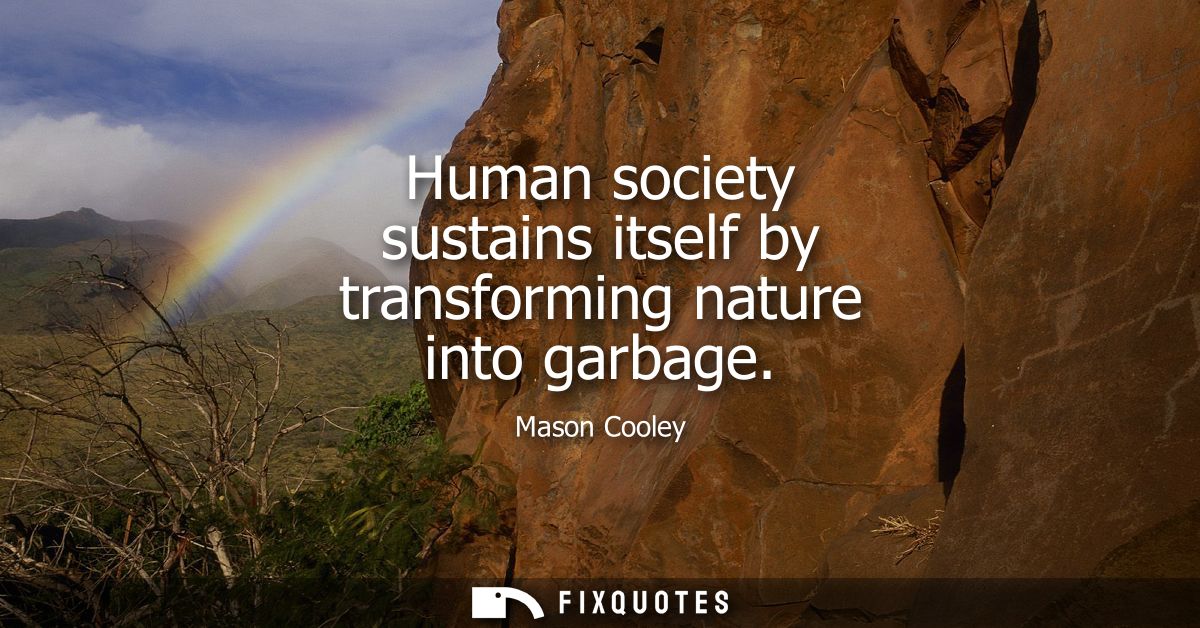
"Human society sustains itself by transforming nature into garbage"
About this Quote
A whole civilization, Cooley suggests, is basically a long, elegant act of littering. The line lands because it takes the proudest story modernity tells about itself - progress as refinement, comfort, “development” - and flips it into a blunt material ledger: extraction in, waste out. “Sustains itself” is the dagger. Garbage here isn’t a side effect or a regrettable externality; it’s the engine. To keep society running, we don’t merely use nature, we metabolize it into residue.
Cooley’s phrasing is also slyly egalitarian. He doesn’t say capitalism, industry, or America; he says “human society,” implicating everything from the first hearth to the latest smartphone upgrade. That broadness is the subtextual provocation: if waste is structural, then our favorite solutions (better individual choices, cleaner branding, greener consumerism) start to look like cosmetic edits to a system whose core output is trash. The sentence compresses the uncomfortable truth that “value” in an economy often means moving matter from a shared commons into private goods - and then, soon enough, into landfills, oceans, and atmosphere.
Context matters: Cooley’s aphorisms bloom in the late-20th-century moment when environmental anxiety stops being niche and becomes a cultural undertone - postwar abundance curdling into smog, plastics, Superfund sites, climate science. The line works because it isn’t moralizing; it’s diagnostic. It makes you hear the hum of the machine behind the polite music of everyday life.
Cooley’s phrasing is also slyly egalitarian. He doesn’t say capitalism, industry, or America; he says “human society,” implicating everything from the first hearth to the latest smartphone upgrade. That broadness is the subtextual provocation: if waste is structural, then our favorite solutions (better individual choices, cleaner branding, greener consumerism) start to look like cosmetic edits to a system whose core output is trash. The sentence compresses the uncomfortable truth that “value” in an economy often means moving matter from a shared commons into private goods - and then, soon enough, into landfills, oceans, and atmosphere.
Context matters: Cooley’s aphorisms bloom in the late-20th-century moment when environmental anxiety stops being niche and becomes a cultural undertone - postwar abundance curdling into smog, plastics, Superfund sites, climate science. The line works because it isn’t moralizing; it’s diagnostic. It makes you hear the hum of the machine behind the polite music of everyday life.
Quote Details
| Topic | Nature |
|---|
More Quotes by Mason
Add to List