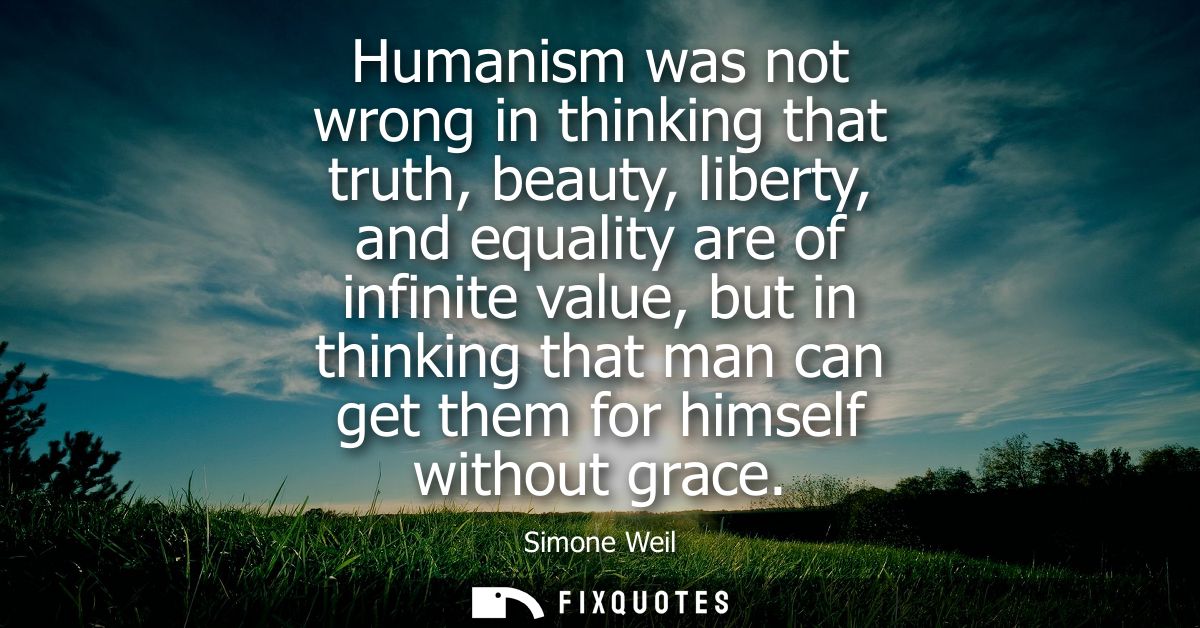
"Humanism was not wrong in thinking that truth, beauty, liberty, and equality are of infinite value, but in thinking that man can get them for himself without grace"
About this Quote
The line works because it’s built as a trapdoor. “Not wrong... but” lets the reader settle into agreement before the floor drops out under “man can get them for himself.” Weil isn’t scolding people for wanting the good; she’s diagnosing the pride baked into secular progress narratives, where history is a staircase and humanity is its own savior. “Grace” here is doing heavy, abrasive work. It’s not a sentimental religious add-on; it’s her name for what can’t be manufactured by willpower, policy, or enlightened education alone. The best things, she implies, are not products. They are gifts, eruptions, visitations - and our job is attention, receptivity, self-emptying.
Context sharpens the critique. Weil lived through the 1930s and early 1940s, watching grand human projects - revolutionary politics, technocratic planning, national destinies - promise emancipation and deliver mechanized cruelty. Her suspicion is that when humans try to possess the infinite, they turn it into an instrument: “truth” becomes propaganda, “equality” becomes coercion, “liberty” becomes license for the strong. Grace is the check on that conversion: a refusal to confuse moral ideals with human control, and a demand that humility precede reform.
Quote Details
| Topic | Truth |
|---|---|
| Source | Help us find the source |
| Cite |
Citation Formats
APA Style (7th ed.)
Weil, Simone. (2026, January 15). Humanism was not wrong in thinking that truth, beauty, liberty, and equality are of infinite value, but in thinking that man can get them for himself without grace. FixQuotes. https://fixquotes.com/quotes/humanism-was-not-wrong-in-thinking-that-truth-24156/
Chicago Style
Weil, Simone. "Humanism was not wrong in thinking that truth, beauty, liberty, and equality are of infinite value, but in thinking that man can get them for himself without grace." FixQuotes. January 15, 2026. https://fixquotes.com/quotes/humanism-was-not-wrong-in-thinking-that-truth-24156/.
MLA Style (9th ed.)
"Humanism was not wrong in thinking that truth, beauty, liberty, and equality are of infinite value, but in thinking that man can get them for himself without grace." FixQuotes, 15 Jan. 2026, https://fixquotes.com/quotes/humanism-was-not-wrong-in-thinking-that-truth-24156/. Accessed 29 Mar. 2026.