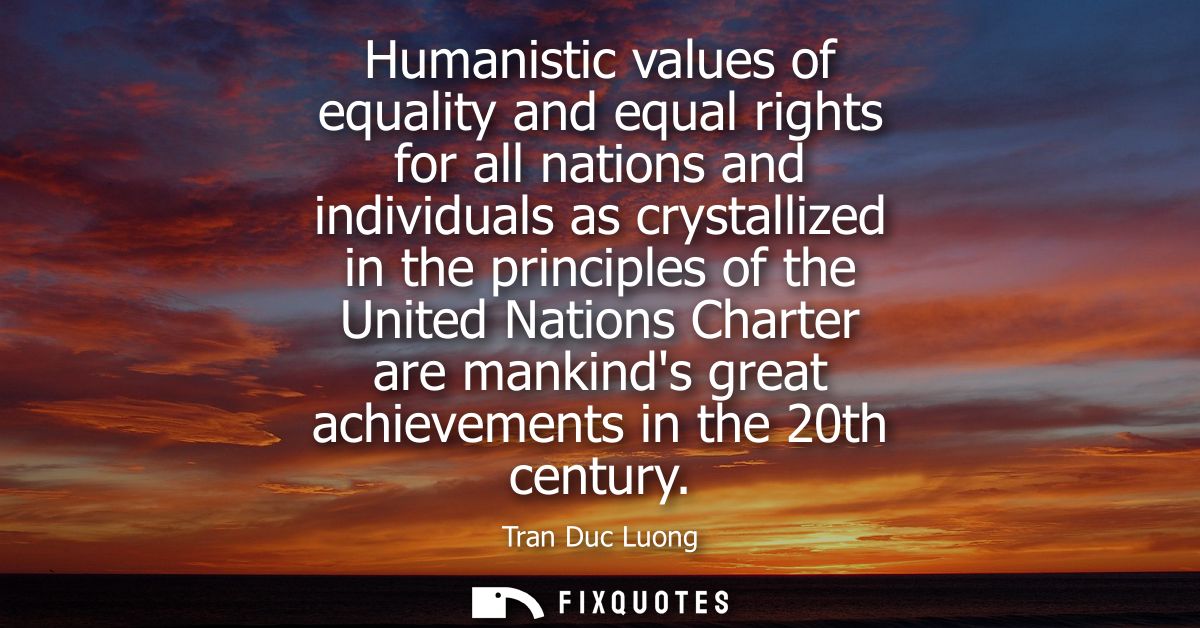
"Humanistic values of equality and equal rights for all nations and individuals as crystallized in the principles of the United Nations Charter are mankind's great achievements in the 20th century"
About this Quote
Calling the UN Charter a 20th-century “great achievement” isn’t just praise; it’s a claim to moral membership in the postwar world order. Tran Duc Luong, speaking as a head of state from a country long defined abroad by war, decolonization, and ideological sorting, is positioning Vietnam inside a framework that treats sovereignty and human dignity as mutually reinforcing. That pairing matters. “Equality and equal rights for all nations and individuals” stitches together two ambitions that often collide: the right of states to noninterference and the rights of people against states. The line tries to harmonize them by invoking the Charter as a settled “crystallized” consensus rather than an ongoing argument.
The subtext is diplomatic: legitimacy flows from speaking the UN’s language. For smaller or recently marginalized nations, “equal rights for all nations” is a veiled demand that global rules not be written solely by great powers. For governments wary of external pressure, it’s also a reminder that the UN system was built as much to prevent domination as to prevent atrocities. By labeling these ideals as “mankind’s” achievement, Luong flattens the Charter’s messier reality - selective enforcement, veto politics, humanitarian intervention debates - into an aspirational monument. That simplification is the point: it turns contested norms into common ground.
Contextually, this rhetoric fits Vietnam’s post-Doi Moi trajectory: economic opening paired with careful political control, and international integration paired with insistence on sovereignty. The quote works because it speaks in the UN’s highest register while quietly advancing a practical message: respect our place at the table, and respect the boundaries around how we govern.
The subtext is diplomatic: legitimacy flows from speaking the UN’s language. For smaller or recently marginalized nations, “equal rights for all nations” is a veiled demand that global rules not be written solely by great powers. For governments wary of external pressure, it’s also a reminder that the UN system was built as much to prevent domination as to prevent atrocities. By labeling these ideals as “mankind’s” achievement, Luong flattens the Charter’s messier reality - selective enforcement, veto politics, humanitarian intervention debates - into an aspirational monument. That simplification is the point: it turns contested norms into common ground.
Contextually, this rhetoric fits Vietnam’s post-Doi Moi trajectory: economic opening paired with careful political control, and international integration paired with insistence on sovereignty. The quote works because it speaks in the UN’s highest register while quietly advancing a practical message: respect our place at the table, and respect the boundaries around how we govern.
Quote Details
| Topic | Human Rights |
|---|
More Quotes by Tran
Add to List