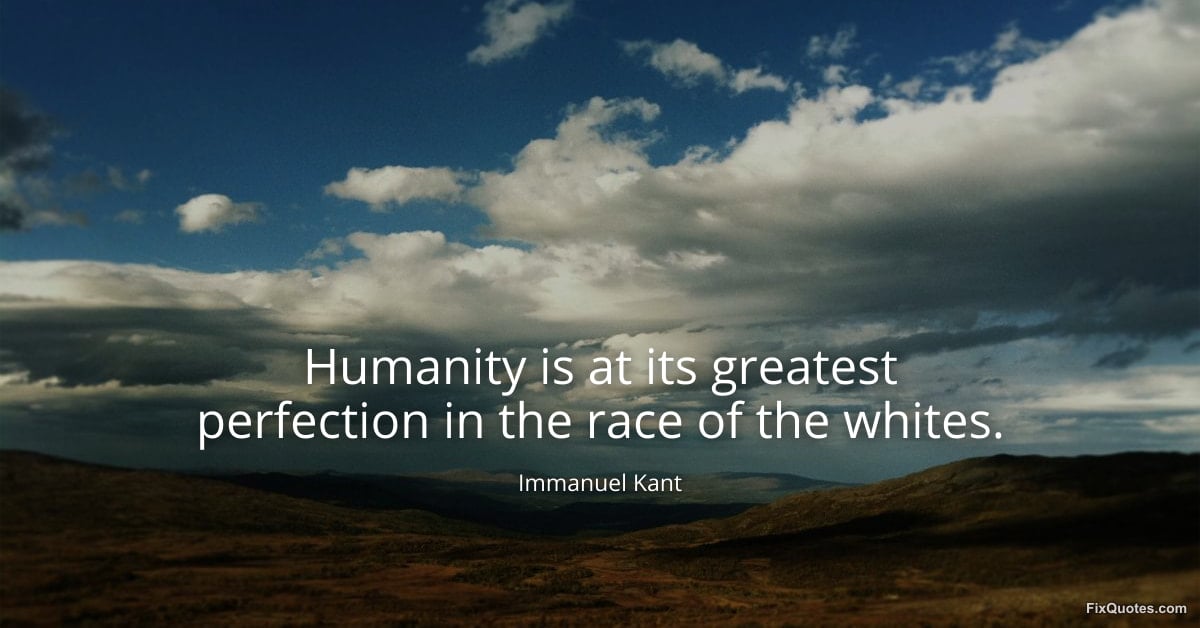
"Humanity is at its greatest perfection in the race of the whites"
About this Quote
Kant’s line lands with the cold confidence of a man trying to turn prejudice into architecture. It’s not a stray insult; it’s a taxonomic claim, the kind that aspires to be “objective” because it borrows the posture of science. The specific intent is classificatory: to rank human groups as though moral and intellectual capacity were natural properties that can be sorted like minerals. By calling white humanity “greatest perfection”, Kant smuggles a whole political order into a single aesthetic word. “Perfection” doesn’t just describe; it authorizes. It makes European dominance read like a culmination rather than a conquest.
The subtext is the quiet transformation of contingency into destiny. Enlightenment universalism is supposed to mean that reason belongs to everyone; this sentence works like a trapdoor beneath that promise. If the “highest” human type is already identified with whiteness, then the rest of humanity becomes an educational problem, a civilizational backlog, or a justification for tutelage. You can hear the later bureaucratic vocabulary forming: improvement, uplift, development. Race becomes the alibi that lets empire imagine itself as pedagogy.
Context matters because Kant isn’t speaking from the margins of his era; he’s near the center of European intellectual prestige, writing amid colonial expansion, the Atlantic slave trade, and a growing European obsession with classification (natural history, anthropology, “scientific” hierarchy). The line exposes how easily the Enlightenment’s tools - reason, system, universality - can be repurposed to produce exclusion with a clean conscience. The shock isn’t only that Kant held racist views; it’s how seamlessly the sentence converts philosophy’s search for order into a moral ranking of people.
The subtext is the quiet transformation of contingency into destiny. Enlightenment universalism is supposed to mean that reason belongs to everyone; this sentence works like a trapdoor beneath that promise. If the “highest” human type is already identified with whiteness, then the rest of humanity becomes an educational problem, a civilizational backlog, or a justification for tutelage. You can hear the later bureaucratic vocabulary forming: improvement, uplift, development. Race becomes the alibi that lets empire imagine itself as pedagogy.
Context matters because Kant isn’t speaking from the margins of his era; he’s near the center of European intellectual prestige, writing amid colonial expansion, the Atlantic slave trade, and a growing European obsession with classification (natural history, anthropology, “scientific” hierarchy). The line exposes how easily the Enlightenment’s tools - reason, system, universality - can be repurposed to produce exclusion with a clean conscience. The shock isn’t only that Kant held racist views; it’s how seamlessly the sentence converts philosophy’s search for order into a moral ranking of people.
Quote Details
| Source | Help us find the source |
|---|---|
| Cite |
Citation Formats
APA Style (7th ed.)
Kant, Immanuel. (2026, February 10). Humanity is at its greatest perfection in the race of the whites. FixQuotes. https://fixquotes.com/quotes/humanity-is-at-its-greatest-perfection-in-the-185063/
Chicago Style
Kant, Immanuel. "Humanity is at its greatest perfection in the race of the whites." FixQuotes. February 10, 2026. https://fixquotes.com/quotes/humanity-is-at-its-greatest-perfection-in-the-185063/.
MLA Style (9th ed.)
"Humanity is at its greatest perfection in the race of the whites." FixQuotes, 10 Feb. 2026, https://fixquotes.com/quotes/humanity-is-at-its-greatest-perfection-in-the-185063/. Accessed 12 Feb. 2026.
More Quotes by Immanuel
Add to List