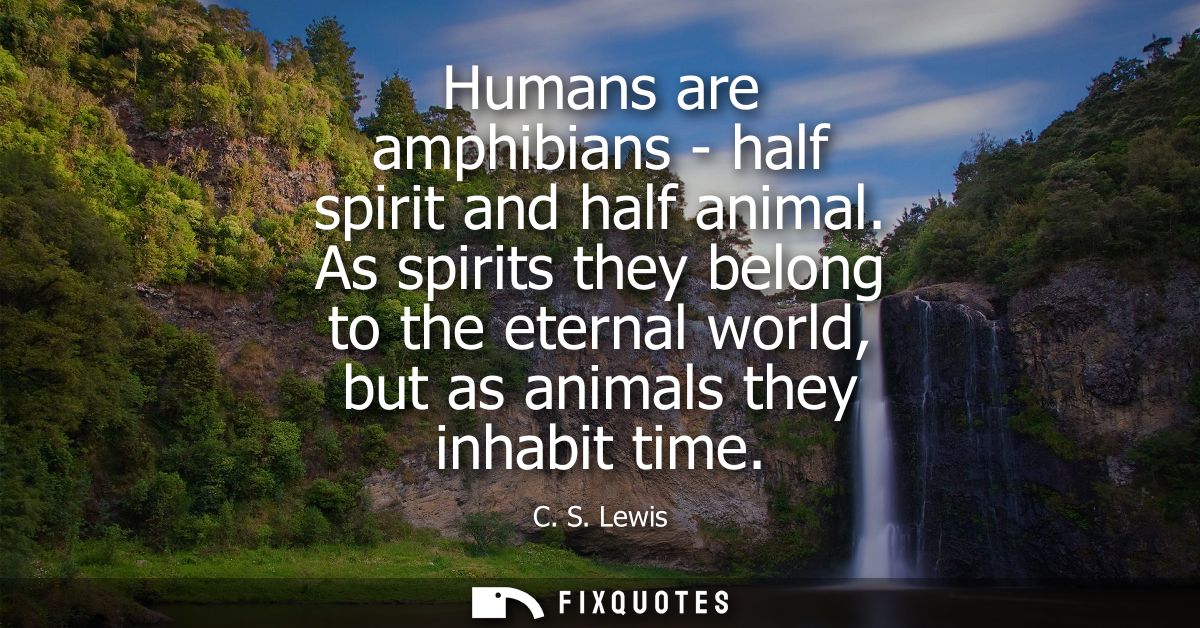
"Humans are amphibians - half spirit and half animal. As spirits they belong to the eternal world, but as animals they inhabit time"
About this Quote
The subtext is a critique of reductionism from both directions. Materialism flattens “spirit” into brain chemistry; sentimental spirituality pretends the “animal” doesn’t matter. Lewis needles both by insisting the divide is not cosmetic but structural. “As spirits they belong to the eternal world” frames longing, conscience, and the hunger for meaning as signals of real citizenship elsewhere. Then he snaps back to biology: “as animals they inhabit time,” bound to decay, desire, fatigue, and the relentless clock. Time isn’t just scheduling here; it’s the realm of limitation, where every choice excludes alternatives and every body keeps receipts.
Context matters: Lewis, writing as a Christian apologist in a 20th century scarred by mechanized war and growing secular confidence, needed language that could translate theology into felt experience. The intent isn’t to shame the body; it’s to explain the friction of being human and to argue that spiritual aspiration without discipline is fantasy, while moral seriousness without transcendence becomes bleak stoicism. The power of the quote is its refusal to let either half win.
Quote Details
| Topic | Meaning of Life |
|---|---|
| Source | Help us find the source |
| Cite |
Citation Formats
APA Style (7th ed.)
Lewis, C. S. (2026, January 18). Humans are amphibians - half spirit and half animal. As spirits they belong to the eternal world, but as animals they inhabit time. FixQuotes. https://fixquotes.com/quotes/humans-are-amphibians-half-spirit-and-half-13668/
Chicago Style
Lewis, C. S. "Humans are amphibians - half spirit and half animal. As spirits they belong to the eternal world, but as animals they inhabit time." FixQuotes. January 18, 2026. https://fixquotes.com/quotes/humans-are-amphibians-half-spirit-and-half-13668/.
MLA Style (9th ed.)
"Humans are amphibians - half spirit and half animal. As spirits they belong to the eternal world, but as animals they inhabit time." FixQuotes, 18 Jan. 2026, https://fixquotes.com/quotes/humans-are-amphibians-half-spirit-and-half-13668/. Accessed 4 Apr. 2026.