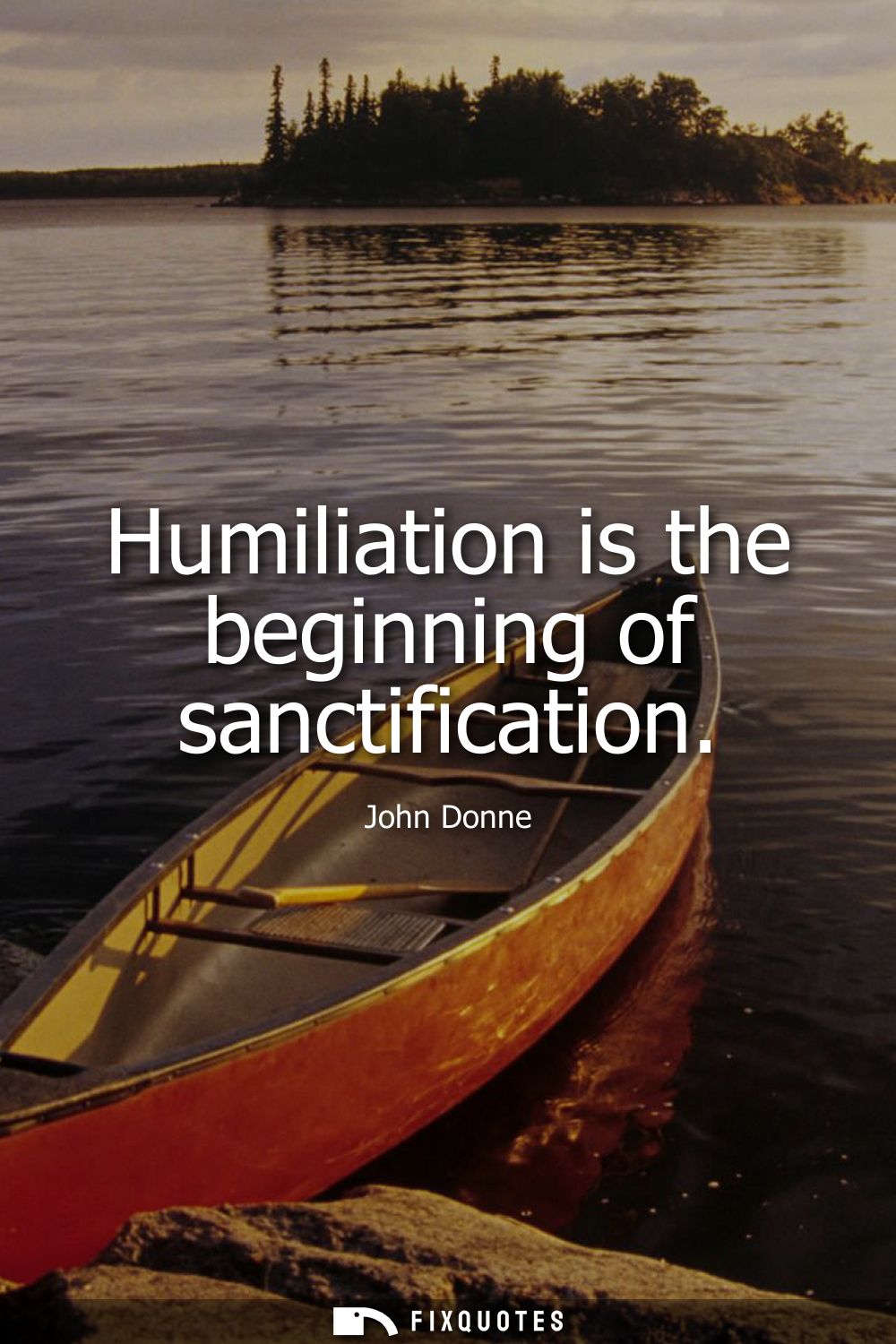
"Humiliation is the beginning of sanctification"
About this Quote
Donne’s line turns spiritual self-improvement into a psychological ambush: you don’t climb toward holiness by polishing your virtues, you fall into it by being brought low. “Humiliation” here isn’t mere embarrassment; it’s humiliation in the older sense of humilitas, the enforced lowering of the self that clears space for God. The phrase has the hard snap of a paradox, and that’s the point. Sanctification sounds like a slow, orderly process; humiliation is sudden, social, bodily. Donne yokes them so the reader feels the shock of how grace often enters: not through triumph, but through exposure.
The intent is pastoral and bracing. Donne, an Anglican preacher with a famously barbed interior life, keeps insisting that the self is the primary obstacle to salvation. Pride doesn’t just offend God; it blocks perception. Humiliation becomes an instrument that breaks the spell of self-mastery, forcing recognition of dependence. The subtext is almost diagnostic: if you’re never humiliated, you might be curating an image rather than confronting a soul.
Context matters. Donne wrote and preached in a post-Reformation England obsessed with sincerity, confession, and the credibility of faith. His own biography - from ambitious courtier to clergyman, with public reversals and private griefs - makes humiliation less an abstract doctrine than a lived rhythm. The line works because it refuses comfort: sanctification begins not when you feel worthy, but when you stop trying to be.
The intent is pastoral and bracing. Donne, an Anglican preacher with a famously barbed interior life, keeps insisting that the self is the primary obstacle to salvation. Pride doesn’t just offend God; it blocks perception. Humiliation becomes an instrument that breaks the spell of self-mastery, forcing recognition of dependence. The subtext is almost diagnostic: if you’re never humiliated, you might be curating an image rather than confronting a soul.
Context matters. Donne wrote and preached in a post-Reformation England obsessed with sincerity, confession, and the credibility of faith. His own biography - from ambitious courtier to clergyman, with public reversals and private griefs - makes humiliation less an abstract doctrine than a lived rhythm. The line works because it refuses comfort: sanctification begins not when you feel worthy, but when you stop trying to be.
Quote Details
| Topic | Humility |
|---|---|
| Source | Help us find the source |
| Cite |
Citation Formats
APA Style (7th ed.)
Donne, John. (2026, January 18). Humiliation is the beginning of sanctification. FixQuotes. https://fixquotes.com/quotes/humiliation-is-the-beginning-of-sanctification-8428/
Chicago Style
Donne, John. "Humiliation is the beginning of sanctification." FixQuotes. January 18, 2026. https://fixquotes.com/quotes/humiliation-is-the-beginning-of-sanctification-8428/.
MLA Style (9th ed.)
"Humiliation is the beginning of sanctification." FixQuotes, 18 Jan. 2026, https://fixquotes.com/quotes/humiliation-is-the-beginning-of-sanctification-8428/. Accessed 13 Feb. 2026.
More Quotes by John
Add to List