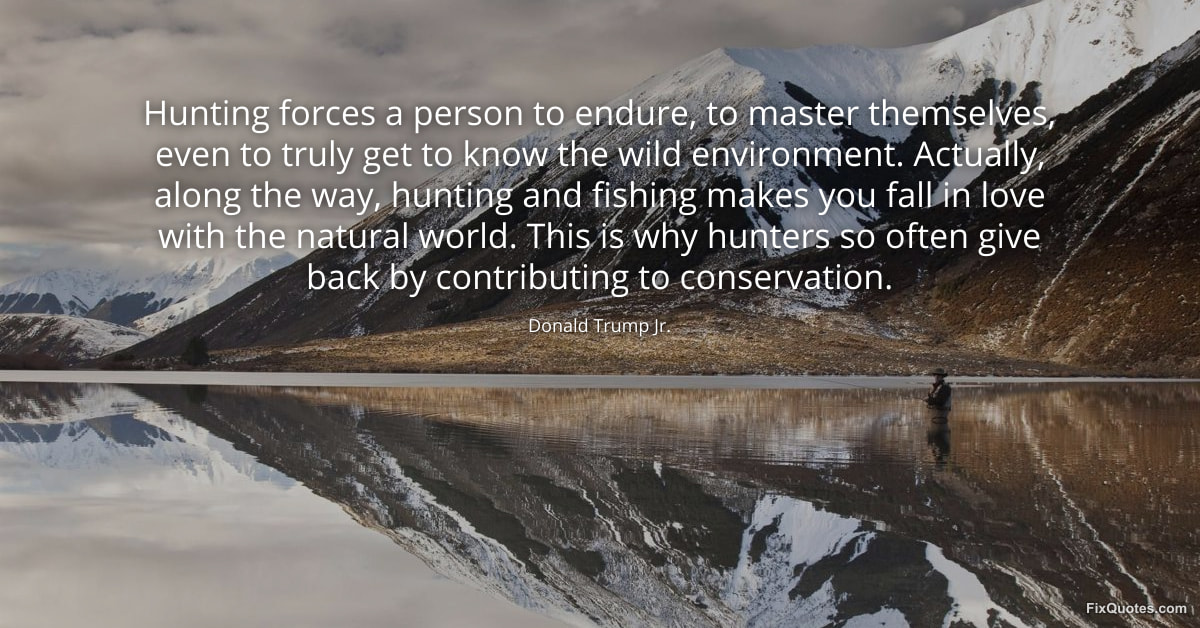
"Hunting forces a person to endure, to master themselves, even to truly get to know the wild environment. Actually, along the way, hunting and fishing makes you fall in love with the natural world. This is why hunters so often give back by contributing to conservation"
About this Quote
The subtext is defensive, but it’s also aspirational. Hunting here becomes a moral credential, a way to claim legitimacy in conservation debates where hunters are often treated as suspect. “Fall in love with the natural world” is doing heavy emotional work: it suggests the act of pursuing and killing an animal is not a contradiction but a pathway to care. That claim doesn’t resolve the ethical tension so much as reframe it as maturity: you can love what you take from.
Context matters. In modern American politics, “hunter” functions as both lifestyle brand and tribal signal. This quote speaks to a constituency that feels caricatured by urban environmentalism and wants recognition as the original conservationists. The final line is the argument’s keystone: hunters “give back” by funding conservation, a nod to real mechanisms (licenses, excise taxes) that turns a cultural argument into an economic one.
It’s persuasive because it offers redemption without apology: your pastime isn’t merely acceptable; it’s civic-minded. The pitch is less “trust hunters” than “we’re already doing the work.”
Quote Details
| Topic | Nature |
|---|---|
| Source | Help us find the source |
| Cite |
Citation Formats
APA Style (7th ed.)
Jr., Donald Trump. (2026, January 15). Hunting forces a person to endure, to master themselves, even to truly get to know the wild environment. Actually, along the way, hunting and fishing makes you fall in love with the natural world. This is why hunters so often give back by contributing to conservation. FixQuotes. https://fixquotes.com/quotes/hunting-forces-a-person-to-endure-to-master-173261/
Chicago Style
Jr., Donald Trump. "Hunting forces a person to endure, to master themselves, even to truly get to know the wild environment. Actually, along the way, hunting and fishing makes you fall in love with the natural world. This is why hunters so often give back by contributing to conservation." FixQuotes. January 15, 2026. https://fixquotes.com/quotes/hunting-forces-a-person-to-endure-to-master-173261/.
MLA Style (9th ed.)
"Hunting forces a person to endure, to master themselves, even to truly get to know the wild environment. Actually, along the way, hunting and fishing makes you fall in love with the natural world. This is why hunters so often give back by contributing to conservation." FixQuotes, 15 Jan. 2026, https://fixquotes.com/quotes/hunting-forces-a-person-to-endure-to-master-173261/. Accessed 16 Feb. 2026.