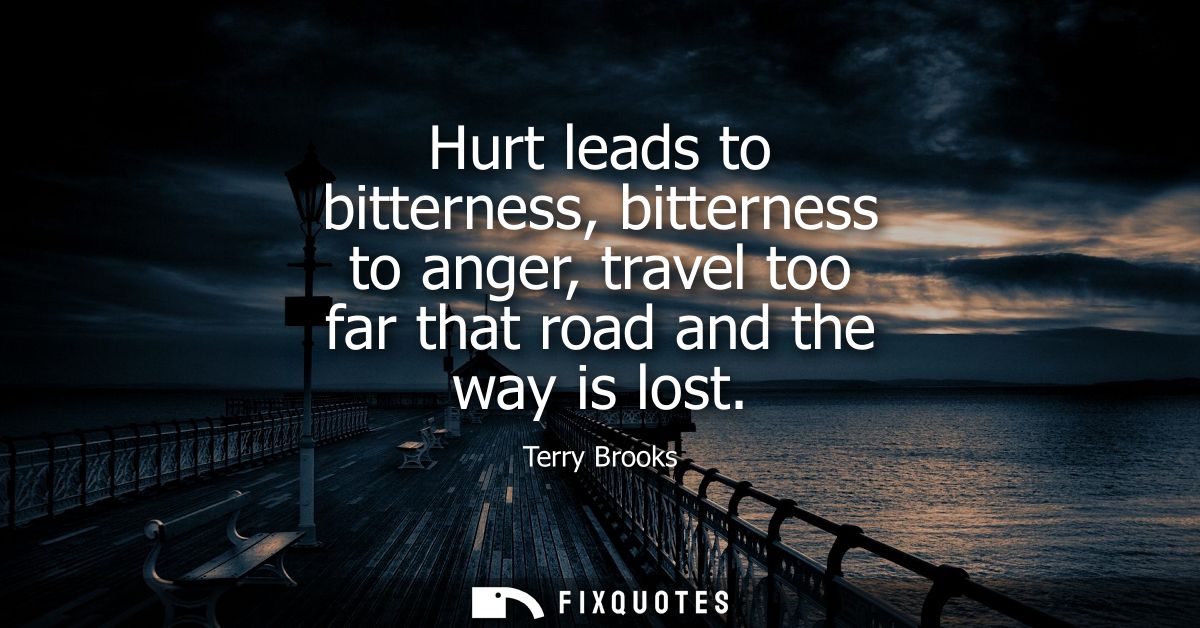
"Hurt leads to bitterness, bitterness to anger, travel too far that road and the way is lost"
About this Quote
The phrasing borrows the cadence of warning and prophecy (“travel too far that road”), which is classic Brooks: high fantasy as a delivery system for behavioral psychology. He’s writing in a genre where roads are literal and symbolic, and where characters are constantly tempted by “the way” that seems justified in the moment but costs them their moral center. “The way is lost” lands like a small tragedy. Not “you are lost” - as if the path itself disappears, as if repeated choices erase the possibility of return.
Subtextually, it’s also a critique of righteous suffering. Hurt often comes with social permission; bitterness can masquerade as wisdom; anger can feel like strength. Brooks punctures that progression by treating it as a seduction, not a transformation you control. In the context of epic narratives - betrayals, wars, ancestral grudges - this is a quiet thesis statement: the true antagonist isn’t the Dark Lord. It’s the emotional logic that makes vengeance feel inevitable.
Quote Details
| Topic | Anger |
|---|---|
| Source | Help us find the source |
| Cite |
Citation Formats
APA Style (7th ed.)
Brooks, Terry. (2026, January 16). Hurt leads to bitterness, bitterness to anger, travel too far that road and the way is lost. FixQuotes. https://fixquotes.com/quotes/hurt-leads-to-bitterness-bitterness-to-anger-97994/
Chicago Style
Brooks, Terry. "Hurt leads to bitterness, bitterness to anger, travel too far that road and the way is lost." FixQuotes. January 16, 2026. https://fixquotes.com/quotes/hurt-leads-to-bitterness-bitterness-to-anger-97994/.
MLA Style (9th ed.)
"Hurt leads to bitterness, bitterness to anger, travel too far that road and the way is lost." FixQuotes, 16 Jan. 2026, https://fixquotes.com/quotes/hurt-leads-to-bitterness-bitterness-to-anger-97994/. Accessed 12 Feb. 2026.