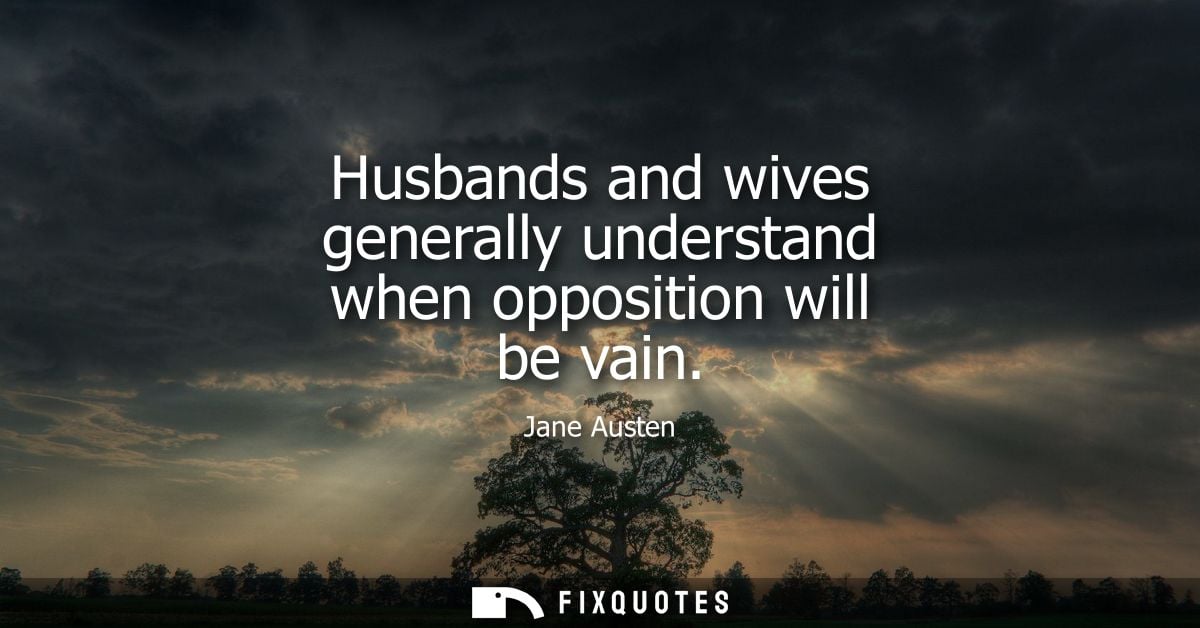
"Husbands and wives generally understand when opposition will be vain"
About this Quote
Austen slips a whole marriage treaty into one coolly observational sentence. "Generally" is doing stealth work: it flatters readers with the sense that this is merely common knowledge, then quietly indicts how normal it is for a household to run on calibrated surrender. The line isn’t about mutual understanding in the Hallmark sense; it’s about the intimate intelligence couples develop for each other’s leverage points, moods, and social constraints. They learn, often early, when resistance is pointless because the other person holds the stronger claim: money, temperament, reputation, gendered authority, or simply the stamina to outlast an argument.
The wit lands because "opposition" belongs to politics and war, not to domestic life. Austen imports that vocabulary into the sitting room, exposing marriage as a small-scale power structure where strategy matters. "Vain" sharpens the cynicism. It implies not just futility but a kind of self-deception: to keep fighting is to pretend the marriage is a fair forum, when in fact the rules are already set.
Context matters. Austen is writing in a world where marriage is economic infrastructure and social mobility, especially for women with limited legal and financial autonomy. Under those conditions, "understanding" can be less about empathy than about survival and negotiation. The sentence captures her larger project: making the private sphere legible as a site of coercion and comedy at once, where affection and dominance can share the same teacup.
The wit lands because "opposition" belongs to politics and war, not to domestic life. Austen imports that vocabulary into the sitting room, exposing marriage as a small-scale power structure where strategy matters. "Vain" sharpens the cynicism. It implies not just futility but a kind of self-deception: to keep fighting is to pretend the marriage is a fair forum, when in fact the rules are already set.
Context matters. Austen is writing in a world where marriage is economic infrastructure and social mobility, especially for women with limited legal and financial autonomy. Under those conditions, "understanding" can be less about empathy than about survival and negotiation. The sentence captures her larger project: making the private sphere legible as a site of coercion and comedy at once, where affection and dominance can share the same teacup.
Quote Details
| Topic | Husband & Wife |
|---|---|
| Source | Help us find the source |
| Cite |
Citation Formats
APA Style (7th ed.)
Austen, Jane. (2026, January 17). Husbands and wives generally understand when opposition will be vain. FixQuotes. https://fixquotes.com/quotes/husbands-and-wives-generally-understand-when-31831/
Chicago Style
Austen, Jane. "Husbands and wives generally understand when opposition will be vain." FixQuotes. January 17, 2026. https://fixquotes.com/quotes/husbands-and-wives-generally-understand-when-31831/.
MLA Style (9th ed.)
"Husbands and wives generally understand when opposition will be vain." FixQuotes, 17 Jan. 2026, https://fixquotes.com/quotes/husbands-and-wives-generally-understand-when-31831/. Accessed 5 Apr. 2026.
More Quotes by Jane
Add to List