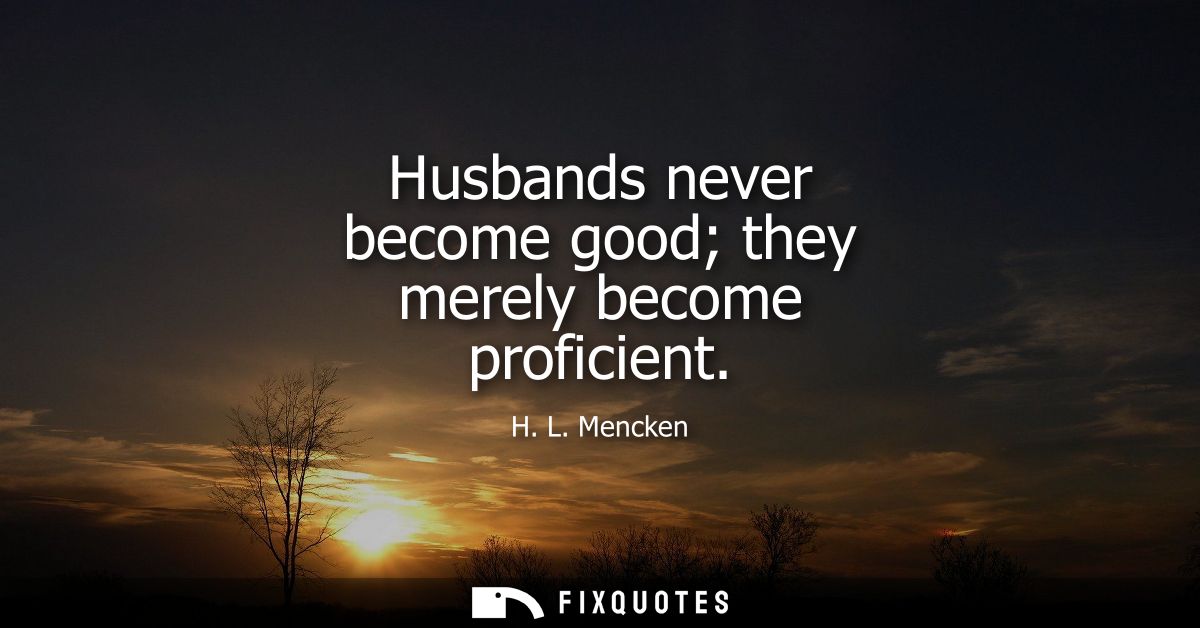
"Husbands never become good; they merely become proficient"
About this Quote
Mencken lands the punch with a grammar trick: he denies “good” as a moral category and replaces it with “proficient,” a word from the workshop, not the chapel. That swap is the whole joke and the whole indictment. Marriage, in his framing, isn’t a path to virtue or tenderness; it’s a system you learn to operate. The husband doesn’t grow; he adapts. He becomes competent at the routines, negotiations, evasions, and small performances that keep the machinery from seizing.
The intent is less a cheap swipe at men than a satirical demotion of romantic ideology. “Good” implies character, conscience, and inner transformation. “Proficient” implies technique: repetition, feedback, and incentives. Mencken’s subtext is that the institution trains behavior without ennobling it. You can get better at being married the way you get better at office politics: you learn what to say, when to yield, where the land mines are, how to look contrite without changing. It’s cynicism with a scalpel edge: he’s mocking the cultural script that marriage refines men into something morally improved.
Context matters. Mencken wrote from early 20th-century America, allergic to piety and boosterish sentimentality, watching middle-class respectability harden into a kind of civic religion. His best lines treat “respectable life” as a theater where everyone pretends the compromises are virtues. This one works because it doesn’t argue; it categorizes. Once “husband” is filed under “skill,” the romance collapses into procedure, and the reader is left laughing at a truth that feels uncomfortably observable.
The intent is less a cheap swipe at men than a satirical demotion of romantic ideology. “Good” implies character, conscience, and inner transformation. “Proficient” implies technique: repetition, feedback, and incentives. Mencken’s subtext is that the institution trains behavior without ennobling it. You can get better at being married the way you get better at office politics: you learn what to say, when to yield, where the land mines are, how to look contrite without changing. It’s cynicism with a scalpel edge: he’s mocking the cultural script that marriage refines men into something morally improved.
Context matters. Mencken wrote from early 20th-century America, allergic to piety and boosterish sentimentality, watching middle-class respectability harden into a kind of civic religion. His best lines treat “respectable life” as a theater where everyone pretends the compromises are virtues. This one works because it doesn’t argue; it categorizes. Once “husband” is filed under “skill,” the romance collapses into procedure, and the reader is left laughing at a truth that feels uncomfortably observable.
Quote Details
| Topic | Husband & Wife |
|---|---|
| Source | Help us find the source |
| Cite |
Citation Formats
APA Style (7th ed.)
Mencken, H. L. (2026, January 18). Husbands never become good; they merely become proficient. FixQuotes. https://fixquotes.com/quotes/husbands-never-become-good-they-merely-become-7470/
Chicago Style
Mencken, H. L. "Husbands never become good; they merely become proficient." FixQuotes. January 18, 2026. https://fixquotes.com/quotes/husbands-never-become-good-they-merely-become-7470/.
MLA Style (9th ed.)
"Husbands never become good; they merely become proficient." FixQuotes, 18 Jan. 2026, https://fixquotes.com/quotes/husbands-never-become-good-they-merely-become-7470/. Accessed 30 Mar. 2026.
More Quotes by L. Mencken
Add to List