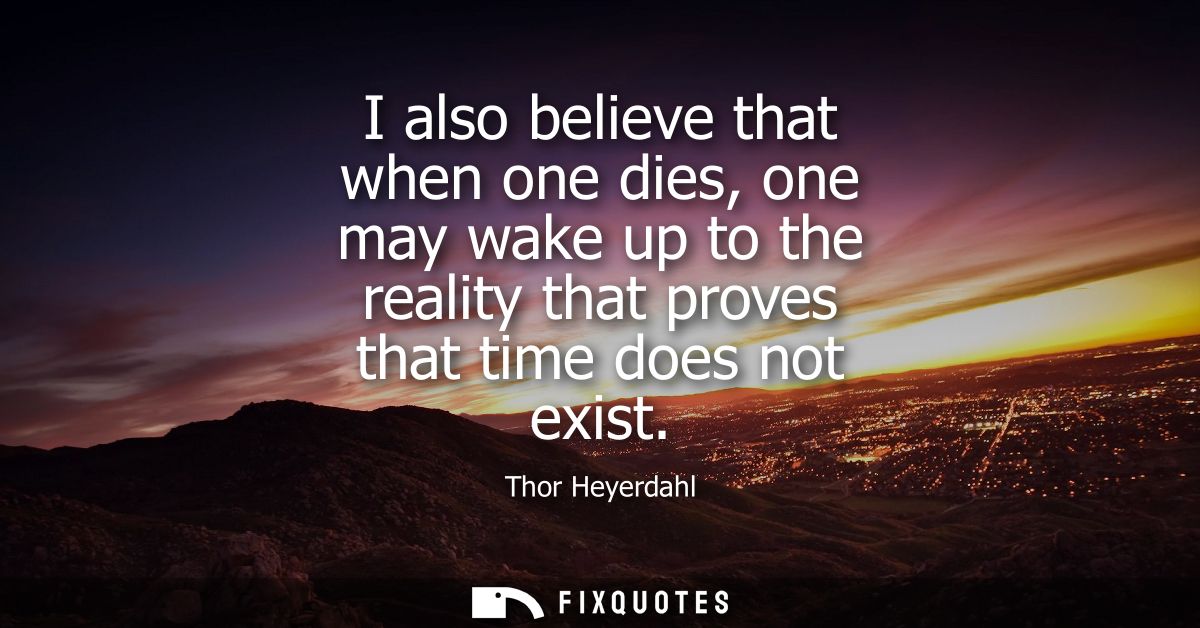
"I also believe that when one dies, one may wake up to the reality that proves that time does not exist"
About this Quote
Heyerdahl’s line reads like a field note from the edge of the map, where empirical adventure starts brushing up against metaphysics. As an explorer, he made a career out of insulting the tidy timelines of “progress” and “impossibility” - sailing the Kon-Tiki to argue that history might be messier, older, and more interconnected than the gatekeepers claimed. So when he suggests that death could reveal time as an illusion, it isn’t just spiritual pondering; it’s a continuation of his life’s contrarian posture: the world is bigger than the categories we use to domesticate it.
The intent is quietly radical. “Wake up” frames death not as an ending but as an epistemic upgrade, a shock of clarity after the dreamlike constraints of the living mind. It borrows the language of enlightenment rather than religion: not heaven, not judgment, but “reality.” That word does heavy lifting, implying that our ordinary experience of past-to-future is a perceptual habit, not a fact.
Subtext: the explorer’s frustration with linear narratives. Time is how institutions file us, how historians arrange us, how skeptics dismiss the unlikely. If time “does not exist,” then distance collapses too - between cultures, between eras, between what we think we know and what might be true.
Contextually, it also lands in a 20th-century moment saturated with relativity, psychedelia, and a popular appetite for cosmic reframe. Heyerdahl gives that era a rugged, human-scale mysticism: the same man who tested oceans with a raft imagines death as the final expedition, beyond the clock.
The intent is quietly radical. “Wake up” frames death not as an ending but as an epistemic upgrade, a shock of clarity after the dreamlike constraints of the living mind. It borrows the language of enlightenment rather than religion: not heaven, not judgment, but “reality.” That word does heavy lifting, implying that our ordinary experience of past-to-future is a perceptual habit, not a fact.
Subtext: the explorer’s frustration with linear narratives. Time is how institutions file us, how historians arrange us, how skeptics dismiss the unlikely. If time “does not exist,” then distance collapses too - between cultures, between eras, between what we think we know and what might be true.
Contextually, it also lands in a 20th-century moment saturated with relativity, psychedelia, and a popular appetite for cosmic reframe. Heyerdahl gives that era a rugged, human-scale mysticism: the same man who tested oceans with a raft imagines death as the final expedition, beyond the clock.
Quote Details
| Topic | Mortality |
|---|---|
| Source | Help us find the source |
More Quotes by Thor
Add to List