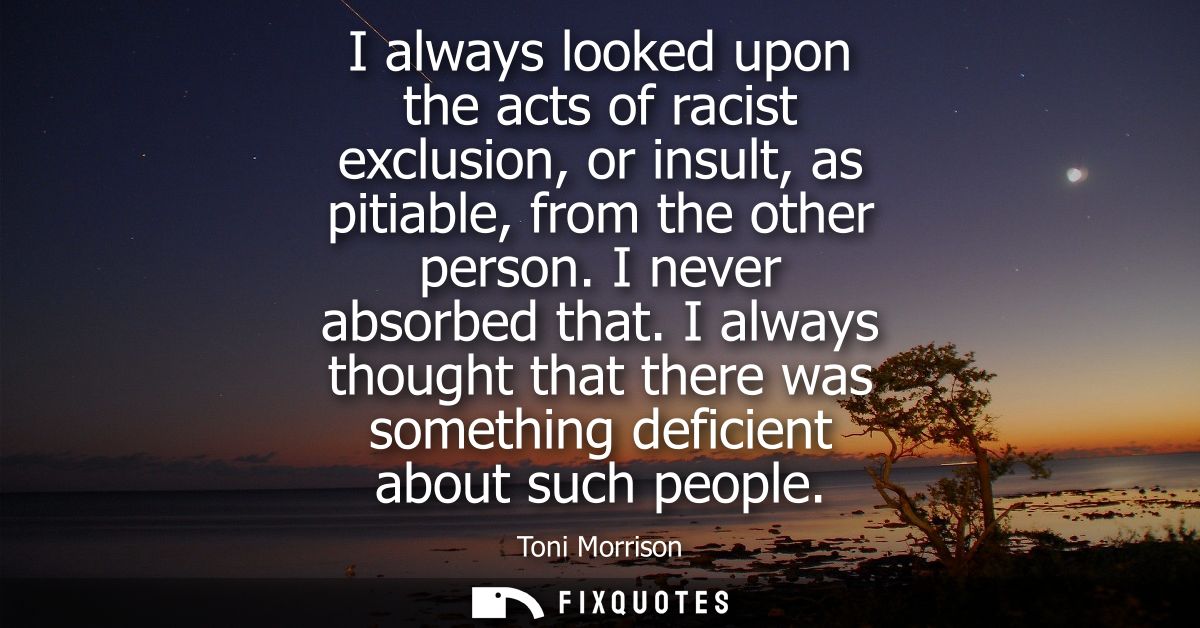
"I always looked upon the acts of racist exclusion, or insult, as pitiable, from the other person. I never absorbed that. I always thought that there was something deficient about such people"
About this Quote
The subtext is a survival strategy that’s also an aesthetic principle. “I never absorbed that” reads like a lesson in psychic boundaries: you can register hostility without letting it become internal narration. Morrison’s fiction is full of characters navigating a world eager to stamp meaning onto Black life; here she names the counter-move. Don’t metabolize someone else’s sickness as self-knowledge.
Context matters: Morrison came of age under Jim Crow’s long shadow and wrote through the supposedly “post-racial” decades when polite America kept inventing new costumes for the same hierarchy. Her stance isn’t naive optimism; it’s moral clarity sharpened by experience. “Deficient” is deliberately clinical, as if diagnosing an impairment: racism is not an opinion, it’s a failure of imagination and humanity, a dependency on an invented superiority. The line also gestures toward her larger project: reclaiming narrative authority. If racism is a deficiency in the racist, then Blackness isn’t the problem to be explained - it’s the racist’s interior poverty that needs accounting.
Quote Details
| Topic | Equality |
|---|---|
| Source | Help us find the source |
| Cite |
Citation Formats
APA Style (7th ed.)
Morrison, Toni. (2026, January 16). I always looked upon the acts of racist exclusion, or insult, as pitiable, from the other person. I never absorbed that. I always thought that there was something deficient about such people. FixQuotes. https://fixquotes.com/quotes/i-always-looked-upon-the-acts-of-racist-exclusion-99643/
Chicago Style
Morrison, Toni. "I always looked upon the acts of racist exclusion, or insult, as pitiable, from the other person. I never absorbed that. I always thought that there was something deficient about such people." FixQuotes. January 16, 2026. https://fixquotes.com/quotes/i-always-looked-upon-the-acts-of-racist-exclusion-99643/.
MLA Style (9th ed.)
"I always looked upon the acts of racist exclusion, or insult, as pitiable, from the other person. I never absorbed that. I always thought that there was something deficient about such people." FixQuotes, 16 Jan. 2026, https://fixquotes.com/quotes/i-always-looked-upon-the-acts-of-racist-exclusion-99643/. Accessed 29 Mar. 2026.