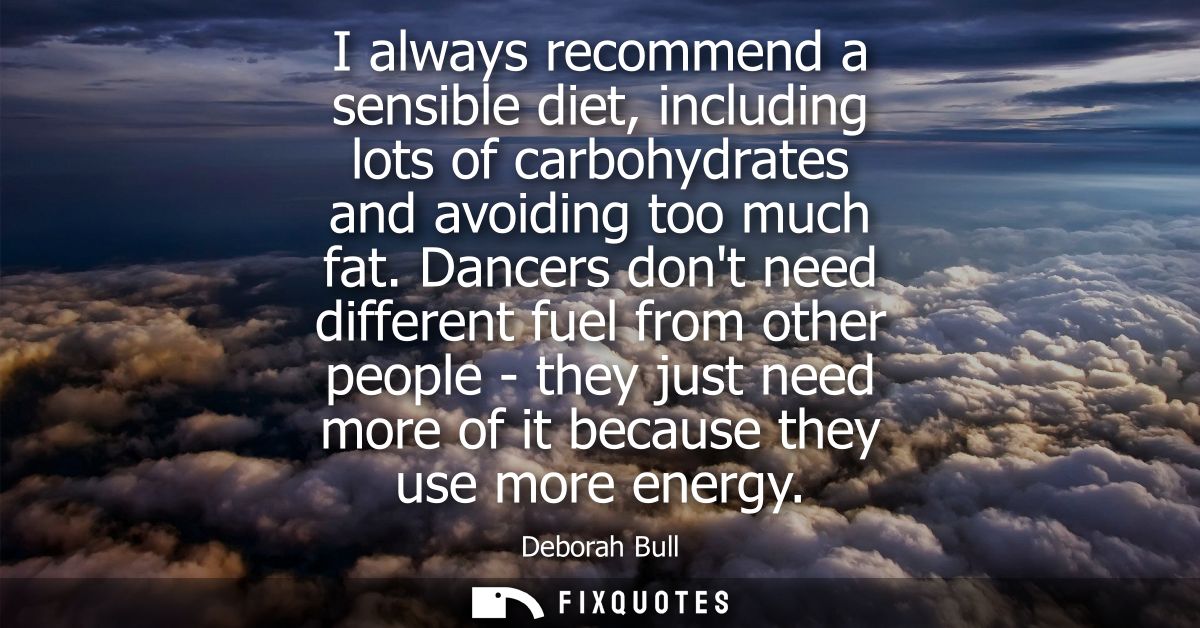
"I always recommend a sensible diet, including lots of carbohydrates and avoiding too much fat. Dancers don't need different fuel from other people - they just need more of it because they use more energy"
About this Quote
The subtext is sharper than it looks. By calling the diet “sensible,” Bull positions herself against both extremes that have historically stalked dance: the romanticized starvation regimen and the pseudo-scientific fads that promise control through restriction. Carbohydrates, long demonized in popular diet cycles, get rehabilitated here as practical, trainable energy - not a guilty pleasure. Avoiding “too much fat” is similarly measured, not absolutist; it signals performance pragmatism, not purity politics.
Context matters: Bull comes out of a British ballet tradition where bodies are constantly watched, commented on, and implicitly policed. Her statement reads like harm reduction in public form - an attempt to normalize eating enough, to separate health from spectacle, and to remind young dancers that their talent is not proven by how little they consume but by what their bodies can sustain.
Quote Details
| Topic | Health |
|---|---|
| Source | Help us find the source |
| Cite |
Citation Formats
APA Style (7th ed.)
Bull, Deborah. (2026, January 17). I always recommend a sensible diet, including lots of carbohydrates and avoiding too much fat. Dancers don't need different fuel from other people - they just need more of it because they use more energy. FixQuotes. https://fixquotes.com/quotes/i-always-recommend-a-sensible-diet-including-lots-52409/
Chicago Style
Bull, Deborah. "I always recommend a sensible diet, including lots of carbohydrates and avoiding too much fat. Dancers don't need different fuel from other people - they just need more of it because they use more energy." FixQuotes. January 17, 2026. https://fixquotes.com/quotes/i-always-recommend-a-sensible-diet-including-lots-52409/.
MLA Style (9th ed.)
"I always recommend a sensible diet, including lots of carbohydrates and avoiding too much fat. Dancers don't need different fuel from other people - they just need more of it because they use more energy." FixQuotes, 17 Jan. 2026, https://fixquotes.com/quotes/i-always-recommend-a-sensible-diet-including-lots-52409/. Accessed 25 Mar. 2026.