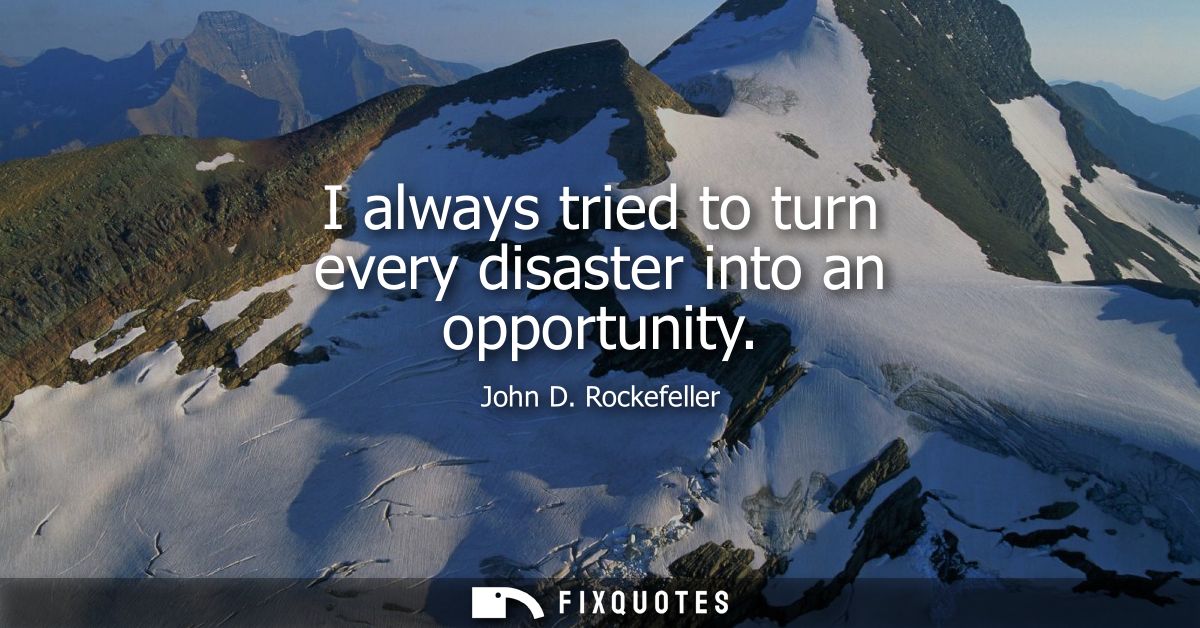
"I always tried to turn every disaster into an opportunity"
About this Quote
Rockefeller’s line is the kind of polished grit that reads like self-help, then sharpens into strategy once you remember who’s talking. “Disaster” isn’t just bad luck here; it’s volatility as a business condition. In the late 19th and early 20th centuries, panics, price collapses, labor unrest, and regulatory backlash weren’t interruptions to capitalism’s story - they were the plot. Rockefeller built Standard Oil in that plot, often by treating chaos as a clearance sale: when competitors were overleveraged and credit tightened, the strongest balance sheet could buy, consolidate, and set terms.
The intent is reputational as much as philosophical. Rockefeller spent decades recasting himself from ruthless consolidator to sober steward, especially as muckrakers and antitrust crusaders turned him into a symbol of corporate overreach. Framed as personal character - “I always tried” - the sentence makes power sound like virtue and domination sound like resilience. It’s a masterclass in moralizing the market: if you “turn” disaster into opportunity, you’re not exploiting someone else’s misfortune; you’re simply being disciplined.
The subtext is colder than the phrasing. Opportunity doesn’t appear; it’s engineered. “Turn” implies agency, even alchemy: you apply method, scale, and patience until others’ failures become your leverage. Coming from a businessman whose empire thrived on integration, pricing control, and relentless efficiency, the quote functions as both advice and absolution: when the world breaks, the prepared don’t just endure - they expand.
The intent is reputational as much as philosophical. Rockefeller spent decades recasting himself from ruthless consolidator to sober steward, especially as muckrakers and antitrust crusaders turned him into a symbol of corporate overreach. Framed as personal character - “I always tried” - the sentence makes power sound like virtue and domination sound like resilience. It’s a masterclass in moralizing the market: if you “turn” disaster into opportunity, you’re not exploiting someone else’s misfortune; you’re simply being disciplined.
The subtext is colder than the phrasing. Opportunity doesn’t appear; it’s engineered. “Turn” implies agency, even alchemy: you apply method, scale, and patience until others’ failures become your leverage. Coming from a businessman whose empire thrived on integration, pricing control, and relentless efficiency, the quote functions as both advice and absolution: when the world breaks, the prepared don’t just endure - they expand.
Quote Details
| Topic | Motivational |
|---|---|
| Source | Help us find the source |
| Cite |
Citation Formats
APA Style (7th ed.)
Rockefeller, John D. (2026, January 15). I always tried to turn every disaster into an opportunity. FixQuotes. https://fixquotes.com/quotes/i-always-tried-to-turn-every-disaster-into-an-14678/
Chicago Style
Rockefeller, John D. "I always tried to turn every disaster into an opportunity." FixQuotes. January 15, 2026. https://fixquotes.com/quotes/i-always-tried-to-turn-every-disaster-into-an-14678/.
MLA Style (9th ed.)
"I always tried to turn every disaster into an opportunity." FixQuotes, 15 Jan. 2026, https://fixquotes.com/quotes/i-always-tried-to-turn-every-disaster-into-an-14678/. Accessed 7 Mar. 2026.
More Quotes by John
Add to List