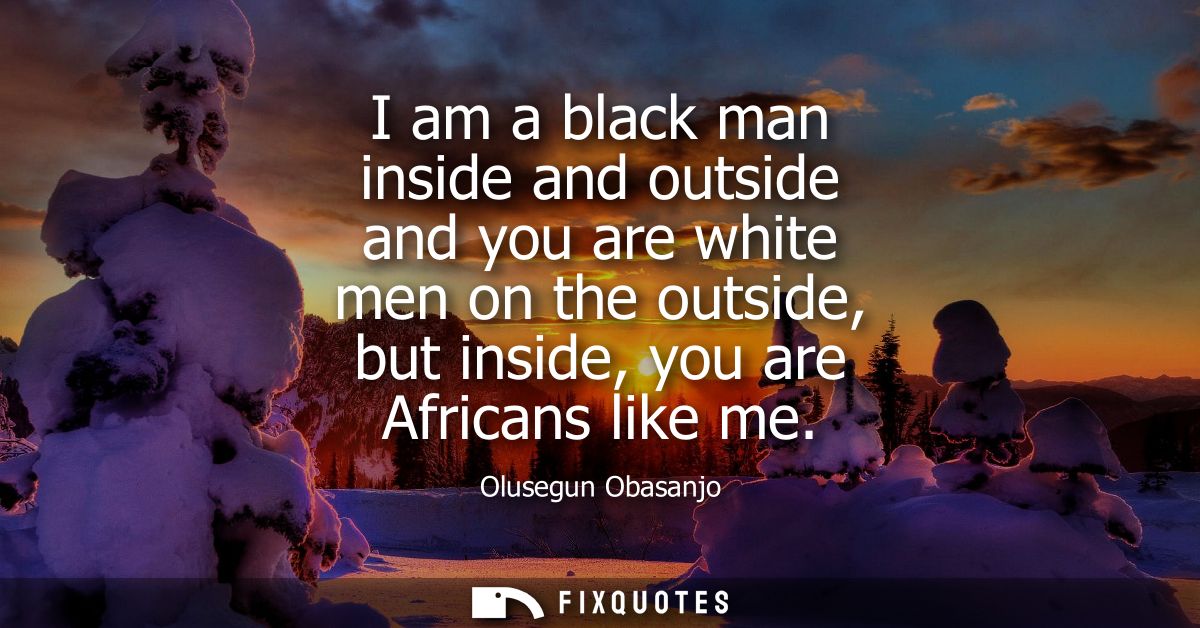
"I am a black man inside and outside and you are white men on the outside, but inside, you are Africans like me"
About this Quote
The twist - “inside, you are Africans like me” - is both invitation and accusation. It invites white interlocutors (often Western leaders, expatriates, or descendants of colonial settlement) to accept a shared origin story and a shared responsibility. It also accuses them of selective amnesia: benefiting from Africa as a place of extraction, while treating Africanness as something to manage at arm’s length. Obasanjo makes “African” a category of belonging that can’t be reduced to phenotype, but he doesn’t make it frictionless; the phrase “like me” insists that kinship comes with obligations.
Coming from a Nigerian head of state shaped by postcolonial power struggles and international bargaining, the rhetoric is strategic. It’s meant to disarm paternalism and re-center agency: if you’re African “inside,” you don’t get to speak to Africa as a problem. You’re implicated in its future.
Quote Details
| Topic | Equality |
|---|---|
| Source | Help us find the source |
| Cite |
Citation Formats
APA Style (7th ed.)
Obasanjo, Olusegun. (2026, January 16). I am a black man inside and outside and you are white men on the outside, but inside, you are Africans like me. FixQuotes. https://fixquotes.com/quotes/i-am-a-black-man-inside-and-outside-and-you-are-127960/
Chicago Style
Obasanjo, Olusegun. "I am a black man inside and outside and you are white men on the outside, but inside, you are Africans like me." FixQuotes. January 16, 2026. https://fixquotes.com/quotes/i-am-a-black-man-inside-and-outside-and-you-are-127960/.
MLA Style (9th ed.)
"I am a black man inside and outside and you are white men on the outside, but inside, you are Africans like me." FixQuotes, 16 Jan. 2026, https://fixquotes.com/quotes/i-am-a-black-man-inside-and-outside-and-you-are-127960/. Accessed 1 Apr. 2026.