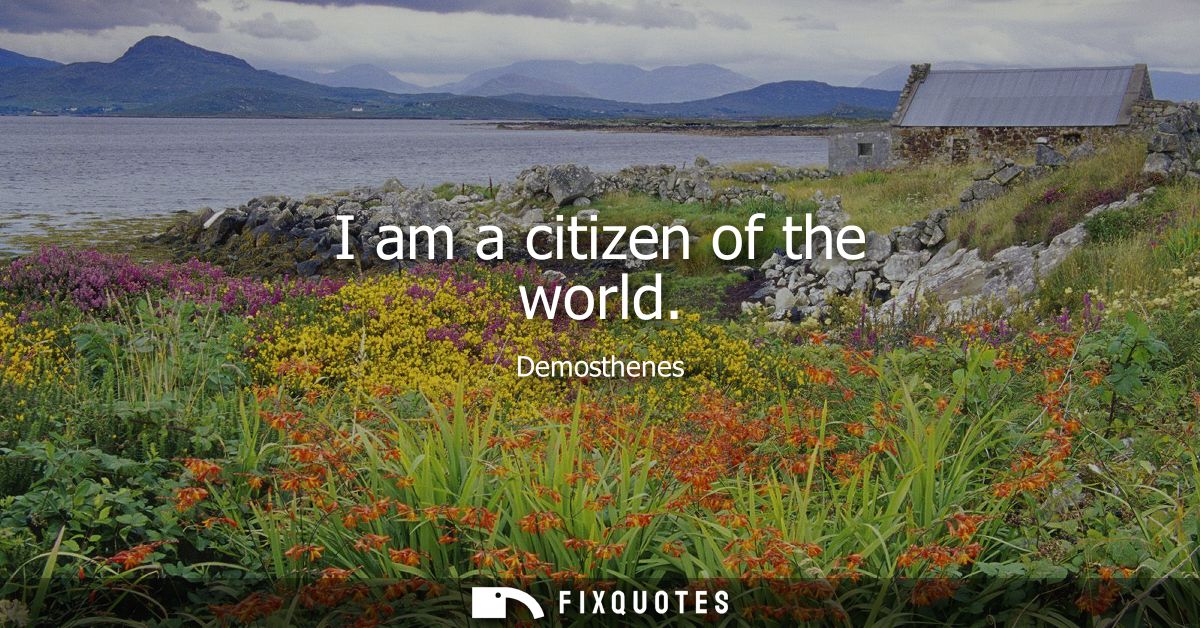
"I am a citizen of the world"
About this Quote
In Demosthenes' mouth, "I am a citizen of the world" lands less like a kumbaya slogan than a stress test for Greek identity at the moment it was being forcibly renegotiated. This is a statesman of the polis, not a dreamy cosmopolitan: his career was built on the high-stakes insistence that Athens should govern itself, speak for itself, and resist being folded into someone else's order. So the line works by sounding expansive while smuggling in a warning: when the old borders of belonging are being redrawn by empire, you either broaden your idea of civic duty or watch it be defined for you.
The phrase borrows moral altitude from universality. "Citizen" is the operative word, not "traveler" or "human". Citizenship implies obligations, speech rights, and political consequence. Pairing it with "the world" creates a deliberate tension between the intimate scale of the city-state and the new, intimidating scale of Macedonian power. It's also a rhetorical judo move: it reclaims agency from a world that is beginning to treat Greek cities as provincial pieces on a larger board.
Subtextually, there's a bid to outgrow parochial rivalries without surrendering the hard-won Athenian habit of public argument. Demosthenes is imagining a civic identity that can survive displacement: a portable allegiance to law, deliberation, and responsibility rather than to one patch of ground. Coming from a man fighting Philip's rise, the line reads as both defiance and adaptation - a way to say, we belong to something larger than your conquest, and we intend to bring our politics with us.
The phrase borrows moral altitude from universality. "Citizen" is the operative word, not "traveler" or "human". Citizenship implies obligations, speech rights, and political consequence. Pairing it with "the world" creates a deliberate tension between the intimate scale of the city-state and the new, intimidating scale of Macedonian power. It's also a rhetorical judo move: it reclaims agency from a world that is beginning to treat Greek cities as provincial pieces on a larger board.
Subtextually, there's a bid to outgrow parochial rivalries without surrendering the hard-won Athenian habit of public argument. Demosthenes is imagining a civic identity that can survive displacement: a portable allegiance to law, deliberation, and responsibility rather than to one patch of ground. Coming from a man fighting Philip's rise, the line reads as both defiance and adaptation - a way to say, we belong to something larger than your conquest, and we intend to bring our politics with us.
Quote Details
| Topic | Wisdom |
|---|---|
| Source | Help us find the source |
| Cite |
Citation Formats
APA Style (7th ed.)
Demosthenes. (2026, January 15). I am a citizen of the world. FixQuotes. https://fixquotes.com/quotes/i-am-a-citizen-of-the-world-74171/
Chicago Style
Demosthenes. "I am a citizen of the world." FixQuotes. January 15, 2026. https://fixquotes.com/quotes/i-am-a-citizen-of-the-world-74171/.
MLA Style (9th ed.)
"I am a citizen of the world." FixQuotes, 15 Jan. 2026, https://fixquotes.com/quotes/i-am-a-citizen-of-the-world-74171/. Accessed 30 Mar. 2026.
More Quotes by Demosthenes
Add to List