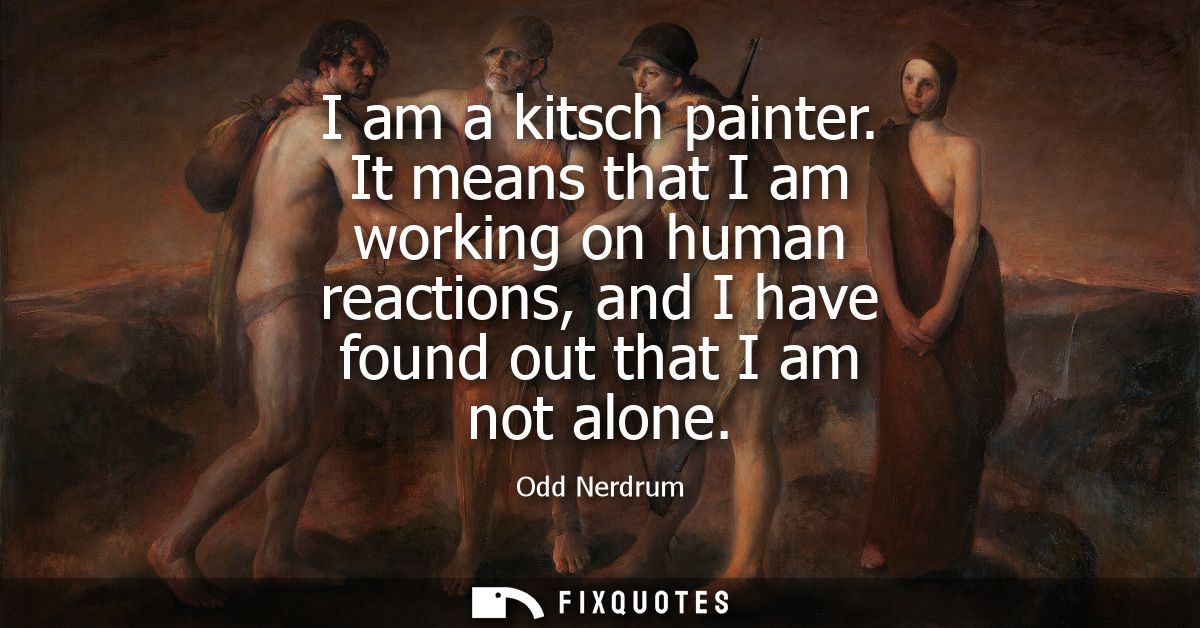
"I am a kitsch painter. It means that I am working on human reactions, and I have found out that I am not alone"
About this Quote
The line "working on human reactions" is deliberately unromantic, almost clinical. He’s not claiming transcendence; he’s claiming effect. That’s the provocation. Nerdrum positions painting less as formal innovation and more as emotional engineering - a return to older painterly ambitions (pathos, myth, drama, mortality) that contemporary institutions often file under "illustration" or "craft". The subtext is a critique of a professionalized avant-garde that can feel like it’s performing skepticism for insiders while outsourcing feeling to mass culture.
"I have found out that I am not alone" turns the manifesto into a populist wink. It acknowledges the quiet majority: viewers who want images that communicate, that risk beauty, that aren’t afraid of narrative or tenderness. Nerdrum’s context matters here: a Scandinavian painter who built a career in open conflict with modernist orthodoxies, styling himself as an atelier traditionalist in an era that prizes concept and irony. The quote works because it’s both confession and challenge: he admits he’s chasing reaction, then dares you to admit you want one.
Quote Details
| Topic | Art |
|---|---|
| Source | Help us find the source |
| Cite |
Citation Formats
APA Style (7th ed.)
Nerdrum, Odd. (2026, January 15). I am a kitsch painter. It means that I am working on human reactions, and I have found out that I am not alone. FixQuotes. https://fixquotes.com/quotes/i-am-a-kitsch-painter-it-means-that-i-am-working-172187/
Chicago Style
Nerdrum, Odd. "I am a kitsch painter. It means that I am working on human reactions, and I have found out that I am not alone." FixQuotes. January 15, 2026. https://fixquotes.com/quotes/i-am-a-kitsch-painter-it-means-that-i-am-working-172187/.
MLA Style (9th ed.)
"I am a kitsch painter. It means that I am working on human reactions, and I have found out that I am not alone." FixQuotes, 15 Jan. 2026, https://fixquotes.com/quotes/i-am-a-kitsch-painter-it-means-that-i-am-working-172187/. Accessed 3 Apr. 2026.