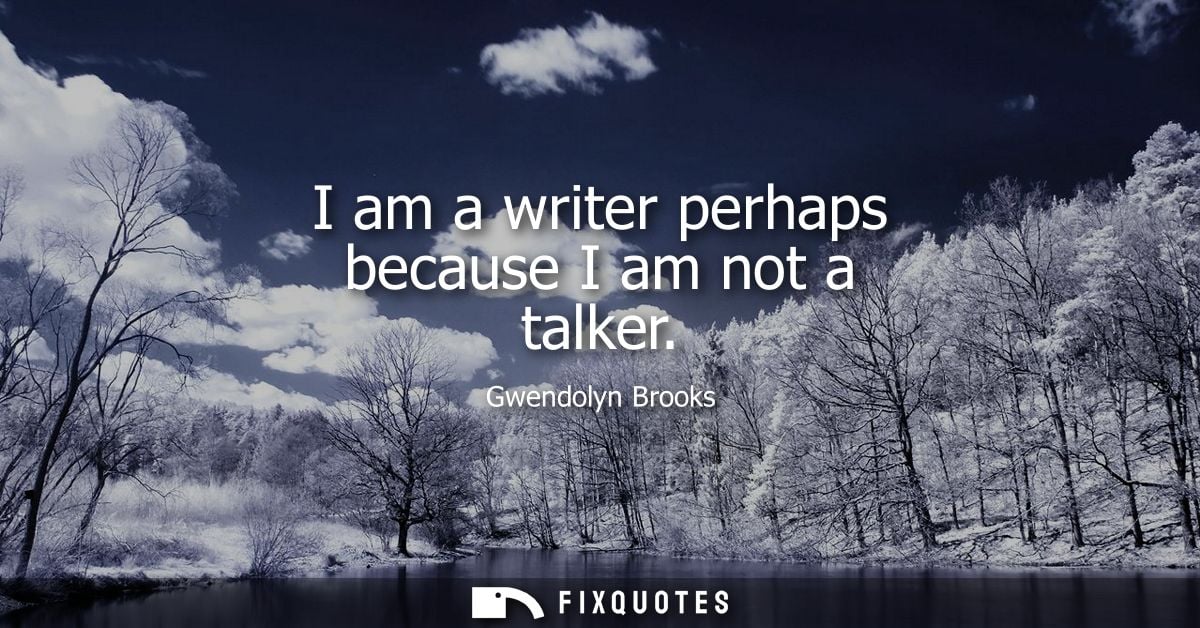
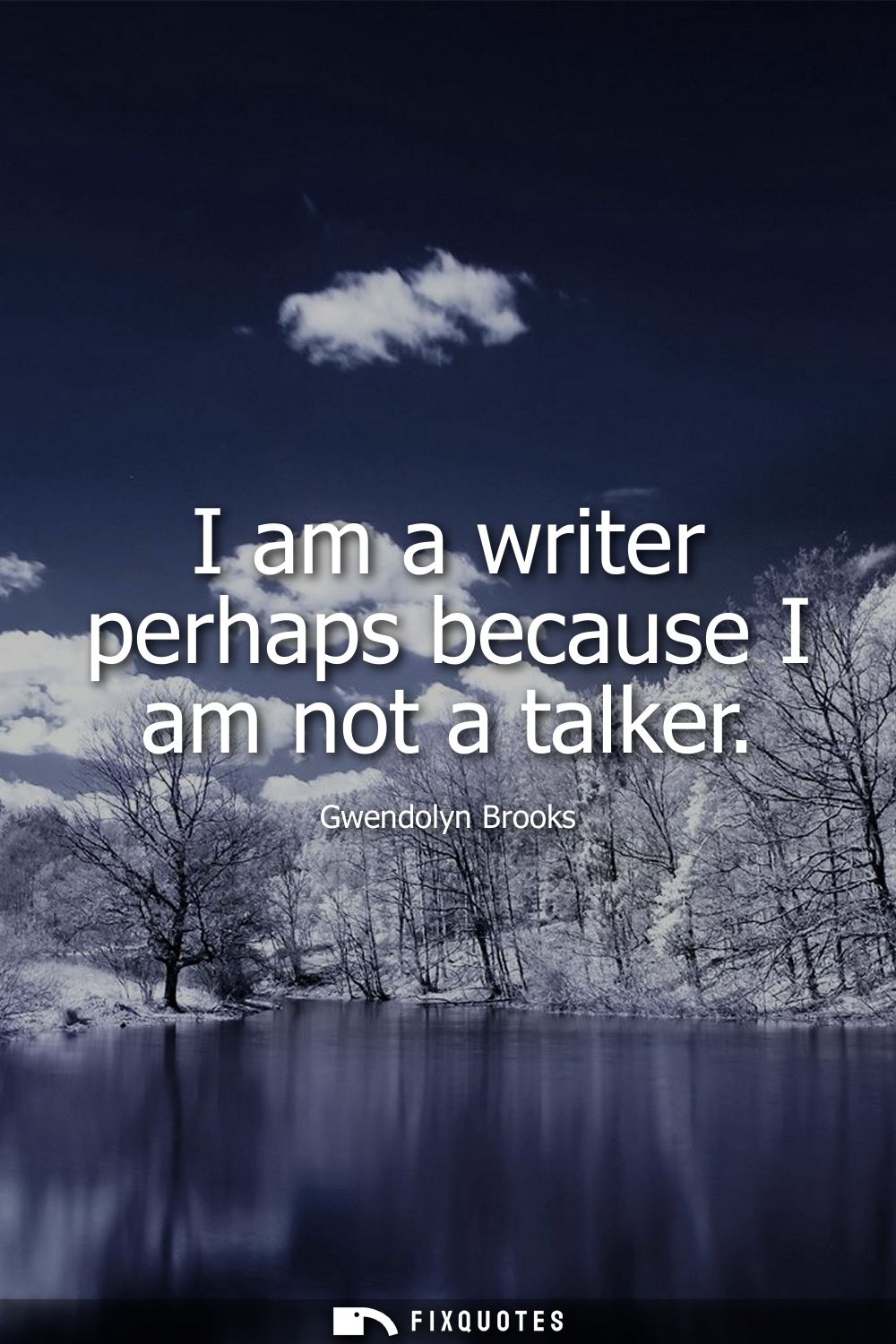
"I am a writer perhaps because I am not a talker"
About this Quote
Brooks slips a quiet provocation into a line that sounds almost apologetic: the writer is born from a deficit. “Perhaps” is the hinge. It refuses a tidy origin story and lets the sentence hover between confession and strategy, as if she’s daring you to decide whether silence is limitation or leverage.
The split between “writer” and “talker” isn’t just personality typing. In Brooks’s world, talk is public space: quick, contested, policed. Mid-century America asked Black women to be legible on demand but not necessarily heard, to perform clarity without owning the room. Claiming “not a talker” can read as self-protection, a way of sidestepping the traps of being misquoted, dismissed, or forced into respectability scripts. On the page, she controls time. She can revise, compress, cut. She can make a line do what conversation often can’t: hold multiple truths without immediately being cross-examined.
There’s also a sly reversal of cultural hierarchy. We tend to treat the talker as the natural leader, the charismatic center. Brooks suggests the opposite: the non-talker may be the one paying closest attention. Writing becomes not a consolation prize but a technology of precision, a place where reticence turns into authority.
For a poet who made entire neighborhoods speak in sharply rendered voices, the subtext is generous, not shy. Silence isn’t absence; it’s the pressure that produces form.
The split between “writer” and “talker” isn’t just personality typing. In Brooks’s world, talk is public space: quick, contested, policed. Mid-century America asked Black women to be legible on demand but not necessarily heard, to perform clarity without owning the room. Claiming “not a talker” can read as self-protection, a way of sidestepping the traps of being misquoted, dismissed, or forced into respectability scripts. On the page, she controls time. She can revise, compress, cut. She can make a line do what conversation often can’t: hold multiple truths without immediately being cross-examined.
There’s also a sly reversal of cultural hierarchy. We tend to treat the talker as the natural leader, the charismatic center. Brooks suggests the opposite: the non-talker may be the one paying closest attention. Writing becomes not a consolation prize but a technology of precision, a place where reticence turns into authority.
For a poet who made entire neighborhoods speak in sharply rendered voices, the subtext is generous, not shy. Silence isn’t absence; it’s the pressure that produces form.
Quote Details
| Topic | Writing |
|---|---|
| Source | Help us find the source |
| Cite |
Citation Formats
APA Style (7th ed.)
Brooks, Gwendolyn. (2026, January 15). I am a writer perhaps because I am not a talker. FixQuotes. https://fixquotes.com/quotes/i-am-a-writer-perhaps-because-i-am-not-a-talker-144076/
Chicago Style
Brooks, Gwendolyn. "I am a writer perhaps because I am not a talker." FixQuotes. January 15, 2026. https://fixquotes.com/quotes/i-am-a-writer-perhaps-because-i-am-not-a-talker-144076/.
MLA Style (9th ed.)
"I am a writer perhaps because I am not a talker." FixQuotes, 15 Jan. 2026, https://fixquotes.com/quotes/i-am-a-writer-perhaps-because-i-am-not-a-talker-144076/. Accessed 12 Feb. 2026.
More Quotes by Gwendolyn
Add to List