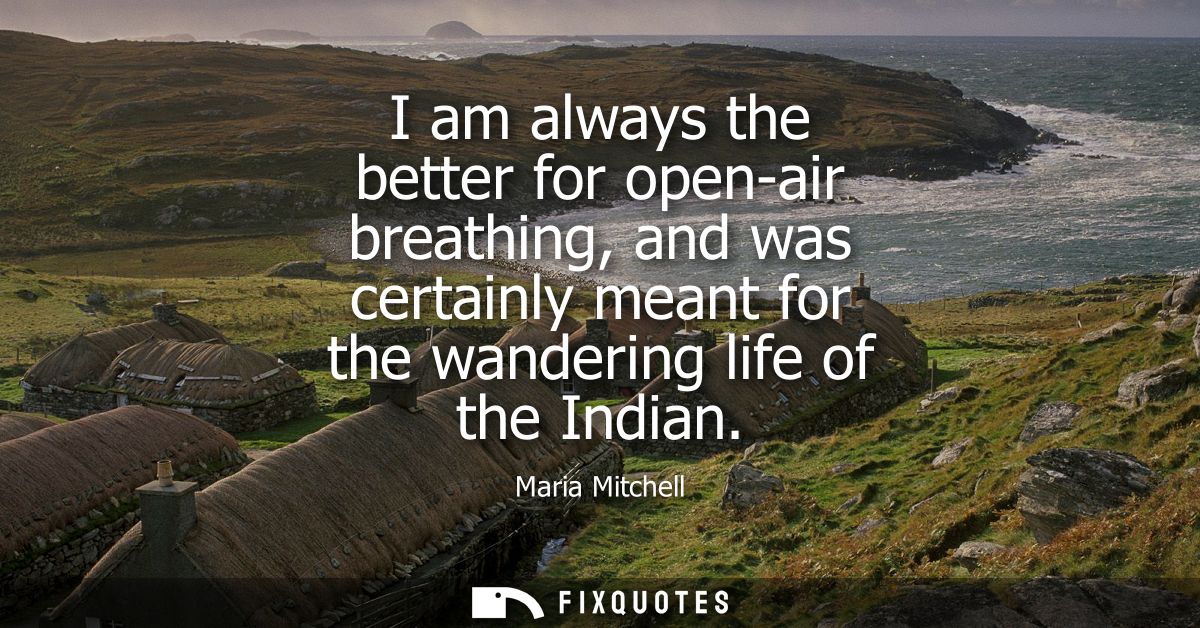
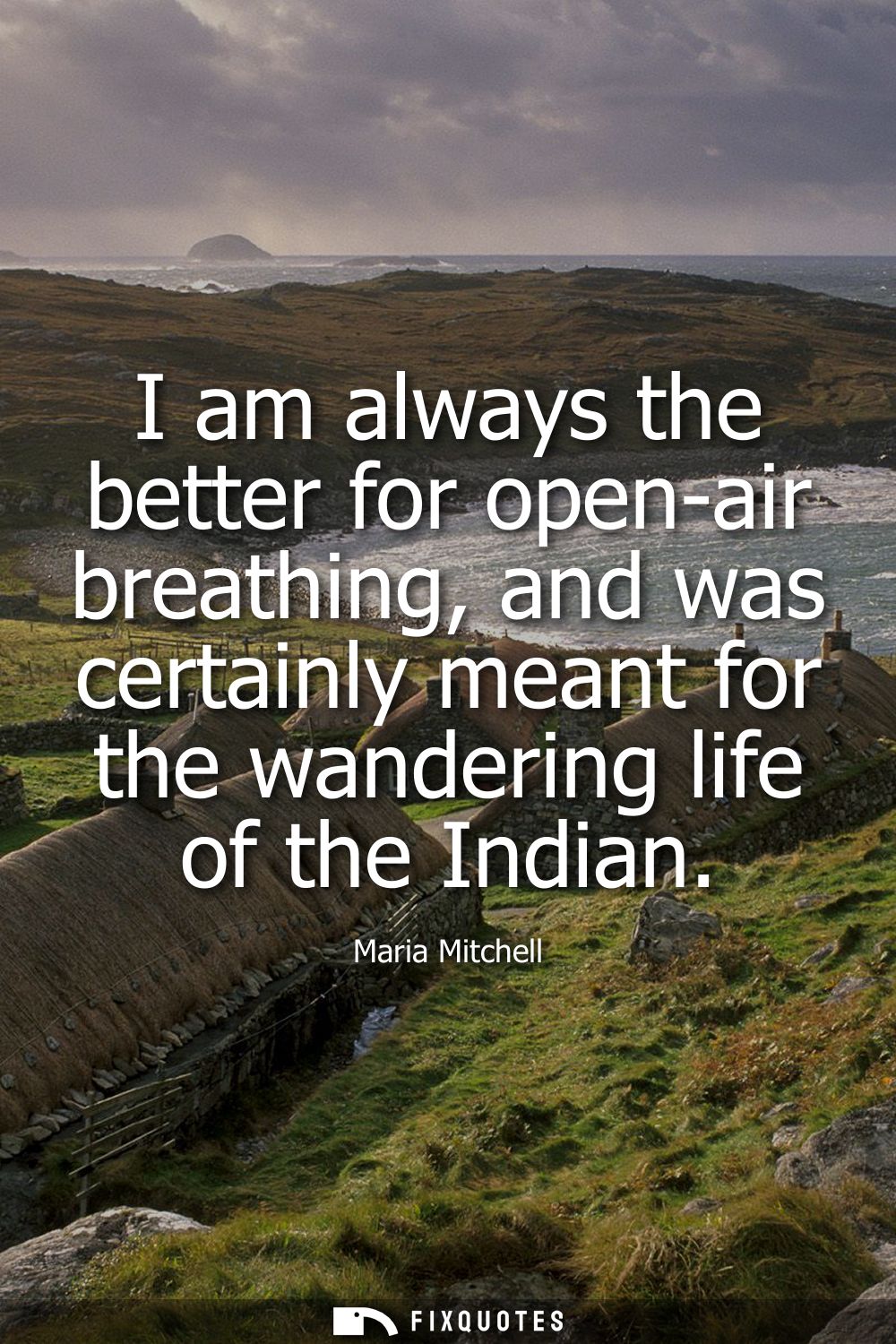
"I am always the better for open-air breathing, and was certainly meant for the wandering life of the Indian"
About this Quote
Mitchell was an astronomer, someone whose work quite literally required exposure to the night, to weather, to long hours outside the domestic sphere. “Always the better” turns respiration into self-justification: the body endorses the life the world questions. In an era that framed respectable womanhood as indoor, fragile, and carefully managed, she insists the opposite. She thrives when she’s uncontained.
The second clause, though, lands with historical friction. “The wandering life of the Indian” is less ethnography than metaphor, filtered through the romanticized, colonial vocabulary of her time. It borrows the idea of Indigenous freedom to authorize her own longing for movement, without grappling with the forced displacement and violence underpinning that very “wandering.” That appropriation is the tell: Mitchell is reaching for a figure that signals radical independence, because she lacks a socially acceptable template for a woman who wants to roam.
So the line works as both self-portrait and cultural document: a scientist claiming physical and spiritual room to range, using the available language of frontier myth to pry open a space where female ambition can breathe.
Quote Details
| Topic | Wanderlust |
|---|---|
| Source | Help us find the source |
| Cite |
Citation Formats
APA Style (7th ed.)
Mitchell, Maria. (2026, January 15). I am always the better for open-air breathing, and was certainly meant for the wandering life of the Indian. FixQuotes. https://fixquotes.com/quotes/i-am-always-the-better-for-open-air-breathing-and-156732/
Chicago Style
Mitchell, Maria. "I am always the better for open-air breathing, and was certainly meant for the wandering life of the Indian." FixQuotes. January 15, 2026. https://fixquotes.com/quotes/i-am-always-the-better-for-open-air-breathing-and-156732/.
MLA Style (9th ed.)
"I am always the better for open-air breathing, and was certainly meant for the wandering life of the Indian." FixQuotes, 15 Jan. 2026, https://fixquotes.com/quotes/i-am-always-the-better-for-open-air-breathing-and-156732/. Accessed 29 Mar. 2026.