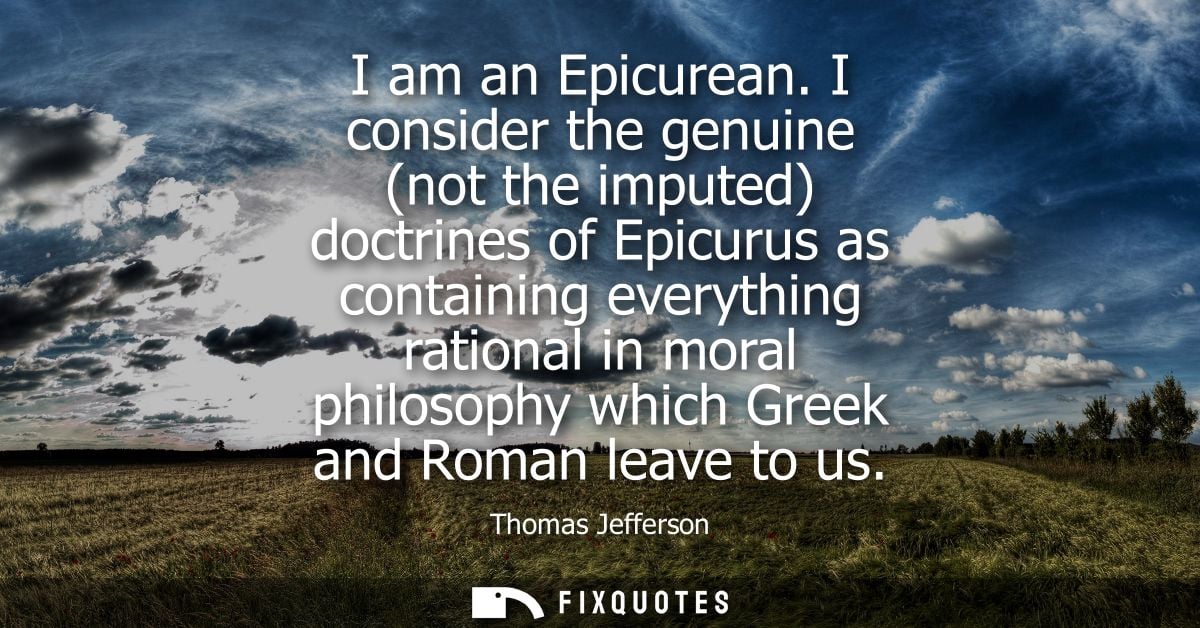
"I am an Epicurean. I consider the genuine (not the imputed) doctrines of Epicurus as containing everything rational in moral philosophy which Greek and Roman leave to us"
About this Quote
The context matters. Jefferson spent his life fighting the entanglement of church authority with civic life, and Epicurus offered an attractive moral architecture without revelation: ethics grounded in human flourishing, friendship, restraint, and the management of fear (especially fear of divine punishment). Calling Epicurus “everything rational in moral philosophy” is a provocation aimed at inherited prestige. He positions classical wisdom as a toolkit, not a temple: Greeks and Romans “leave” us fragments, and Epicurus is the piece Jefferson thinks can be rebuilt into a modern moral program.
The subtext is a founder staking a claim for enlightenment ethics inside a culture that still wanted public virtue to sound Christian. Jefferson’s Epicureanism is his way of saying: you can have morality without clergy, pleasure without decadence, and a stable republic without metaphysical policing.
Quote Details
| Topic | Ethics & Morality |
|---|---|
| Source | Help us find the source |
| Cite |
Citation Formats
APA Style (7th ed.)
Jefferson, Thomas. (2026, January 17). I am an Epicurean. I consider the genuine (not the imputed) doctrines of Epicurus as containing everything rational in moral philosophy which Greek and Roman leave to us. FixQuotes. https://fixquotes.com/quotes/i-am-an-epicurean-i-consider-the-genuine-not-the-27352/
Chicago Style
Jefferson, Thomas. "I am an Epicurean. I consider the genuine (not the imputed) doctrines of Epicurus as containing everything rational in moral philosophy which Greek and Roman leave to us." FixQuotes. January 17, 2026. https://fixquotes.com/quotes/i-am-an-epicurean-i-consider-the-genuine-not-the-27352/.
MLA Style (9th ed.)
"I am an Epicurean. I consider the genuine (not the imputed) doctrines of Epicurus as containing everything rational in moral philosophy which Greek and Roman leave to us." FixQuotes, 17 Jan. 2026, https://fixquotes.com/quotes/i-am-an-epicurean-i-consider-the-genuine-not-the-27352/. Accessed 31 Mar. 2026.