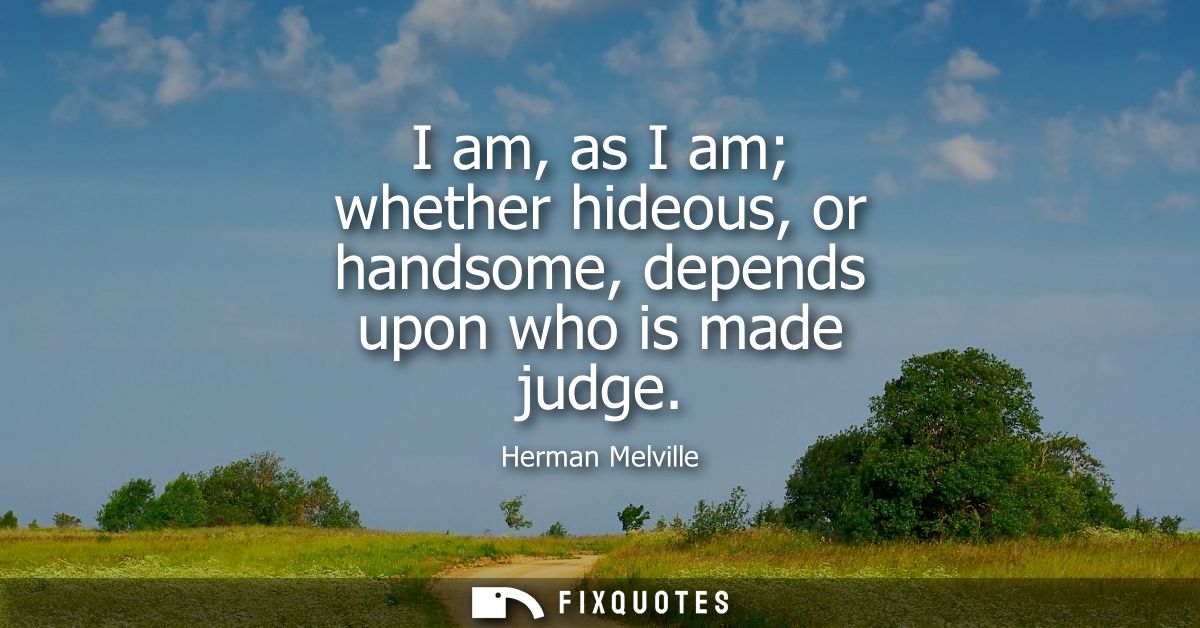
"I am, as I am; whether hideous, or handsome, depends upon who is made judge"
About this Quote
That word choice matters. “Judge” isn’t “viewer” or “friend.” It implies authority, bias dressed up as neutrality, and consequences. Melville is talking about aesthetics, but he’s really talking about moral legibility: who is allowed to be read as respectable, human, trustworthy. In a Melville universe, people are constantly misread and reclassified, whether by class, race, reputation, or the crude mythology of “character.” The sea may be indifferent, but society is not.
The subtext has a sting of self-protection. If the verdict depends on the judge, then the judged can refuse to internalize it. It’s a sentence that anticipates modern anxieties about branding and optics while refusing to surrender to them. Melville doesn’t offer self-esteem; he offers a colder, sharper freedom: you can’t control the court, but you can recognize the game.
Quote Details
| Topic | Self-Love |
|---|---|
| Source | Help us find the source |
| Cite |
Citation Formats
APA Style (7th ed.)
Melville, Herman. (2026, January 18). I am, as I am; whether hideous, or handsome, depends upon who is made judge. FixQuotes. https://fixquotes.com/quotes/i-am-as-i-am-whether-hideous-or-handsome-depends-23147/
Chicago Style
Melville, Herman. "I am, as I am; whether hideous, or handsome, depends upon who is made judge." FixQuotes. January 18, 2026. https://fixquotes.com/quotes/i-am-as-i-am-whether-hideous-or-handsome-depends-23147/.
MLA Style (9th ed.)
"I am, as I am; whether hideous, or handsome, depends upon who is made judge." FixQuotes, 18 Jan. 2026, https://fixquotes.com/quotes/i-am-as-i-am-whether-hideous-or-handsome-depends-23147/. Accessed 11 Mar. 2026.