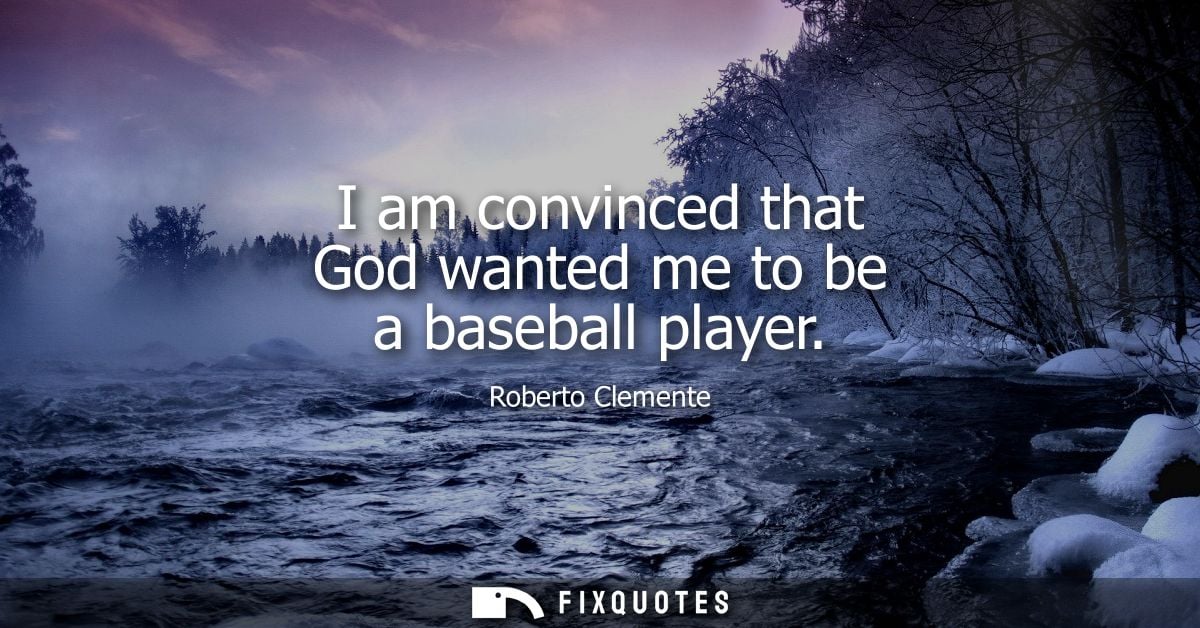
"I am convinced that God wanted me to be a baseball player"
About this Quote
There is a quiet audacity in Clemente framing a Hall of Fame career as an assignment, not an achievement. “I am convinced” lands like testimony, not hype: he’s not selling a brand, he’s naming a burden. In a sport that rewards self-mythologizing, Clemente reaches for something older and less negotiable than talent - vocation. God “wanted” him to be a baseball player suggests purpose with obligations attached: to play brilliantly, yes, but also to represent, to endure, to give.
The line gains its charge from Clemente’s particular context. A Black Puerto Rican star in the mainland major leagues, he was routinely misheard and underestimated, his accent mocked, his intelligence questioned, his seriousness treated as attitude. Claiming divine intent becomes a way of refusing the league’s smaller story about who he was allowed to be. It’s not mere piety; it’s a counter-authority. If gatekeepers won’t grant dignity, he invokes a higher committee.
The subtext also points forward to the life that made his legend: a public moral core that didn’t stop at the foul line. Clemente’s humanitarian work and his death in a relief mission to Nicaragua turn “wanted me” into something chillingly literal. This wasn’t a platitude about destiny; it was a worldview where fame is only justified by service.
Clemente’s genius here is emotional, not philosophical. He compresses pride and humility into one sentence: I’m chosen, therefore I’m responsible. In modern sports culture, that reads less like superstition and more like a demand that greatness mean something.
The line gains its charge from Clemente’s particular context. A Black Puerto Rican star in the mainland major leagues, he was routinely misheard and underestimated, his accent mocked, his intelligence questioned, his seriousness treated as attitude. Claiming divine intent becomes a way of refusing the league’s smaller story about who he was allowed to be. It’s not mere piety; it’s a counter-authority. If gatekeepers won’t grant dignity, he invokes a higher committee.
The subtext also points forward to the life that made his legend: a public moral core that didn’t stop at the foul line. Clemente’s humanitarian work and his death in a relief mission to Nicaragua turn “wanted me” into something chillingly literal. This wasn’t a platitude about destiny; it was a worldview where fame is only justified by service.
Clemente’s genius here is emotional, not philosophical. He compresses pride and humility into one sentence: I’m chosen, therefore I’m responsible. In modern sports culture, that reads less like superstition and more like a demand that greatness mean something.
Quote Details
| Topic | God |
|---|
More Quotes by Roberto
Add to List