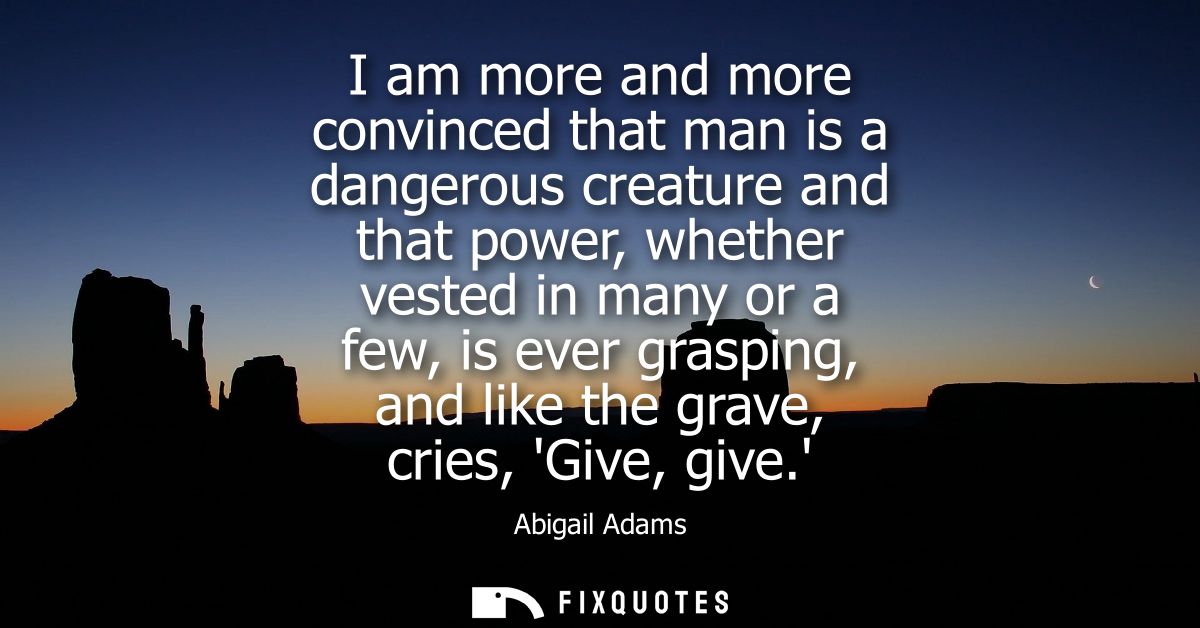
"I am more and more convinced that man is a dangerous creature and that power, whether vested in many or a few, is ever grasping, and like the grave, cries, 'Give, give'"
About this Quote
The quote’s engine is its refusal to pick a comforting villain. Power “vested in many or a few” clears the usual escape hatches: it’s not just kings, not just mobs, not just the other side. The danger is structural. Put authority anywhere and it develops a hunger. That’s why the metaphor works so well. Comparing power to the grave is a masterstroke of Puritan-inflected imagery: an appetite that cannot be satisfied, a force that turns every gift into a down payment. “Give, give” isn’t a policy argument; it’s a diagnosis of compulsion.
The subtext is also gendered and domestic in a way that makes it sharper. Adams, excluded from formal power, was close enough to see its mechanics without being seduced by its prestige. Her suspicion reads like a warning to her husband and his peers: don’t confuse victory over tyranny with immunity from it. Revolutions don’t end the craving; they relocate it. The intent is prophylactic: build restraints, assume backsliding, and treat virtue as insufficient. Power won’t police itself because it doesn’t know the word “enough.”
Quote Details
| Topic | Ethics & Morality |
|---|---|
| Source | Help us find the source |
| Cite |
Citation Formats
APA Style (7th ed.)
Adams, Abigail. (2026, February 16). I am more and more convinced that man is a dangerous creature and that power, whether vested in many or a few, is ever grasping, and like the grave, cries, 'Give, give'. FixQuotes. https://fixquotes.com/quotes/i-am-more-and-more-convinced-that-man-is-a-19305/
Chicago Style
Adams, Abigail. "I am more and more convinced that man is a dangerous creature and that power, whether vested in many or a few, is ever grasping, and like the grave, cries, 'Give, give'." FixQuotes. February 16, 2026. https://fixquotes.com/quotes/i-am-more-and-more-convinced-that-man-is-a-19305/.
MLA Style (9th ed.)
"I am more and more convinced that man is a dangerous creature and that power, whether vested in many or a few, is ever grasping, and like the grave, cries, 'Give, give'." FixQuotes, 16 Feb. 2026, https://fixquotes.com/quotes/i-am-more-and-more-convinced-that-man-is-a-19305/. Accessed 9 Mar. 2026.