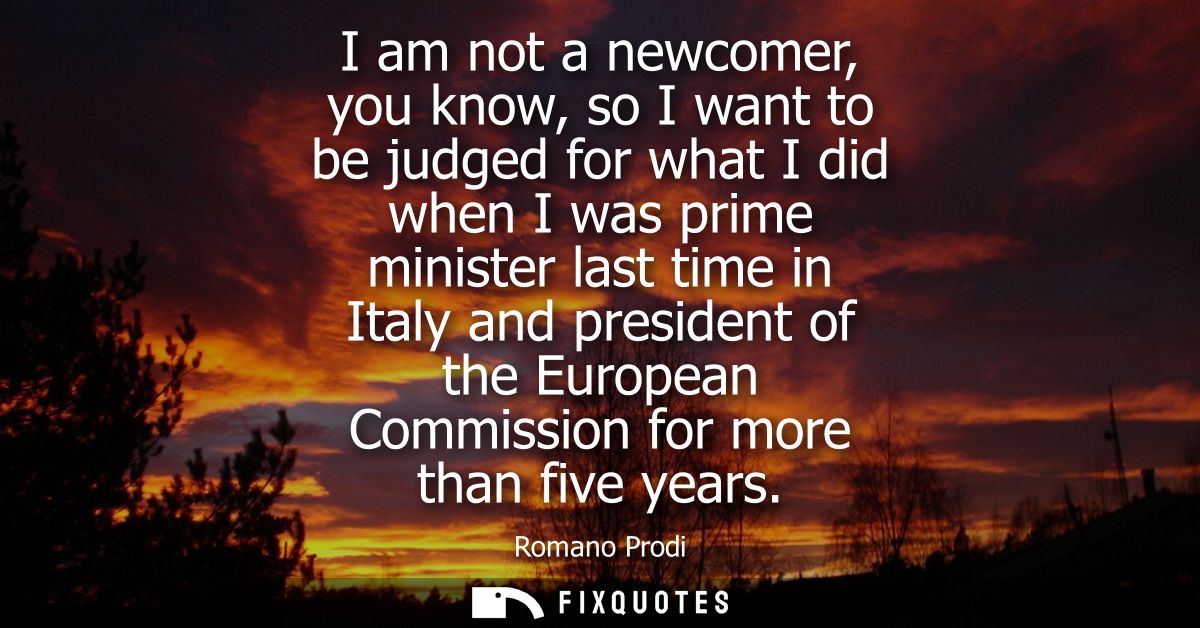
"I am not a newcomer, you know, so I want to be judged for what I did when I was prime minister last time in Italy, and president of the European Commission for more than five years"
About this Quote
The real subtext sits in the word “judged.” Prodi frames politics as an audit, not a popularity contest. That’s both a defense and a flex. By naming two heavyweight posts - prime minister of Italy and president of the European Commission - he invokes credibility that’s transnational, suggesting competence at home and legitimacy in Brussels. It’s also a subtle rebuke to a political culture where past governing is often treated as baggage, and where “Europe” can function as either a badge of seriousness or a target in populist narratives.
Context matters: Prodi’s career is tied to center-left coalition politics and the EU’s integration era, both easy to caricature as technocratic. By staking his claim to being evaluated on outcomes, he anticipates critics who would reduce him to “the Brussels guy” or an artifact of a previous Italy. The line aims to convert experience from liability into leverage: if you’re going to bring him back into the conversation, he’s telling you where the receipts are.
Quote Details
| Topic | Leadership |
|---|---|
| Source | Help us find the source |
| Cite |
Citation Formats
APA Style (7th ed.)
Prodi, Romano. (2026, February 16). I am not a newcomer, you know, so I want to be judged for what I did when I was prime minister last time in Italy, and president of the European Commission for more than five years. FixQuotes. https://fixquotes.com/quotes/i-am-not-a-newcomer-you-know-so-i-want-to-be-147935/
Chicago Style
Prodi, Romano. "I am not a newcomer, you know, so I want to be judged for what I did when I was prime minister last time in Italy, and president of the European Commission for more than five years." FixQuotes. February 16, 2026. https://fixquotes.com/quotes/i-am-not-a-newcomer-you-know-so-i-want-to-be-147935/.
MLA Style (9th ed.)
"I am not a newcomer, you know, so I want to be judged for what I did when I was prime minister last time in Italy, and president of the European Commission for more than five years." FixQuotes, 16 Feb. 2026, https://fixquotes.com/quotes/i-am-not-a-newcomer-you-know-so-i-want-to-be-147935/. Accessed 31 Mar. 2026.