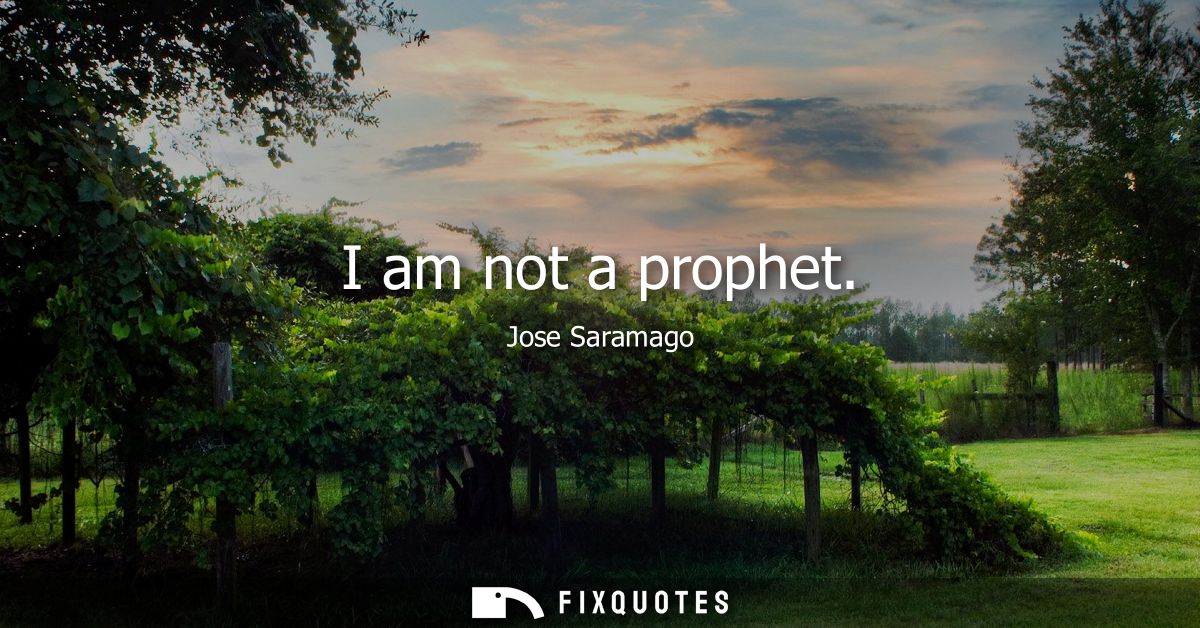
"I am not a prophet"
About this Quote
Refusing the halo is one of Jose Saramago's favorite ways of putting it on. "I am not a prophet" reads like humility, but it works as a preemptive strike against the kind of cultural demand placed on major writers: tell us what comes next, certify our anxieties with a stamp of inevitability, translate politics into fate. Saramago, a novelist of systems and their cruelties, declines the role of seer even as his books routinely feel uncannily predictive. The line is a shield against being misread as an oracle when he is, in fact, a craftsman of thought experiments.
The subtext is slyly ethical. Prophets claim special access; Saramago insists on the opposite: he is a citizen with eyes open, drawing consequences from what is already visible. That stance matters for a writer shaped by dictatorship in Portugal, late-blooming recognition, and a lifelong, explicitly political commitment to the left. In societies trained to treat power as weather, "prophecy" becomes a convenient alibi: no one is responsible, because history was foretold. By rejecting prophecy, Saramago keeps the burden where he wants it: on human choices, on institutions, on the daily complicities that make catastrophe ordinary.
There's also a media-savvy pragmatism here. The public wants authors to speak in slogans; Saramago answers with a phrase that dodges canonization while sharpening his credibility. Not a prophet, just someone describing the present so plainly that the future looks like a confession.
The subtext is slyly ethical. Prophets claim special access; Saramago insists on the opposite: he is a citizen with eyes open, drawing consequences from what is already visible. That stance matters for a writer shaped by dictatorship in Portugal, late-blooming recognition, and a lifelong, explicitly political commitment to the left. In societies trained to treat power as weather, "prophecy" becomes a convenient alibi: no one is responsible, because history was foretold. By rejecting prophecy, Saramago keeps the burden where he wants it: on human choices, on institutions, on the daily complicities that make catastrophe ordinary.
There's also a media-savvy pragmatism here. The public wants authors to speak in slogans; Saramago answers with a phrase that dodges canonization while sharpening his credibility. Not a prophet, just someone describing the present so plainly that the future looks like a confession.
Quote Details
| Topic | Truth |
|---|---|
| Source | Help us find the source |
| Cite |
Citation Formats
APA Style (7th ed.)
Saramago, Jose. (2026, January 17). I am not a prophet. FixQuotes. https://fixquotes.com/quotes/i-am-not-a-prophet-55213/
Chicago Style
Saramago, Jose. "I am not a prophet." FixQuotes. January 17, 2026. https://fixquotes.com/quotes/i-am-not-a-prophet-55213/.
MLA Style (9th ed.)
"I am not a prophet." FixQuotes, 17 Jan. 2026, https://fixquotes.com/quotes/i-am-not-a-prophet-55213/. Accessed 1 Apr. 2026.
More Quotes by Jose
Add to List