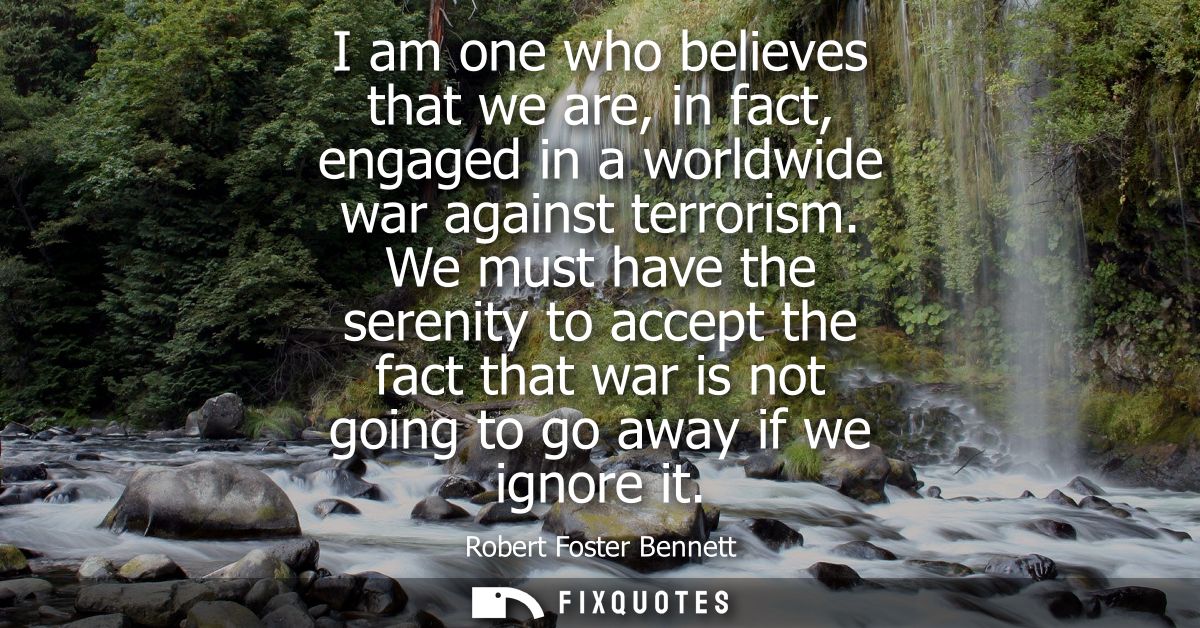
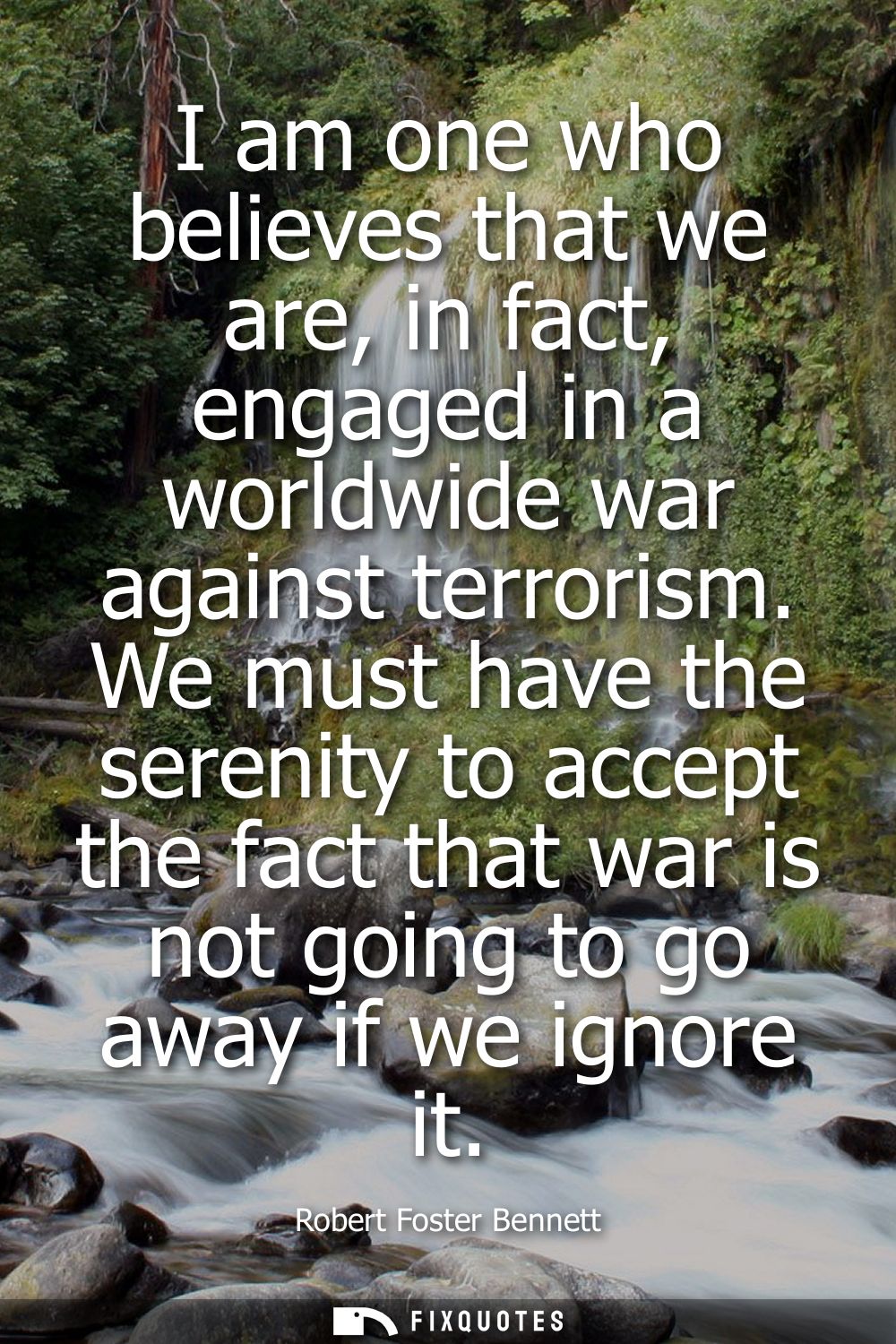
"I am one who believes that we are, in fact, engaged in a worldwide war against terrorism. We must have the serenity to accept the fact that war is not going to go away if we ignore it"
About this Quote
The second sentence is where the rhetoric tightens. “We must have the serenity” borrows the cadence of a prayer, wrapping militarized urgency in the soothing language of personal virtue. That’s not accidental. Serenity reads as maturity, steadiness, even wisdom, turning acceptance into a character test. If you question the frame, you’re not simply wrong; you’re emotionally unserious. “War is not going to go away if we ignore it” is a parental scold aimed at war-weariness: the idea that fatigue itself is a security risk.
Context matters: Bennett was a Republican senator from Utah, speaking in an era when “war on terror” functioned as both policy and political identity. The subtext is permission for permanence. By insisting war won’t “go away,” the quote normalizes a conflict without clear endpoints, where the measure of responsibility becomes endurance rather than strategy, and where skepticism can be recast as avoidance. It’s a compact argument for staying the course by making the alternative sound like willful blindness.
Quote Details
| Topic | War |
|---|---|
| Source | Help us find the source |
| Cite |
Citation Formats
APA Style (7th ed.)
Bennett, Robert Foster. (2026, January 16). I am one who believes that we are, in fact, engaged in a worldwide war against terrorism. We must have the serenity to accept the fact that war is not going to go away if we ignore it. FixQuotes. https://fixquotes.com/quotes/i-am-one-who-believes-that-we-are-in-fact-engaged-102786/
Chicago Style
Bennett, Robert Foster. "I am one who believes that we are, in fact, engaged in a worldwide war against terrorism. We must have the serenity to accept the fact that war is not going to go away if we ignore it." FixQuotes. January 16, 2026. https://fixquotes.com/quotes/i-am-one-who-believes-that-we-are-in-fact-engaged-102786/.
MLA Style (9th ed.)
"I am one who believes that we are, in fact, engaged in a worldwide war against terrorism. We must have the serenity to accept the fact that war is not going to go away if we ignore it." FixQuotes, 16 Jan. 2026, https://fixquotes.com/quotes/i-am-one-who-believes-that-we-are-in-fact-engaged-102786/. Accessed 18 Mar. 2026.