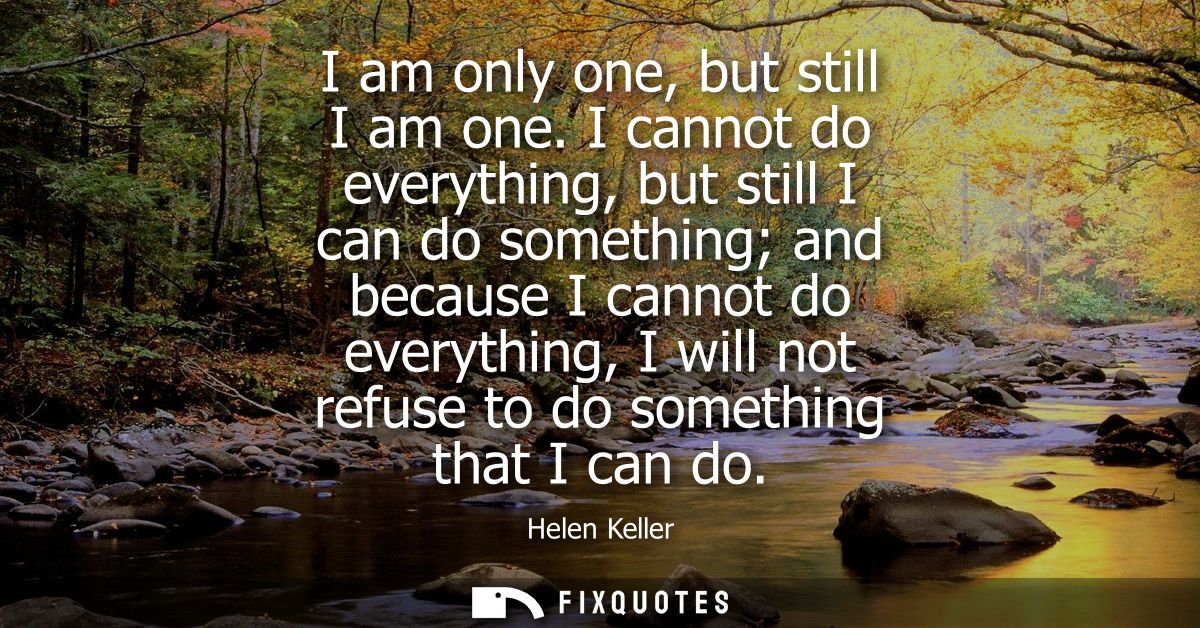
"I am only one, but still I am one. I cannot do everything, but still I can do something; and because I cannot do everything, I will not refuse to do something that I can do"
About this Quote
Keller’s line is a rebuke to the most comforting lie of modern moral life: that unless you can fix the whole mess, you’re off the hook for fixing any of it. The sentence moves like a staircase, each clause narrowing the gap between lofty ideals and actual responsibility. “I am only one” names the smallness people use as an alibi; “but still I am one” turns that same smallness into a lever. The pivot word is “still” - a refusal to let limitation end the argument.
The intent is practical, not sentimental. Keller isn’t selling optimism; she’s dismantling perfectionism. The subtext is aimed at the spectator mindset: the person who consumes tragedy, feels briefly guilty, then opts out because their contribution would be “insignificant.” Keller answers with a moral math problem: insignificance doesn’t equal irrelevance.
Context matters because Keller’s authority is earned, not claimed. Deaf and blind from early childhood, she lived in a world that routinely treated disability as a full stop. She became a public intellectual and activist anyway - for disability rights, women’s suffrage, labor reform, and peace - in an era when “public life” was gatekept by gender, class, and bodily norms. That history sharpens the rhetoric: this isn’t an abstract self-help mantra; it’s a disciplined strategy for agency under constraint.
The final clause is the knife: “I will not refuse.” Refusal is framed as a choice, not a fate. Keller makes incremental action feel less like a consolation prize and more like the minimum standard of decency.
The intent is practical, not sentimental. Keller isn’t selling optimism; she’s dismantling perfectionism. The subtext is aimed at the spectator mindset: the person who consumes tragedy, feels briefly guilty, then opts out because their contribution would be “insignificant.” Keller answers with a moral math problem: insignificance doesn’t equal irrelevance.
Context matters because Keller’s authority is earned, not claimed. Deaf and blind from early childhood, she lived in a world that routinely treated disability as a full stop. She became a public intellectual and activist anyway - for disability rights, women’s suffrage, labor reform, and peace - in an era when “public life” was gatekept by gender, class, and bodily norms. That history sharpens the rhetoric: this isn’t an abstract self-help mantra; it’s a disciplined strategy for agency under constraint.
The final clause is the knife: “I will not refuse.” Refusal is framed as a choice, not a fate. Keller makes incremental action feel less like a consolation prize and more like the minimum standard of decency.
Quote Details
| Topic | Motivational |
|---|---|
| Source | Attributed to Helen Keller , citation appears on the Helen Keller Wikiquote page (no single original primary source given there). |
More Quotes by Helen
Add to List