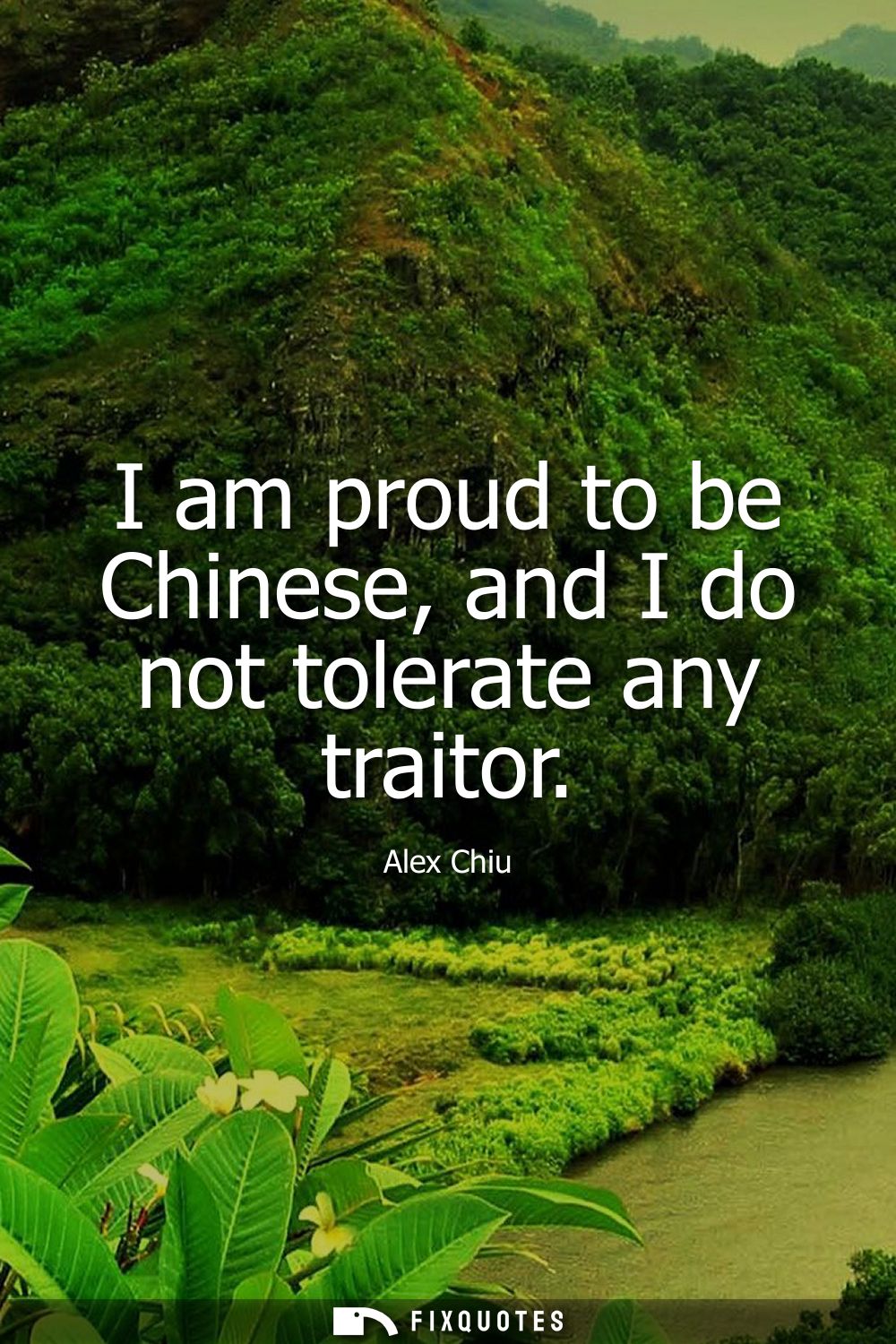
"I am proud to be Chinese, and I do not tolerate any traitor"
About this Quote
A line like this isn’t trying to persuade you so much as to draw a border and dare you to cross it. “I am proud to be Chinese” sounds, on its surface, like ordinary ethnic or national affirmation. The turn is the second clause: “and I do not tolerate any traitor.” Suddenly pride isn’t a feeling; it’s an enforcement mechanism. The sentence converts identity into a loyalty test, implying that “Chinese” is not merely ancestry or citizenship but a moral alignment with a particular version of the nation - and that dissent can be reclassified as betrayal.
The phrasing does a lot of quiet work. “Do not tolerate” is the language of policy and punishment, not debate. It invites an audience to imagine a community under siege, where disagreement isn’t legitimate but dangerous. “Traitor” is deliberately elastic: it can mean someone who collaborates with a foreign power, but in modern political rhetoric it often expands to include critics, protesters, exiles, journalists, or anyone whose speech embarrasses the in-group. The quote’s power comes from that vagueness; it lets listeners plug in their preferred enemy.
Coming from a businessman rather than a statesman, it reads less like a constitutional claim and more like brand signaling. It performs toughness and belonging in a climate where public displays of nationalism can be socially and commercially advantageous, especially amid heightened tensions around diaspora identity, Hong Kong/Taiwan debates, and “foreign influence” narratives. The subtext is clear: if you’re with me, you’re Chinese; if you question me, you’re a traitor.
The phrasing does a lot of quiet work. “Do not tolerate” is the language of policy and punishment, not debate. It invites an audience to imagine a community under siege, where disagreement isn’t legitimate but dangerous. “Traitor” is deliberately elastic: it can mean someone who collaborates with a foreign power, but in modern political rhetoric it often expands to include critics, protesters, exiles, journalists, or anyone whose speech embarrasses the in-group. The quote’s power comes from that vagueness; it lets listeners plug in their preferred enemy.
Coming from a businessman rather than a statesman, it reads less like a constitutional claim and more like brand signaling. It performs toughness and belonging in a climate where public displays of nationalism can be socially and commercially advantageous, especially amid heightened tensions around diaspora identity, Hong Kong/Taiwan debates, and “foreign influence” narratives. The subtext is clear: if you’re with me, you’re Chinese; if you question me, you’re a traitor.
Quote Details
| Topic | Pride |
|---|---|
| Source | Help us find the source |
| Cite |
Citation Formats
APA Style (7th ed.)
Chiu, Alex. (2026, January 16). I am proud to be Chinese, and I do not tolerate any traitor. FixQuotes. https://fixquotes.com/quotes/i-am-proud-to-be-chinese-and-i-do-not-tolerate-138813/
Chicago Style
Chiu, Alex. "I am proud to be Chinese, and I do not tolerate any traitor." FixQuotes. January 16, 2026. https://fixquotes.com/quotes/i-am-proud-to-be-chinese-and-i-do-not-tolerate-138813/.
MLA Style (9th ed.)
"I am proud to be Chinese, and I do not tolerate any traitor." FixQuotes, 16 Jan. 2026, https://fixquotes.com/quotes/i-am-proud-to-be-chinese-and-i-do-not-tolerate-138813/. Accessed 5 Apr. 2026.
More Quotes by Alex
Add to List