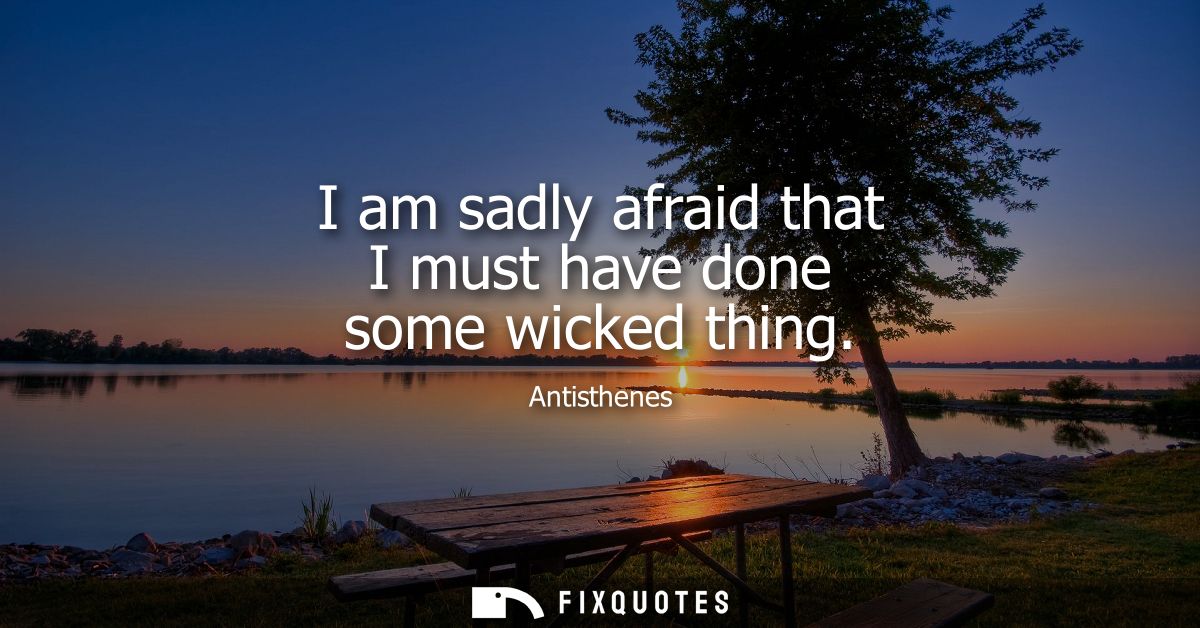
"I am sadly afraid that I must have done some wicked thing"
About this Quote
Guilt is doing its work before any evidence shows up. Antisthenes frames moral anxiety as a kind of internal alarm: if life is going smoothly, he suspects he earned that ease through wrongdoing. The line is almost comically bleak, but its bite is philosophical. It assumes a world where virtue is rarely rewarded and where the self is most trustworthy not in triumph but in suspicion. That inversion is exactly the Cynic-adjacent move: treat comfort as a test, not a prize.
The phrasing matters. "Sadly afraid" doubles the emotional register, combining sorrow (a recognition of human frailty) with fear (a dread of moral accounting). Then he shifts to "must have" - not "may have" - suggesting guilt as inevitability, like the moral universe has statistical laws: good people do not get lucky. The vagueness of "some wicked thing" is also telling. He is not confessing a specific act; he's confessing to the mind's ability to manufacture self-indictment, the way conscience can become a standing charge.
Contextually, Antisthenes sits at the hinge between Socratic ethics and later Cynicism: virtue as self-sufficiency, suspicion of social approval, disdain for the glossy story that success equals merit. Read that way, the line is less self-pity than self-policing. It's an antidote to complacency, an insistence that the good life is not the easy life, and that the first sign of corruption may be the feeling that nothing is wrong.
The phrasing matters. "Sadly afraid" doubles the emotional register, combining sorrow (a recognition of human frailty) with fear (a dread of moral accounting). Then he shifts to "must have" - not "may have" - suggesting guilt as inevitability, like the moral universe has statistical laws: good people do not get lucky. The vagueness of "some wicked thing" is also telling. He is not confessing a specific act; he's confessing to the mind's ability to manufacture self-indictment, the way conscience can become a standing charge.
Contextually, Antisthenes sits at the hinge between Socratic ethics and later Cynicism: virtue as self-sufficiency, suspicion of social approval, disdain for the glossy story that success equals merit. Read that way, the line is less self-pity than self-policing. It's an antidote to complacency, an insistence that the good life is not the easy life, and that the first sign of corruption may be the feeling that nothing is wrong.
Quote Details
| Topic | Ethics & Morality |
|---|---|
| Source | Help us find the source |
| Cite |
Citation Formats
APA Style (7th ed.)
Antisthenes. (2026, January 16). I am sadly afraid that I must have done some wicked thing. FixQuotes. https://fixquotes.com/quotes/i-am-sadly-afraid-that-i-must-have-done-some-119913/
Chicago Style
Antisthenes. "I am sadly afraid that I must have done some wicked thing." FixQuotes. January 16, 2026. https://fixquotes.com/quotes/i-am-sadly-afraid-that-i-must-have-done-some-119913/.
MLA Style (9th ed.)
"I am sadly afraid that I must have done some wicked thing." FixQuotes, 16 Jan. 2026, https://fixquotes.com/quotes/i-am-sadly-afraid-that-i-must-have-done-some-119913/. Accessed 12 Feb. 2026.
More Quotes by Antisthenes
Add to List