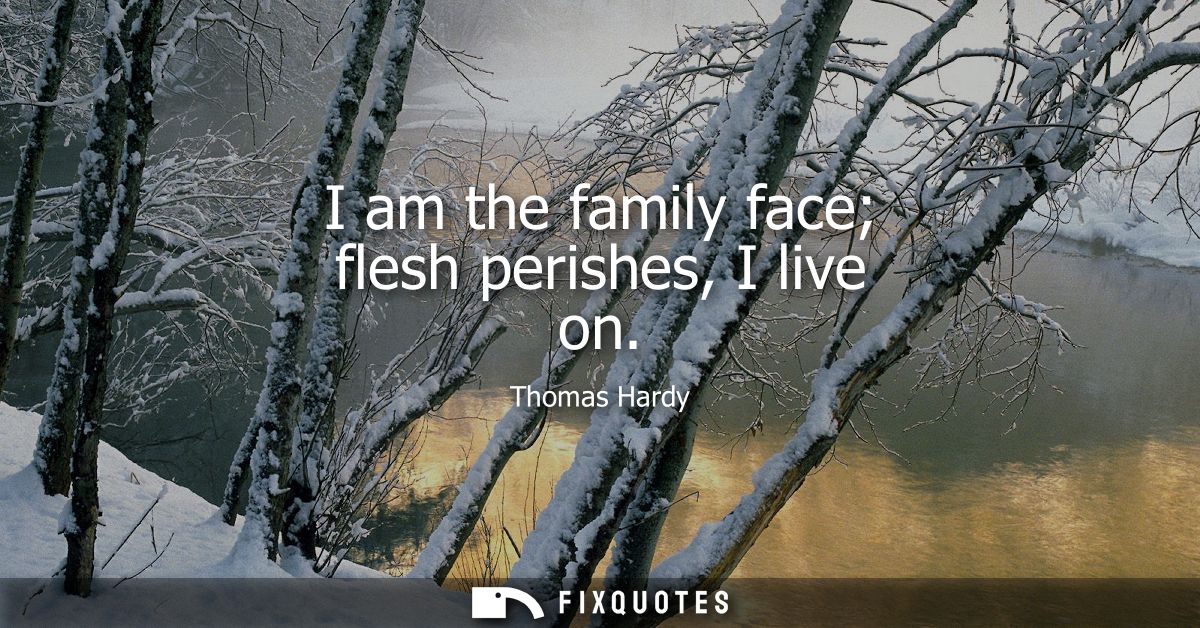
"I am the family face; flesh perishes, I live on"
About this Quote
Hardy’s line is a cool, unsettling boast spoken in the voice of heredity itself: not the person, but the pattern. “I am the family face” turns identity into a kind of property, something owned by lineage rather than by the individual wearing it. The colon does the heavy lifting, snapping us from portrait-sitting calm into metaphysical chill: “flesh perishes, I live on.” What survives is not the soul, not a legacy of deeds, but a set of features that keeps reappearing, indifferent to who inhabits them.
The intent is characteristically Hardy: to puncture comforting narratives about personal uniqueness. He’s writing out of a late-Victorian world newly fluent in Darwinian time, where inheritance and chance can feel more real than providence. The “family face” becomes a memento mori that doesn’t just warn you you’ll die; it tells you you’ll be replaced by a look-alike. That’s the subtextual cruelty: even your most intimate marker, your face, isn’t properly yours. It’s a mask the family keeps recasting, generation after generation.
Hardy also taps a cultural anxiety about portraits, photographs, and the era’s obsession with physiognomy. A face can outlast its owner in frames, albums, and memory, but Hardy twists that into something biological and faintly tyrannical. The line reads like a ghost speaking from the bloodline: intimate, inevitable, and totally unmoved by your private hopes.
The intent is characteristically Hardy: to puncture comforting narratives about personal uniqueness. He’s writing out of a late-Victorian world newly fluent in Darwinian time, where inheritance and chance can feel more real than providence. The “family face” becomes a memento mori that doesn’t just warn you you’ll die; it tells you you’ll be replaced by a look-alike. That’s the subtextual cruelty: even your most intimate marker, your face, isn’t properly yours. It’s a mask the family keeps recasting, generation after generation.
Hardy also taps a cultural anxiety about portraits, photographs, and the era’s obsession with physiognomy. A face can outlast its owner in frames, albums, and memory, but Hardy twists that into something biological and faintly tyrannical. The line reads like a ghost speaking from the bloodline: intimate, inevitable, and totally unmoved by your private hopes.
Quote Details
| Topic | Legacy & Remembrance |
|---|---|
| Source | Help us find the source |
| Cite |
Citation Formats
APA Style (7th ed.)
Hardy, Thomas. (2026, January 18). I am the family face; flesh perishes, I live on. FixQuotes. https://fixquotes.com/quotes/i-am-the-family-face-flesh-perishes-i-live-on-3175/
Chicago Style
Hardy, Thomas. "I am the family face; flesh perishes, I live on." FixQuotes. January 18, 2026. https://fixquotes.com/quotes/i-am-the-family-face-flesh-perishes-i-live-on-3175/.
MLA Style (9th ed.)
"I am the family face; flesh perishes, I live on." FixQuotes, 18 Jan. 2026, https://fixquotes.com/quotes/i-am-the-family-face-flesh-perishes-i-live-on-3175/. Accessed 11 Mar. 2026.
More Quotes by Thomas
Add to List