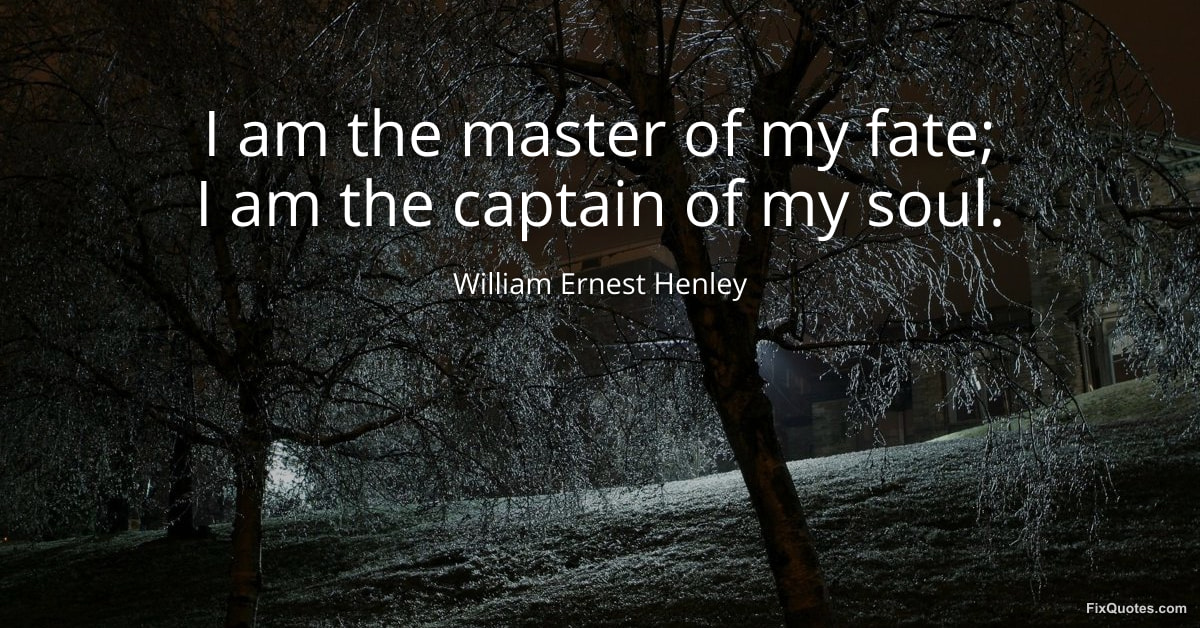
"I am the master of my fate: I am the captain of my soul"
About this Quote
Defiance is the engine here, and it runs on a blunt, almost militarized sense of self-command. Henley writes like a man trying to seize the only territory illness and circumstance can’t occupy: his inner life. “Master” and “captain” aren’t decorative metaphors; they’re roles with jurisdiction. Fate and soul become domains to administer, not mysteries to endure. The line’s force comes from its grammar: two short declarations, symmetrical and final, each beginning with “I am.” No qualifiers, no appeal to mercy, no hedging. It’s a self-issued credential.
The context sharpens the stakes. Henley lived with chronic tuberculosis of the bone; he lost a leg, faced repeated surgeries, and spent long stretches in hospital. “Invictus” (1888) isn’t abstract motivational copy; it’s a man arguing with pain in real time, insisting that suffering can be acknowledged without being obeyed. The subtext is less “nothing can hurt me” than “you can hurt me and still not own me.” That’s why the closing couplet lands: it reframes agency as an interior practice, not an external outcome.
Culturally, the line has endured because it’s portable. It can be read as stoic resilience, as Victorian self-reliance, as modern self-help, even as a mantra for political prisoners. That versatility is also its risk: stripped of Henley’s bruising reality, it can sound like pure individualism. In its original key, it’s not triumphal; it’s survival with teeth.
The context sharpens the stakes. Henley lived with chronic tuberculosis of the bone; he lost a leg, faced repeated surgeries, and spent long stretches in hospital. “Invictus” (1888) isn’t abstract motivational copy; it’s a man arguing with pain in real time, insisting that suffering can be acknowledged without being obeyed. The subtext is less “nothing can hurt me” than “you can hurt me and still not own me.” That’s why the closing couplet lands: it reframes agency as an interior practice, not an external outcome.
Culturally, the line has endured because it’s portable. It can be read as stoic resilience, as Victorian self-reliance, as modern self-help, even as a mantra for political prisoners. That versatility is also its risk: stripped of Henley’s bruising reality, it can sound like pure individualism. In its original key, it’s not triumphal; it’s survival with teeth.
Quote Details
| Topic | Free Will & Fate |
|---|---|
| Source | William Ernest Henley, poem 'Invictus' — closing lines: "I am the master of my fate; I am the captain of my soul." |
| Cite |
Citation Formats
APA Style (7th ed.)
Henley, William Ernest. (2026, February 16). I am the master of my fate: I am the captain of my soul. FixQuotes. https://fixquotes.com/quotes/i-am-the-master-of-my-fate-i-am-the-captain-of-my-130776/
Chicago Style
Henley, William Ernest. "I am the master of my fate: I am the captain of my soul." FixQuotes. February 16, 2026. https://fixquotes.com/quotes/i-am-the-master-of-my-fate-i-am-the-captain-of-my-130776/.
MLA Style (9th ed.)
"I am the master of my fate: I am the captain of my soul." FixQuotes, 16 Feb. 2026, https://fixquotes.com/quotes/i-am-the-master-of-my-fate-i-am-the-captain-of-my-130776/. Accessed 6 Mar. 2026.
More Quotes by William
Add to List