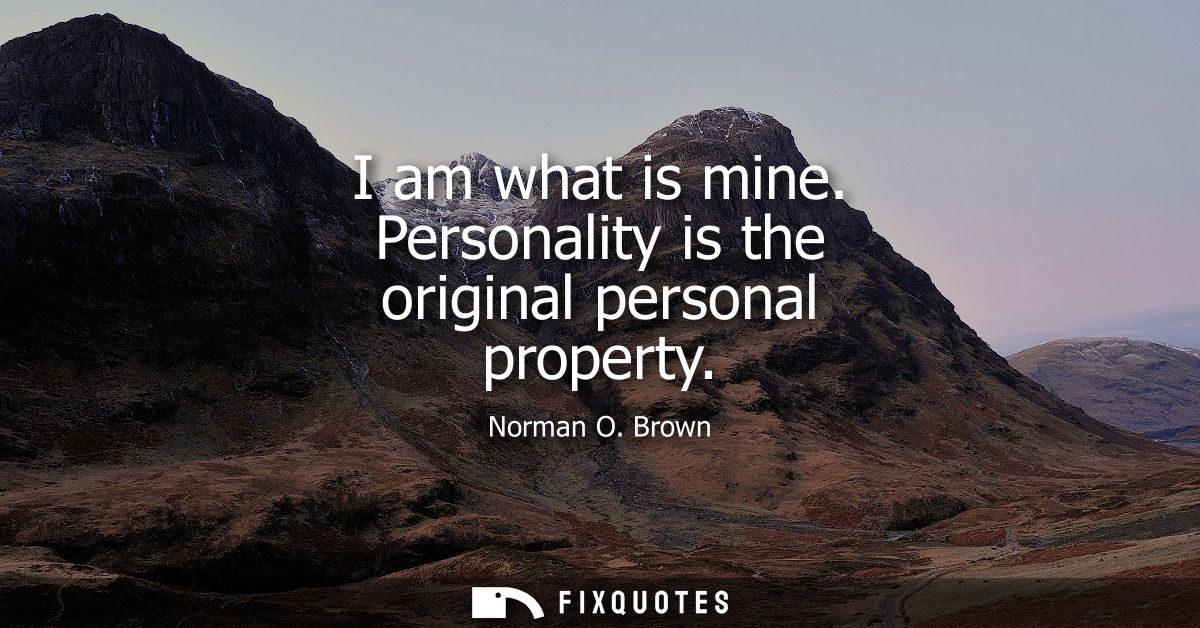
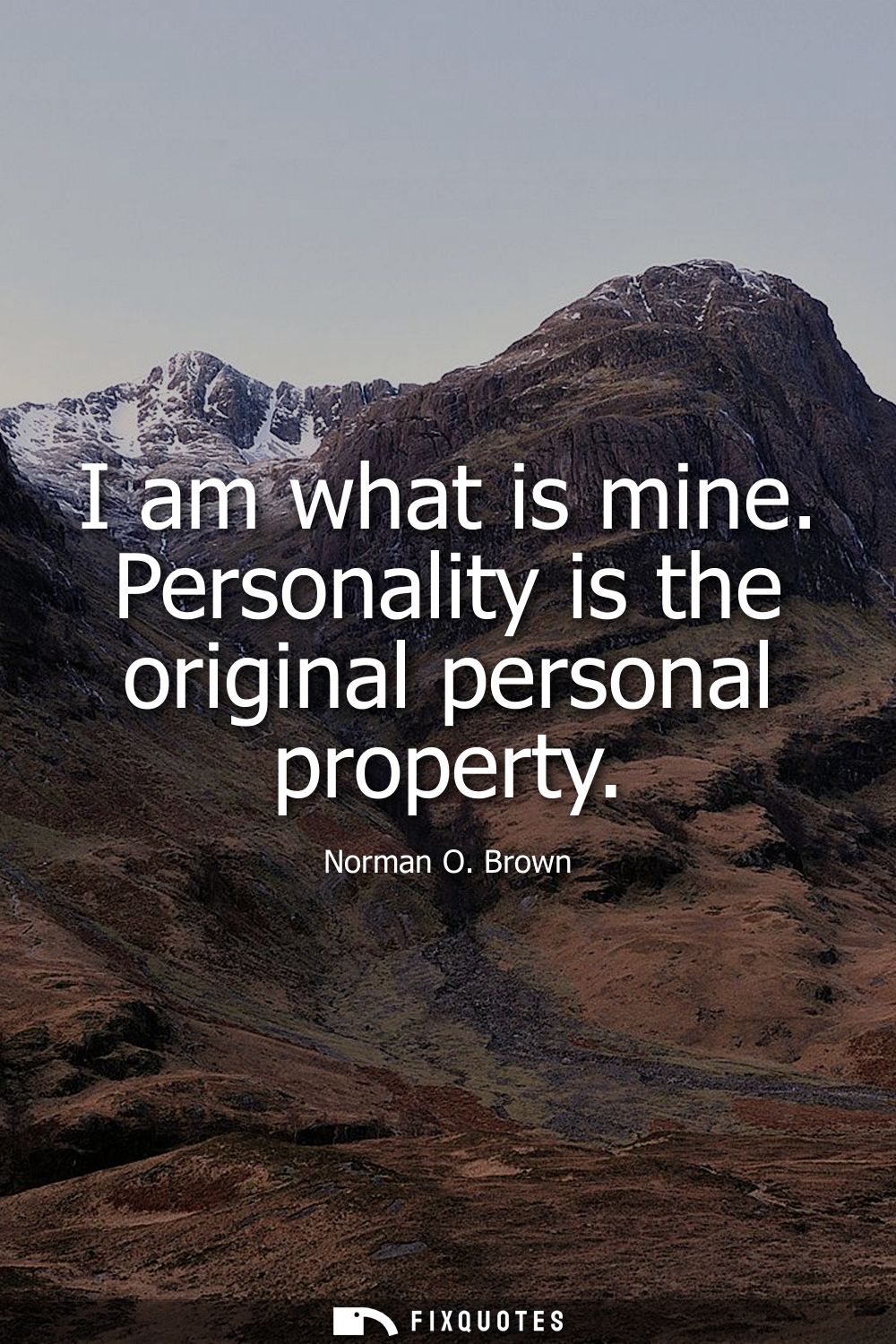
"I am what is mine. Personality is the original personal property"
About this Quote
A land-grab disguised as self-knowledge: Norman O. Brown turns the cozy language of individuality into a legal claim. "I am what is mine" sounds like a spiritual maxim until the second sentence snaps it into focus. Personality, he suggests, is not some airy essence; it behaves like property - something fenced, defended, traded, and policed. The wit is in the inversion: we usually think we own our stuff because we have a self. Brown flips it. The self is what ownership looks like on the inside.
Context matters because Brown spent his career arguing that modern life represses desire and calls the resulting control "civilization". In that light, "personality" becomes less a natural signature than a social technology: a stable, manageable identity suited to a world of contracts, wages, and borders. It's a critique of bourgeois subjecthood without the easy romance of "authenticity". Even the word "original" carries a double charge: personality is primal in the sense of foundational, but also "original" as in first deed of ownership, the initial title that makes everything else claimable.
The subtext is slightly sinister: if personality is property, then it can be accumulated, improved, marketed. Your "brand" stops being a metaphor and becomes the endpoint of a long cultural logic. Brown is poking at how capitalism doesn't just colonize time and labor; it colonizes the very grammar of selfhood, teaching us to treat our inner life as an estate to be managed - and defended against everyone else.
Context matters because Brown spent his career arguing that modern life represses desire and calls the resulting control "civilization". In that light, "personality" becomes less a natural signature than a social technology: a stable, manageable identity suited to a world of contracts, wages, and borders. It's a critique of bourgeois subjecthood without the easy romance of "authenticity". Even the word "original" carries a double charge: personality is primal in the sense of foundational, but also "original" as in first deed of ownership, the initial title that makes everything else claimable.
The subtext is slightly sinister: if personality is property, then it can be accumulated, improved, marketed. Your "brand" stops being a metaphor and becomes the endpoint of a long cultural logic. Brown is poking at how capitalism doesn't just colonize time and labor; it colonizes the very grammar of selfhood, teaching us to treat our inner life as an estate to be managed - and defended against everyone else.
Quote Details
| Topic | Deep |
|---|---|
| Source | Help us find the source |
| Cite |
Citation Formats
APA Style (7th ed.)
Brown, Norman O. (2026, January 16). I am what is mine. Personality is the original personal property. FixQuotes. https://fixquotes.com/quotes/i-am-what-is-mine-personality-is-the-original-116431/
Chicago Style
Brown, Norman O. "I am what is mine. Personality is the original personal property." FixQuotes. January 16, 2026. https://fixquotes.com/quotes/i-am-what-is-mine-personality-is-the-original-116431/.
MLA Style (9th ed.)
"I am what is mine. Personality is the original personal property." FixQuotes, 16 Jan. 2026, https://fixquotes.com/quotes/i-am-what-is-mine-personality-is-the-original-116431/. Accessed 29 Mar. 2026.
More Quotes by Norman
Add to List