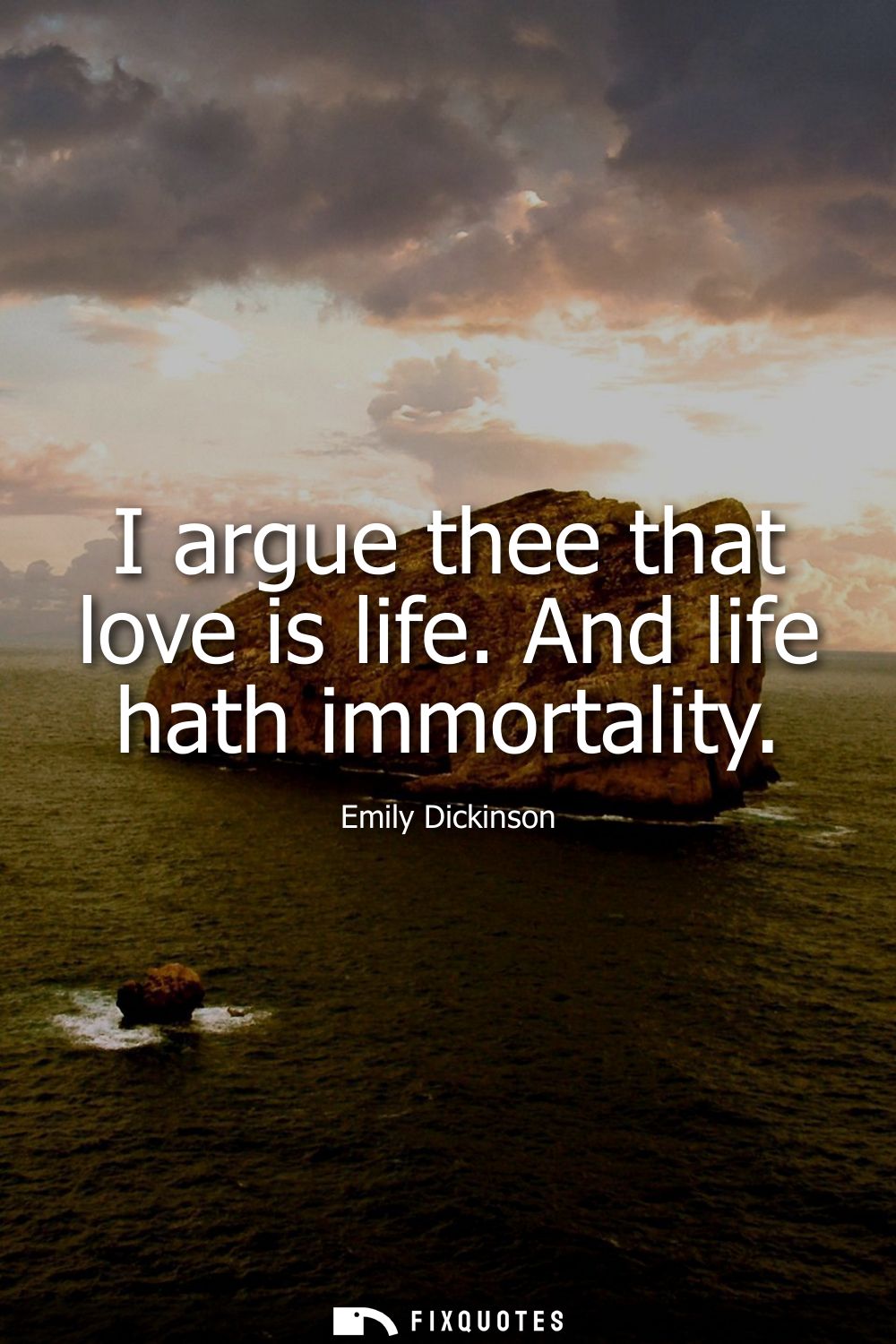
"I argue thee that love is life. And life hath immortality"
About this Quote
Love doesn’t just sweeten existence here; it replaces it. Dickinson’s line yokes two volatile absolutes - love and immortality - with the boldness of someone who knows the claim can’t be proven, only insisted upon. “I argue thee” is a fascinating verb choice: not “I tell,” not “I pray,” but a kind of intimate litigation. She’s making a case to a specific “thee,” a witness and opponent at once, as if love requires persuasion because the world keeps offering counterevidence: loss, illness, distance, death.
The old-fashioned diction (“thee,” “hath”) does more than signal a devotional register. It smuggles romance into the architecture of scripture. Dickinson, steeped in Protestant New England’s rhetoric and famously wary of its institutional demands, borrows its cadences to authorize a heresy: that love, not doctrine, is what grants permanence. She’s not promising an afterlife so much as reframing what “immortality” could mean for a person who lived much of her life in near-seclusion, watching mortality up close and keeping most of her poems private. Immortality becomes less a heaven you earn than a force you touch - briefly, fiercely - inside ordinary life.
The subtext is defiance disguised as tenderness. Dickinson isn’t naïve about death; she’s proposing love as the only argument that can stand in death’s courtroom, not by winning on facts, but by refusing death the final word.
The old-fashioned diction (“thee,” “hath”) does more than signal a devotional register. It smuggles romance into the architecture of scripture. Dickinson, steeped in Protestant New England’s rhetoric and famously wary of its institutional demands, borrows its cadences to authorize a heresy: that love, not doctrine, is what grants permanence. She’s not promising an afterlife so much as reframing what “immortality” could mean for a person who lived much of her life in near-seclusion, watching mortality up close and keeping most of her poems private. Immortality becomes less a heaven you earn than a force you touch - briefly, fiercely - inside ordinary life.
The subtext is defiance disguised as tenderness. Dickinson isn’t naïve about death; she’s proposing love as the only argument that can stand in death’s courtroom, not by winning on facts, but by refusing death the final word.
Quote Details
| Topic | Love |
|---|---|
| Source | Help us find the source |
| Cite |
Citation Formats
APA Style (7th ed.)
Dickinson, Emily. (2026, January 17). I argue thee that love is life. And life hath immortality. FixQuotes. https://fixquotes.com/quotes/i-argue-thee-that-love-is-life-and-life-hath-31040/
Chicago Style
Dickinson, Emily. "I argue thee that love is life. And life hath immortality." FixQuotes. January 17, 2026. https://fixquotes.com/quotes/i-argue-thee-that-love-is-life-and-life-hath-31040/.
MLA Style (9th ed.)
"I argue thee that love is life. And life hath immortality." FixQuotes, 17 Jan. 2026, https://fixquotes.com/quotes/i-argue-thee-that-love-is-life-and-life-hath-31040/. Accessed 11 Mar. 2026.
More Quotes by Emily
Add to List