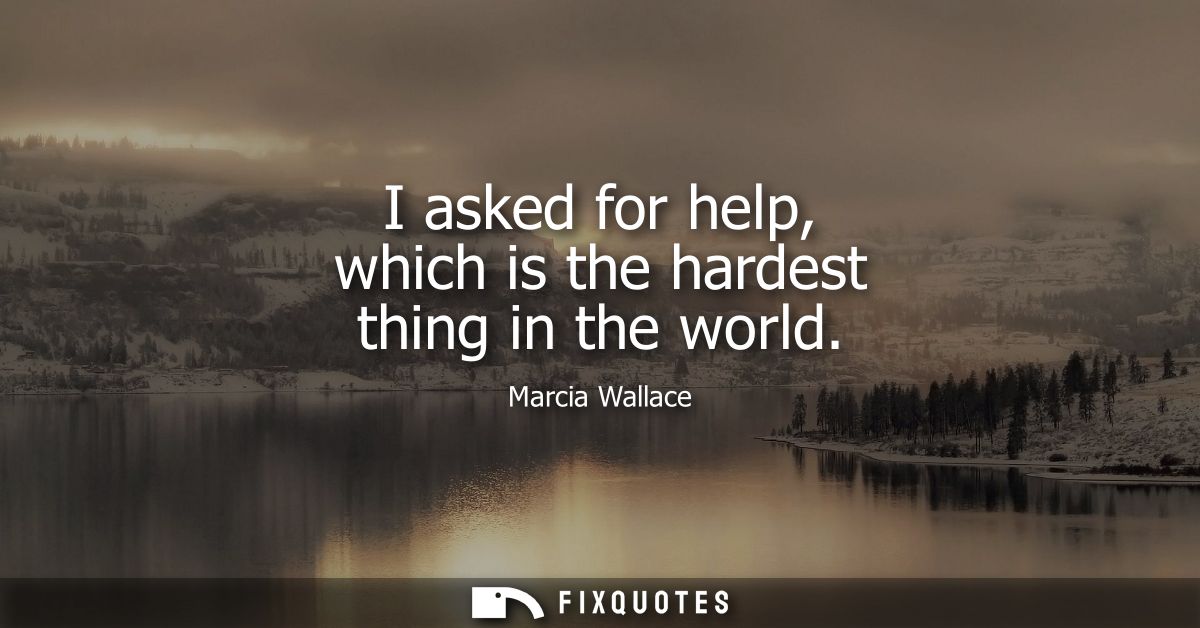
"I asked for help, which is the hardest thing in the world"
About this Quote
Asking for help is framed here not as a practical act but as a social transgression - a small rebellion against the persona we’re trained to perform. Marcia Wallace’s line lands because it treats vulnerability like manual labor: not romantic, not inspirational, just brutally hard. Coming from an actress - someone whose job involves projecting competence, charm, and control on demand - the admission carries extra voltage. It hints at the backstage reality where performance doesn’t protect you from need; it can actually make need feel like failure.
The intent is plainspoken and quietly defiant. Wallace isn’t celebrating strength in the usual, self-congratulatory way. She’s naming the moment strength gets redefined: not powering through, but letting someone see you can’t. The subtext is a whole cultural script about self-sufficiency, especially for women expected to be agreeable caretakers while never becoming burdens. “I asked” implies a deliberative choice, like stepping off a ledge. “For help” implies dependency, which our culture often codes as shame. The kicker is the absolutism: “the hardest thing in the world.” It’s not literally true, but emotionally exact - the kind of exaggeration that signals lived experience rather than rhetoric.
Contextually, Wallace’s era prized stoicism as adulthood and privacy as dignity. Her quote reads like a corrective to that inheritance, a reminder that the real courage sometimes isn’t endurance; it’s disclosure. The line doesn’t ask for applause. It asks for permission.
The intent is plainspoken and quietly defiant. Wallace isn’t celebrating strength in the usual, self-congratulatory way. She’s naming the moment strength gets redefined: not powering through, but letting someone see you can’t. The subtext is a whole cultural script about self-sufficiency, especially for women expected to be agreeable caretakers while never becoming burdens. “I asked” implies a deliberative choice, like stepping off a ledge. “For help” implies dependency, which our culture often codes as shame. The kicker is the absolutism: “the hardest thing in the world.” It’s not literally true, but emotionally exact - the kind of exaggeration that signals lived experience rather than rhetoric.
Contextually, Wallace’s era prized stoicism as adulthood and privacy as dignity. Her quote reads like a corrective to that inheritance, a reminder that the real courage sometimes isn’t endurance; it’s disclosure. The line doesn’t ask for applause. It asks for permission.
Quote Details
| Topic | Mental Health |
|---|---|
| Source | Help us find the source |
| Cite |
Citation Formats
APA Style (7th ed.)
Wallace, Marcia. (2026, January 15). I asked for help, which is the hardest thing in the world. FixQuotes. https://fixquotes.com/quotes/i-asked-for-help-which-is-the-hardest-thing-in-168053/
Chicago Style
Wallace, Marcia. "I asked for help, which is the hardest thing in the world." FixQuotes. January 15, 2026. https://fixquotes.com/quotes/i-asked-for-help-which-is-the-hardest-thing-in-168053/.
MLA Style (9th ed.)
"I asked for help, which is the hardest thing in the world." FixQuotes, 15 Jan. 2026, https://fixquotes.com/quotes/i-asked-for-help-which-is-the-hardest-thing-in-168053/. Accessed 3 Apr. 2026.
More Quotes by Marcia
Add to List