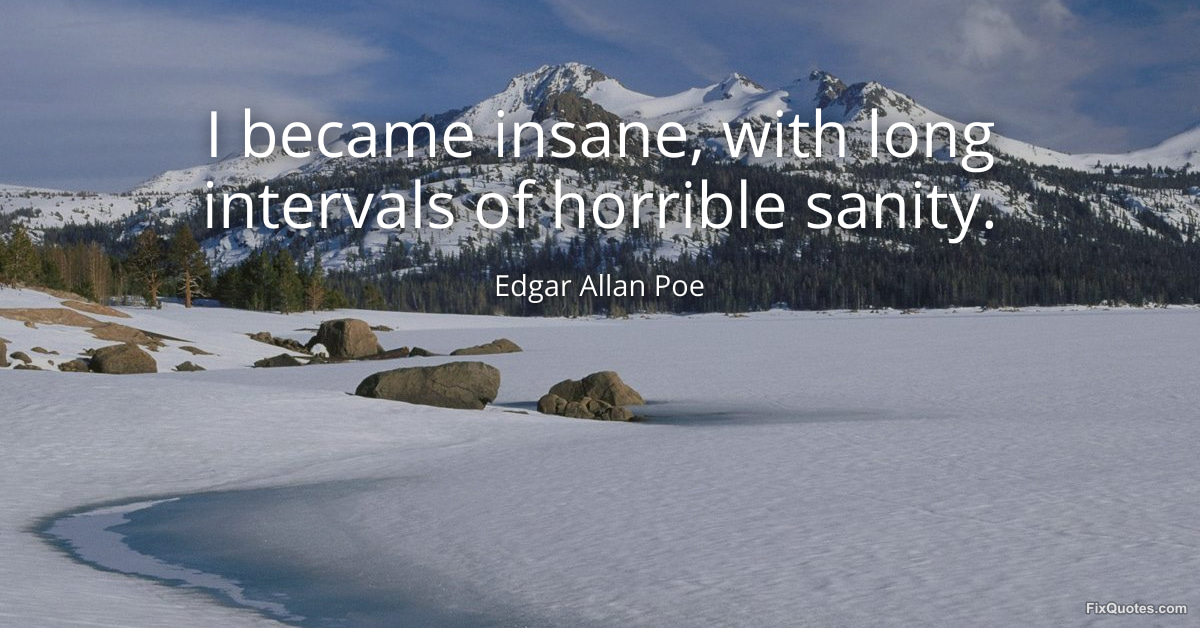
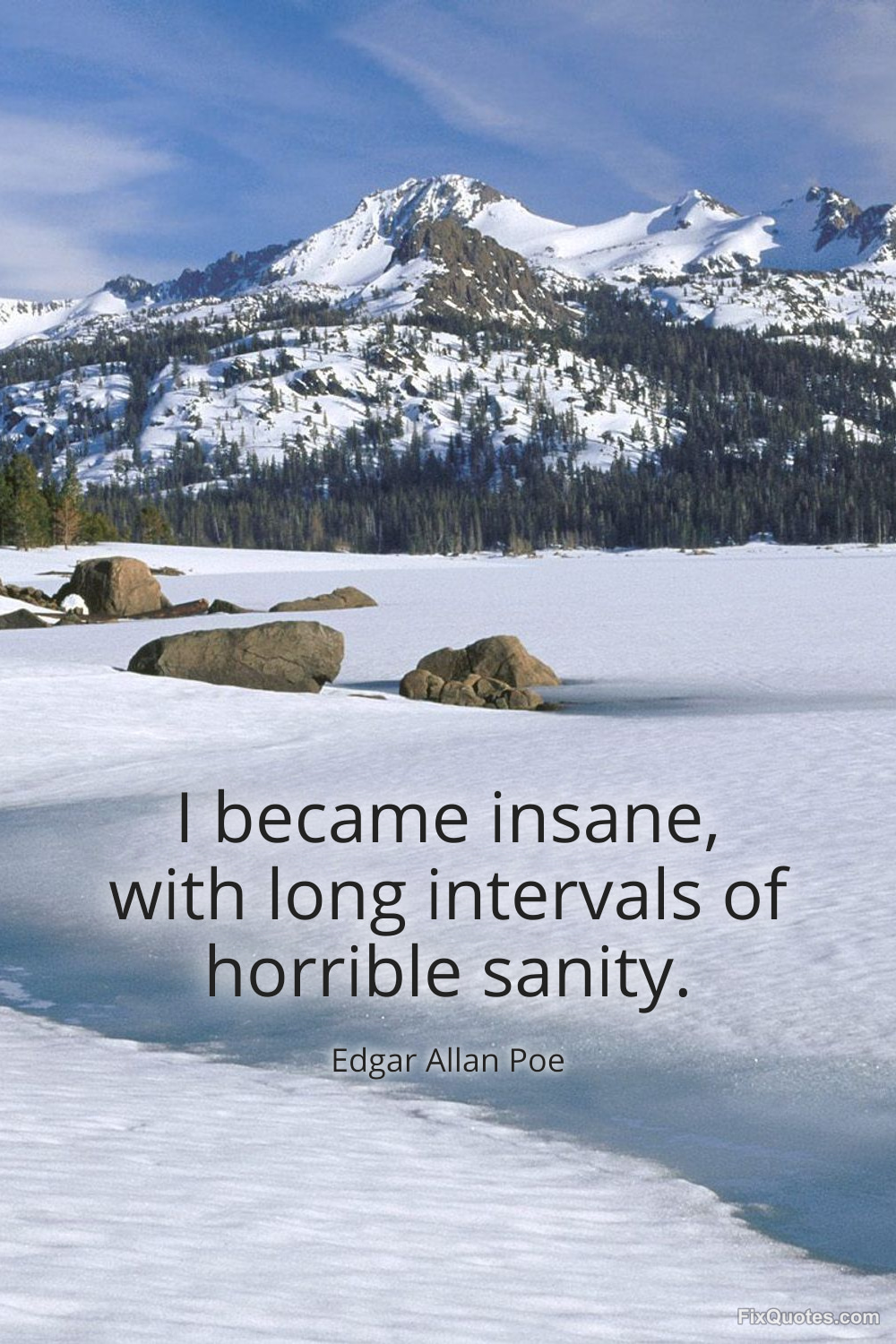
"I became insane, with long intervals of horrible sanity"
About this Quote
Poe’s line flips the usual moral hierarchy: sanity isn’t the goal, it’s the punishment. “I became insane” lands like a confession, but the dagger is in the second clause, where “intervals” suggests a cyclical illness and “horrible” rebrands lucidity as the true horror. The wit is black and surgical. If madness is a refuge, then clarity is a return to the scene of the crime: memory, guilt, grief, bills, bodies. Poe’s speaker isn’t glamorizing insanity so much as indicting what sanity forces you to face.
The phrasing also toys with Victorian-era anxieties about reason and disorder. Nineteenth-century America was busy building asylums and confidence in rational progress; Poe keeps whispering that the mind doesn’t obey the era’s tidy narratives. The “long intervals” implies endurance, not a passing episode. The sanity is “horrible” because it’s coherent: it connects the dots. In Poe’s gothic logic, madness can be a numbing fog, a theatrical mask, even a creative trance. Sanity is the moment the mask slips and the world’s cruelty becomes undeniable.
As a poet and architect of psychological horror, Poe knows that fear isn’t just in the dark; it’s in the light that returns. The line works because it traps you between two terrors: losing your mind, and finding it again.
The phrasing also toys with Victorian-era anxieties about reason and disorder. Nineteenth-century America was busy building asylums and confidence in rational progress; Poe keeps whispering that the mind doesn’t obey the era’s tidy narratives. The “long intervals” implies endurance, not a passing episode. The sanity is “horrible” because it’s coherent: it connects the dots. In Poe’s gothic logic, madness can be a numbing fog, a theatrical mask, even a creative trance. Sanity is the moment the mask slips and the world’s cruelty becomes undeniable.
As a poet and architect of psychological horror, Poe knows that fear isn’t just in the dark; it’s in the light that returns. The line works because it traps you between two terrors: losing your mind, and finding it again.
Quote Details
| Topic | Mental Health |
|---|---|
| Source | Verified source: Edgar Allan Poe to George W. Eveleth (Jan. 4, 1848) (Edgar Allan Poe, 1848)
Evidence:
I became insane, with long intervals of horrible sanity.. This line appears in Poe’s letter to George W. Eveleth dated New-York , Jan. 4, 1848. In the same paragraph Poe continues: “During these fits of absolute unconsciousness I drank, God only knows how often or how much.” The page given is a vetted transcription hosted by the Edgar Allan Poe Society of Baltimore (primary-text presentation of Poe’s letter). The quote is often misdated online (e.g., to 1846), but the letter containing the line is dated January 4, 1848 in the Poe–Eveleth correspondence listing and in the letter text itself. |
| Cite |
Citation Formats
APA Style (7th ed.)
Poe, Edgar Allan. (2026, March 1). I became insane, with long intervals of horrible sanity. FixQuotes. https://fixquotes.com/quotes/i-became-insane-with-long-intervals-of-horrible-13911/
Chicago Style
Poe, Edgar Allan. "I became insane, with long intervals of horrible sanity." FixQuotes. March 1, 2026. https://fixquotes.com/quotes/i-became-insane-with-long-intervals-of-horrible-13911/.
MLA Style (9th ed.)
"I became insane, with long intervals of horrible sanity." FixQuotes, 1 Mar. 2026, https://fixquotes.com/quotes/i-became-insane-with-long-intervals-of-horrible-13911/. Accessed 6 Apr. 2026.
More Quotes by Edgar
Add to List