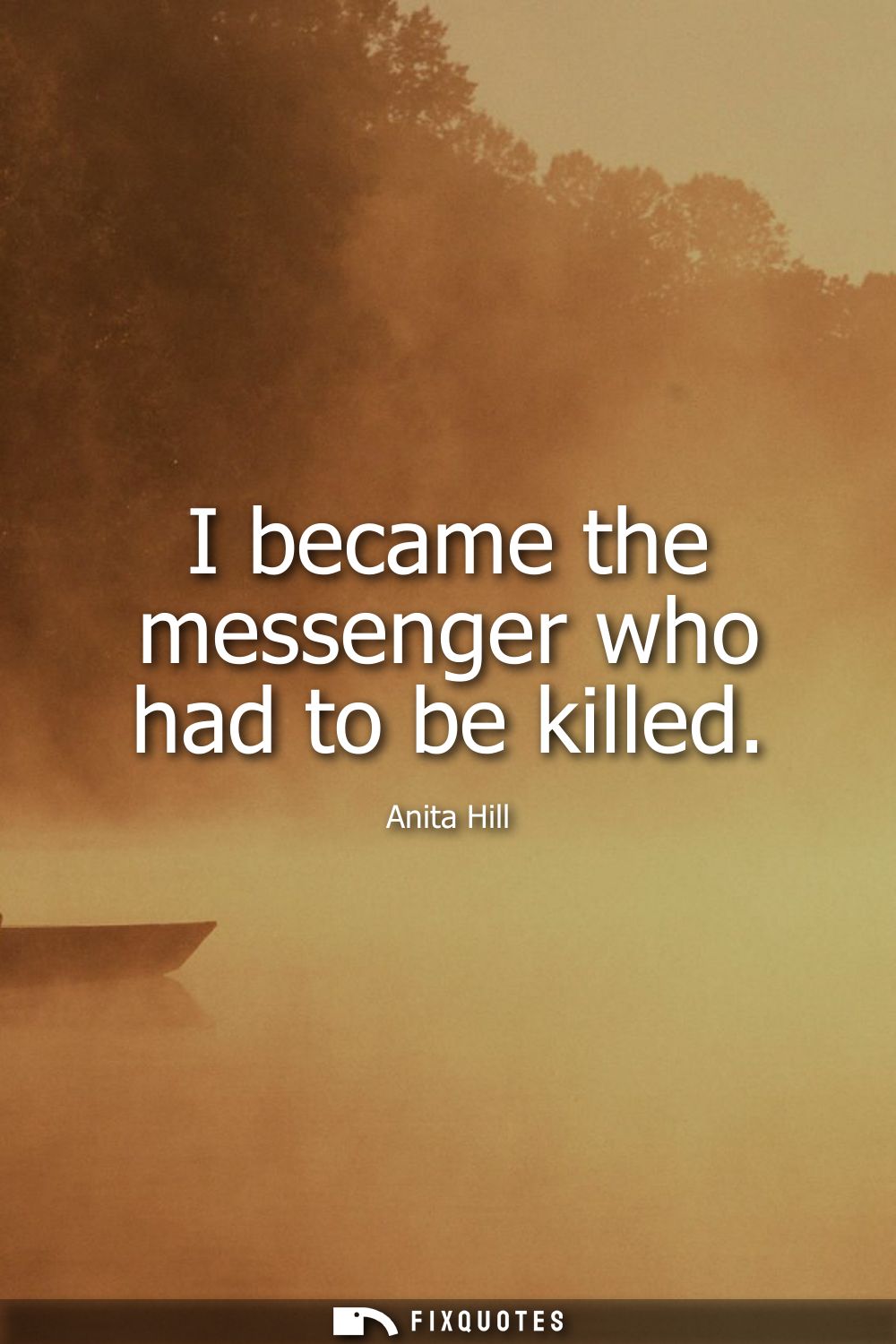
"I became the messenger who had to be killed"
About this Quote
A line like this lands with the cold efficiency of a parable: the messenger isn’t wrong, but the message is intolerable, so the system redirects its rage toward the person carrying it. Anita Hill compresses a whole political ritual into one sentence. “Became” matters. It signals a forced role, not a chosen identity. She’s describing how testimony can strip someone of complexity until they’re a single function in the public mind: accusation incarnate.
The subtext is about preservation. Institutions rarely defend themselves by debating facts on equal terms; they defend themselves by reassigning blame. Hill’s phrasing borrows from the ancient “kill the messenger” logic, but she sharpens it: “had to be killed” suggests necessity, not mere hostility. The point isn’t that people wanted her hurt; it’s that her social elimination (character assassination, credibility erosion, mockery, professional and personal costs) became structurally required to keep the larger story intact. If the messenger survives with credibility, the message survives too.
The context, of course, is the Clarence Thomas hearings and the spectacle of a professional woman made into a national symbol, interrogated as if she were the scandal rather than the witness. Hill is naming how power turns disclosure into transgression, and how a culture that claims to prize truth often treats it as an act of sabotage when it threatens a career, a court, or a comforting narrative about merit.
The subtext is about preservation. Institutions rarely defend themselves by debating facts on equal terms; they defend themselves by reassigning blame. Hill’s phrasing borrows from the ancient “kill the messenger” logic, but she sharpens it: “had to be killed” suggests necessity, not mere hostility. The point isn’t that people wanted her hurt; it’s that her social elimination (character assassination, credibility erosion, mockery, professional and personal costs) became structurally required to keep the larger story intact. If the messenger survives with credibility, the message survives too.
The context, of course, is the Clarence Thomas hearings and the spectacle of a professional woman made into a national symbol, interrogated as if she were the scandal rather than the witness. Hill is naming how power turns disclosure into transgression, and how a culture that claims to prize truth often treats it as an act of sabotage when it threatens a career, a court, or a comforting narrative about merit.
Quote Details
| Topic | Justice |
|---|---|
| Source | Help us find the source |
| Cite |
Citation Formats
APA Style (7th ed.)
Hill, Anita. (2026, January 17). I became the messenger who had to be killed. FixQuotes. https://fixquotes.com/quotes/i-became-the-messenger-who-had-to-be-killed-42423/
Chicago Style
Hill, Anita. "I became the messenger who had to be killed." FixQuotes. January 17, 2026. https://fixquotes.com/quotes/i-became-the-messenger-who-had-to-be-killed-42423/.
MLA Style (9th ed.)
"I became the messenger who had to be killed." FixQuotes, 17 Jan. 2026, https://fixquotes.com/quotes/i-became-the-messenger-who-had-to-be-killed-42423/. Accessed 10 Feb. 2026.
More Quotes by Anita
Add to List