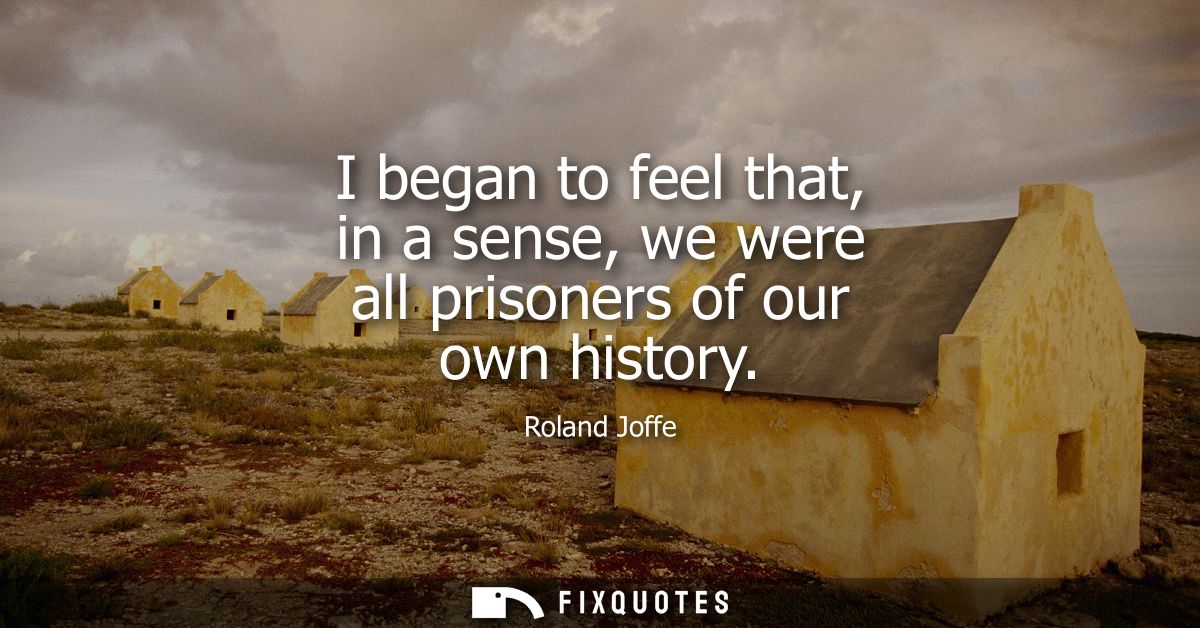
"I began to feel that, in a sense, we were all prisoners of our own history"
About this Quote
The phrasing “began to feel” matters, too. It frames the insight as experiential, earned over time, rather than a prepackaged worldview. Joffe isn’t arguing from a lectern; he’s admitting to a creeping realization that the stories we tell ourselves - nation, faith, duty, identity - don’t merely inform choices. They preselect them. That’s the subtext: free will exists, but it operates inside a set that was built long before you arrived.
“Prisoners” is the blunt instrument. It implies constraint, repetition, a system that keeps reproducing itself. Yet he adds “our own,” which turns the knife: the bars aren’t only imposed by kings, governments, or institutions. They’re internalized. We carry the cell with us, defend it, decorate it, call it tradition.
As a director, Joffe’s intent is also meta-cinematic. Film is history edited into meaning, a medium that can re-stage the past while exposing how it scripts the present. The line hints at why his work so often circles guilt, complicity, and the uneasy feeling that personal conscience is always negotiating with a centuries-long backstory.
Quote Details
| Topic | Free Will & Fate |
|---|---|
| Source | Help us find the source |
| Cite |
Citation Formats
APA Style (7th ed.)
Joffe, Roland. (2026, January 18). I began to feel that, in a sense, we were all prisoners of our own history. FixQuotes. https://fixquotes.com/quotes/i-began-to-feel-that-in-a-sense-we-were-all-3547/
Chicago Style
Joffe, Roland. "I began to feel that, in a sense, we were all prisoners of our own history." FixQuotes. January 18, 2026. https://fixquotes.com/quotes/i-began-to-feel-that-in-a-sense-we-were-all-3547/.
MLA Style (9th ed.)
"I began to feel that, in a sense, we were all prisoners of our own history." FixQuotes, 18 Jan. 2026, https://fixquotes.com/quotes/i-began-to-feel-that-in-a-sense-we-were-all-3547/. Accessed 5 Apr. 2026.