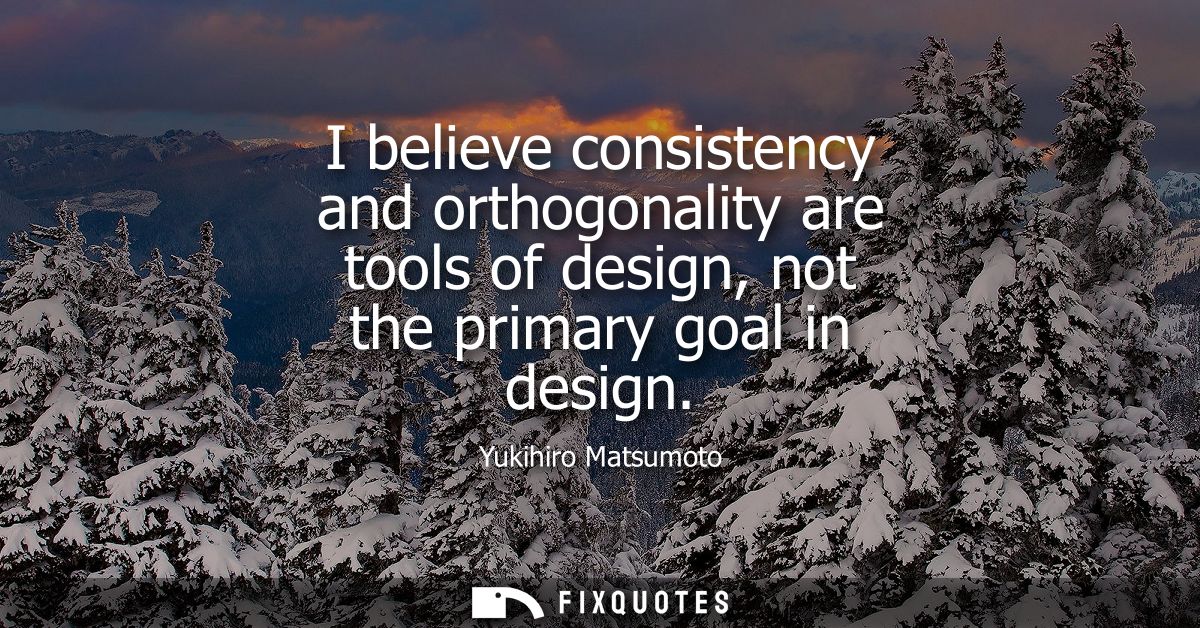
"I believe consistency and orthogonality are tools of design, not the primary goal in design"
About this Quote
The intent is pragmatic, but the subtext is philosophical. Consistency can reduce cognitive load, yes, but it can also fossilize bad decisions. Orthogonality promises a clean grid of independent parts, but real users do not experience systems as tidy matrices; they experience them as stories they have to remember under pressure. Matsumoto is defending the right to bend symmetry in service of human comprehension, even if it makes a language look “impure” to purists.
Context matters: Ruby emerged in a 1990s landscape where Java’s strictness and Perl’s maximalism were warring models of correctness. Ruby’s bet was that developer happiness is not a soft metric but an engineering constraint. This quote is an answer to the predictable critique: “Why isn’t everything perfectly consistent?” His reply: because perfect consistency is often the wrong optimization target.
What makes the line work rhetorically is its demotion of sacred principles into mere tools. It’s a warning against design by checklist. When a system privileges local clarity, expressive shortcuts, and humane defaults, it may violate orthogonality in small ways to preserve a larger coherence: the feeling that the system wants you to succeed.
Quote Details
| Topic | Coding & Programming |
|---|---|
| Source | Help us find the source |
| Cite |
Citation Formats
APA Style (7th ed.)
Matsumoto, Yukihiro. (2026, January 15). I believe consistency and orthogonality are tools of design, not the primary goal in design. FixQuotes. https://fixquotes.com/quotes/i-believe-consistency-and-orthogonality-are-tools-160027/
Chicago Style
Matsumoto, Yukihiro. "I believe consistency and orthogonality are tools of design, not the primary goal in design." FixQuotes. January 15, 2026. https://fixquotes.com/quotes/i-believe-consistency-and-orthogonality-are-tools-160027/.
MLA Style (9th ed.)
"I believe consistency and orthogonality are tools of design, not the primary goal in design." FixQuotes, 15 Jan. 2026, https://fixquotes.com/quotes/i-believe-consistency-and-orthogonality-are-tools-160027/. Accessed 6 Mar. 2026.