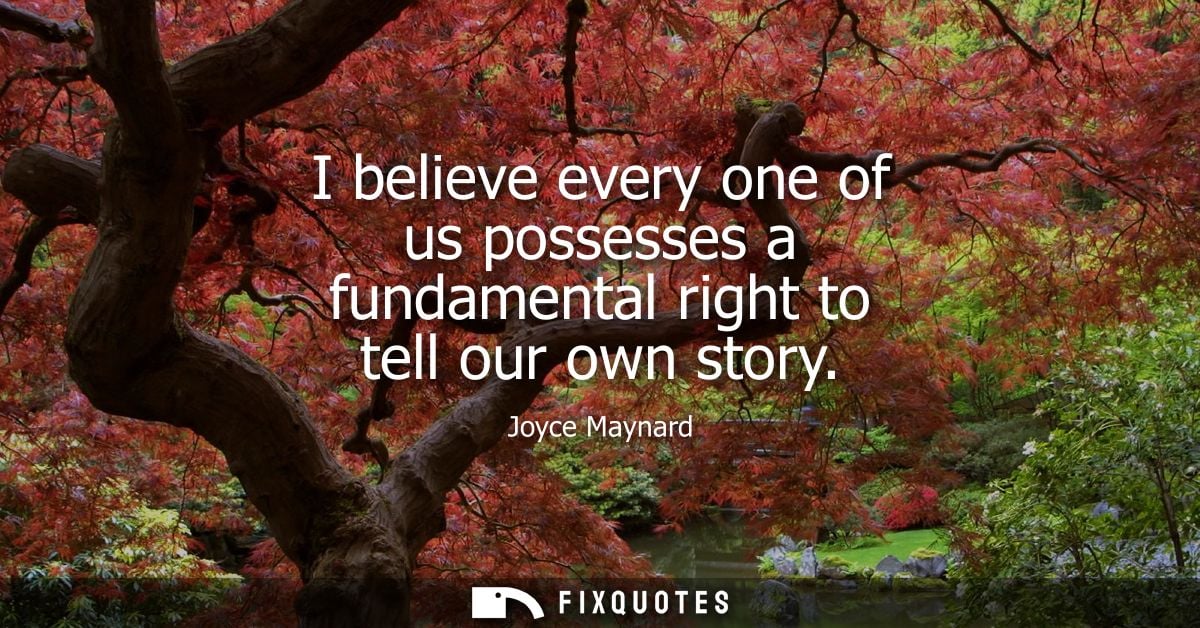
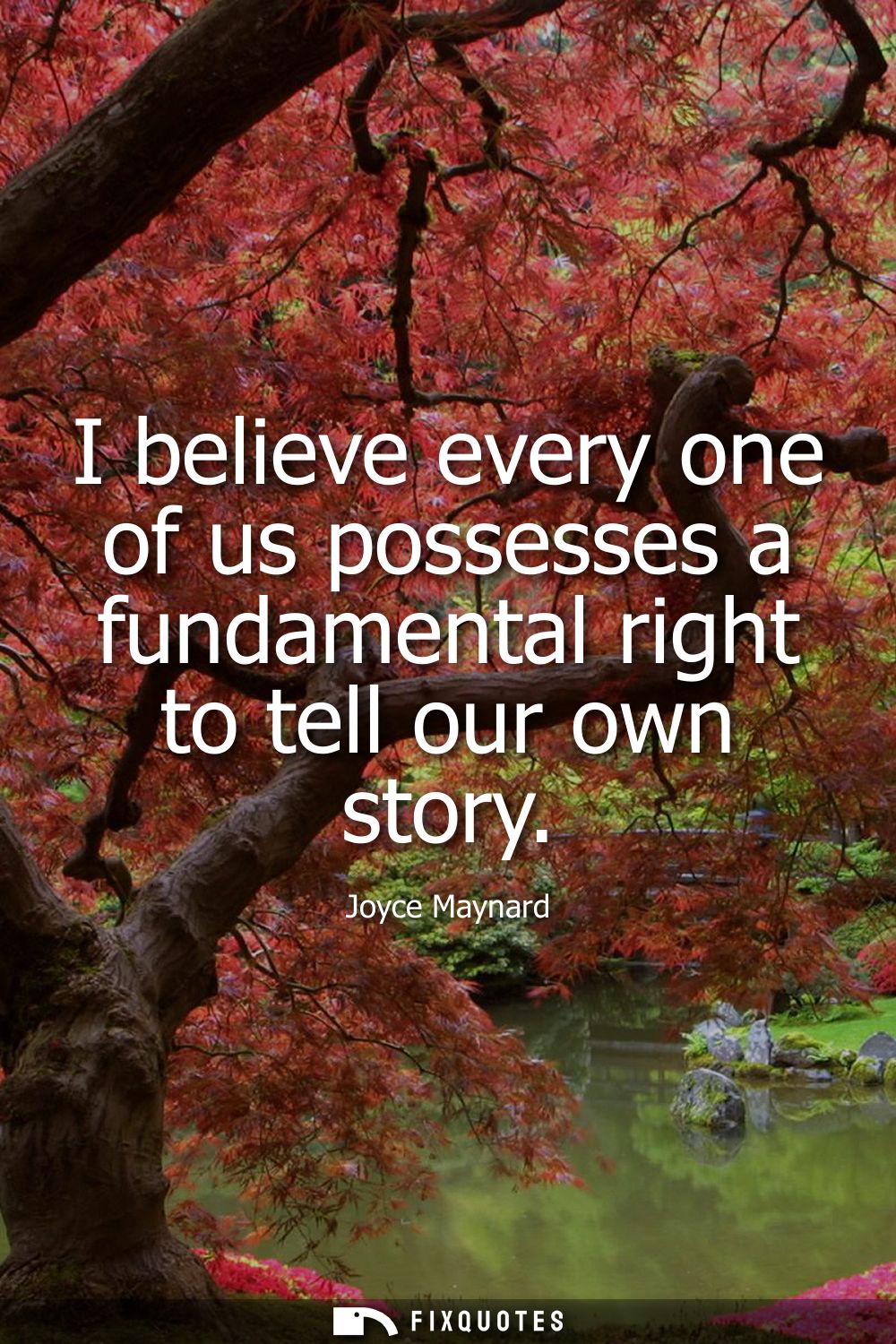
"I believe every one of us possesses a fundamental right to tell our own story"
About this Quote
The subtext is inseparable from Maynard’s own career, marked by public scrutiny and debates over the legitimacy of personal revelation. She knows that telling your story is rarely a solitary act; it implicates other people, sometimes uncomfortably. The sentence anticipates the predictable counterattack - that memoir is betrayal, that privacy is sacred - and answers it by shifting the center of gravity. The default assumption in many cultural arguments is that silence is the responsible choice. Maynard flips that: silence can be coerced, and coerced silence is a form of ownership.
What makes the quote effective is its calm insistence. No melodrama, no defensiveness. It’s a writer staking out territory: narrative as self-determination, especially for those whose lives have been narrated for them.
Quote Details
| Topic | Human Rights |
|---|---|
| Source | Help us find the source |
| Cite |
Citation Formats
APA Style (7th ed.)
Maynard, Joyce. (2026, January 16). I believe every one of us possesses a fundamental right to tell our own story. FixQuotes. https://fixquotes.com/quotes/i-believe-every-one-of-us-possesses-a-fundamental-92643/
Chicago Style
Maynard, Joyce. "I believe every one of us possesses a fundamental right to tell our own story." FixQuotes. January 16, 2026. https://fixquotes.com/quotes/i-believe-every-one-of-us-possesses-a-fundamental-92643/.
MLA Style (9th ed.)
"I believe every one of us possesses a fundamental right to tell our own story." FixQuotes, 16 Jan. 2026, https://fixquotes.com/quotes/i-believe-every-one-of-us-possesses-a-fundamental-92643/. Accessed 3 Apr. 2026.