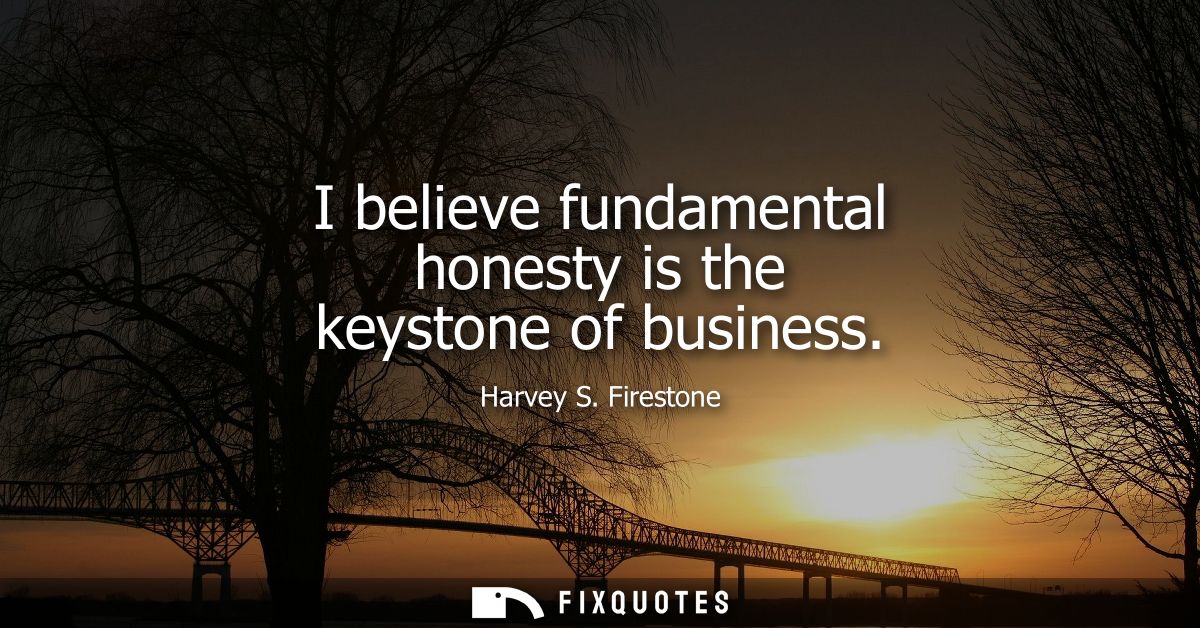
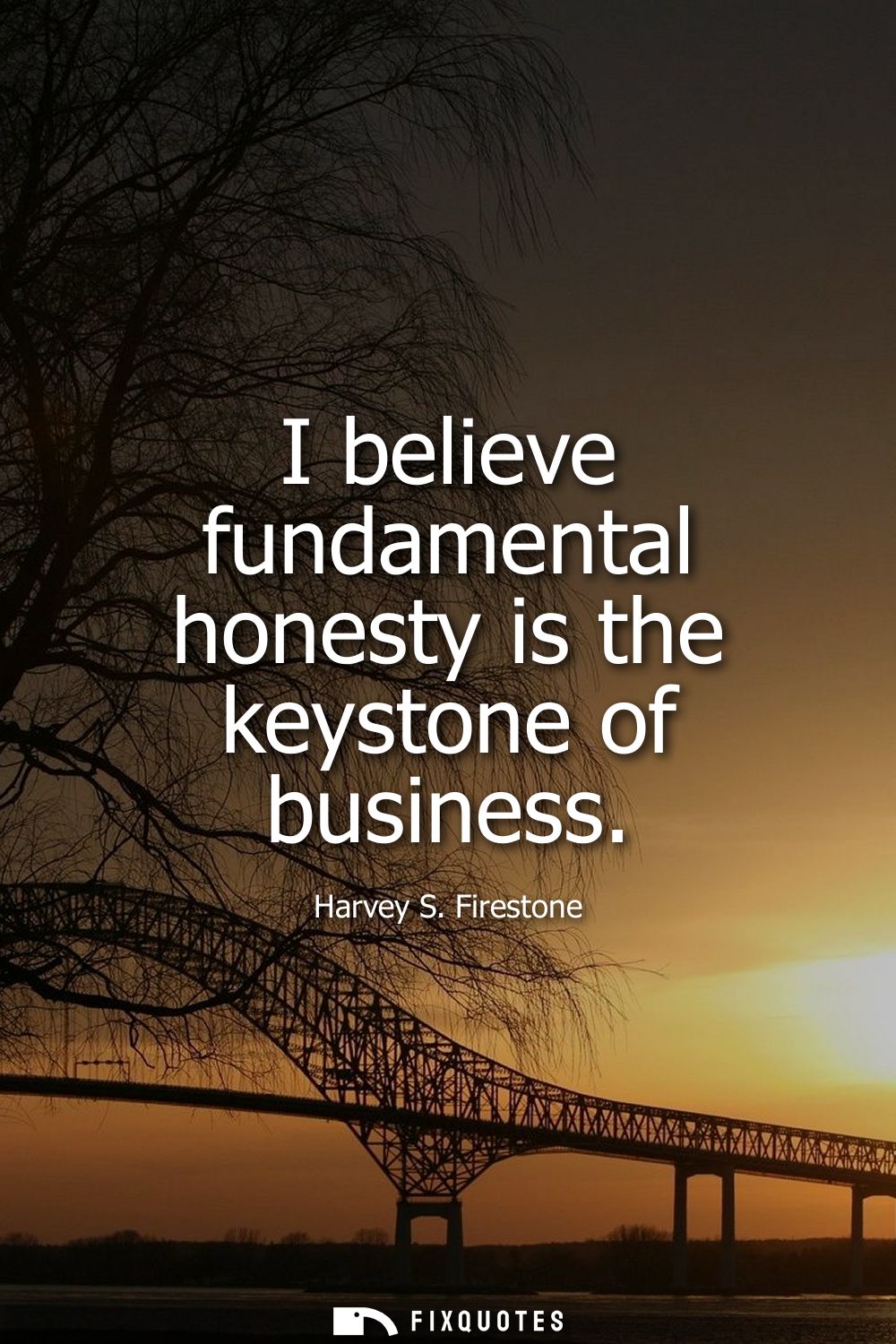
"I believe fundamental honesty is the keystone of business"
About this Quote
Firestone’s line reads less like a moral confession than a business blueprint: honesty isn’t framed as virtue, but as infrastructure. “Keystone” is doing the heavy lifting. In architecture, a keystone holds an arch together under pressure; remove it and everything collapses. Firestone is arguing that trust is load-bearing, the thing that keeps credit flowing, partnerships stable, and a brand from cracking when the market shifts.
The specific intent is pragmatic persuasion, aimed at employees, customers, and fellow industrialists who might treat truth as negotiable in the chase for scale. By calling honesty “fundamental,” he isn’t asking for saintliness; he’s prescribing a baseline standard necessary for repeat transactions. It’s an early 20th-century version of “trust is the product.”
The subtext is reputational: in an era of robber barons, labor conflict, and public suspicion of monopolistic power, a tire magnate doesn’t get to be perceived as merely efficient. He has to be legible as fair. “Honesty” becomes brand strategy, a way to civilize the hard edges of industrial capitalism and neutralize criticism that big business runs on exploitation and spin. It also quietly shifts responsibility onto the individual merchant’s character, rather than on regulation or structural safeguards. If markets fail, it implies, it’s because someone broke the code.
Context sharpens the point. Firestone built an empire dependent on long-term contracts, consumer confidence, and mass marketing tied to the rise of automobiles. In that environment, honesty isn’t idealism; it’s risk management with a moral halo.
The specific intent is pragmatic persuasion, aimed at employees, customers, and fellow industrialists who might treat truth as negotiable in the chase for scale. By calling honesty “fundamental,” he isn’t asking for saintliness; he’s prescribing a baseline standard necessary for repeat transactions. It’s an early 20th-century version of “trust is the product.”
The subtext is reputational: in an era of robber barons, labor conflict, and public suspicion of monopolistic power, a tire magnate doesn’t get to be perceived as merely efficient. He has to be legible as fair. “Honesty” becomes brand strategy, a way to civilize the hard edges of industrial capitalism and neutralize criticism that big business runs on exploitation and spin. It also quietly shifts responsibility onto the individual merchant’s character, rather than on regulation or structural safeguards. If markets fail, it implies, it’s because someone broke the code.
Context sharpens the point. Firestone built an empire dependent on long-term contracts, consumer confidence, and mass marketing tied to the rise of automobiles. In that environment, honesty isn’t idealism; it’s risk management with a moral halo.
Quote Details
| Topic | Honesty & Integrity |
|---|---|
| Source | Help us find the source |
| Cite |
Citation Formats
APA Style (7th ed.)
Firestone, Harvey S. (2026, January 14). I believe fundamental honesty is the keystone of business. FixQuotes. https://fixquotes.com/quotes/i-believe-fundamental-honesty-is-the-keystone-of-137394/
Chicago Style
Firestone, Harvey S. "I believe fundamental honesty is the keystone of business." FixQuotes. January 14, 2026. https://fixquotes.com/quotes/i-believe-fundamental-honesty-is-the-keystone-of-137394/.
MLA Style (9th ed.)
"I believe fundamental honesty is the keystone of business." FixQuotes, 14 Jan. 2026, https://fixquotes.com/quotes/i-believe-fundamental-honesty-is-the-keystone-of-137394/. Accessed 2 Apr. 2026.
More Quotes by Harvey
Add to List