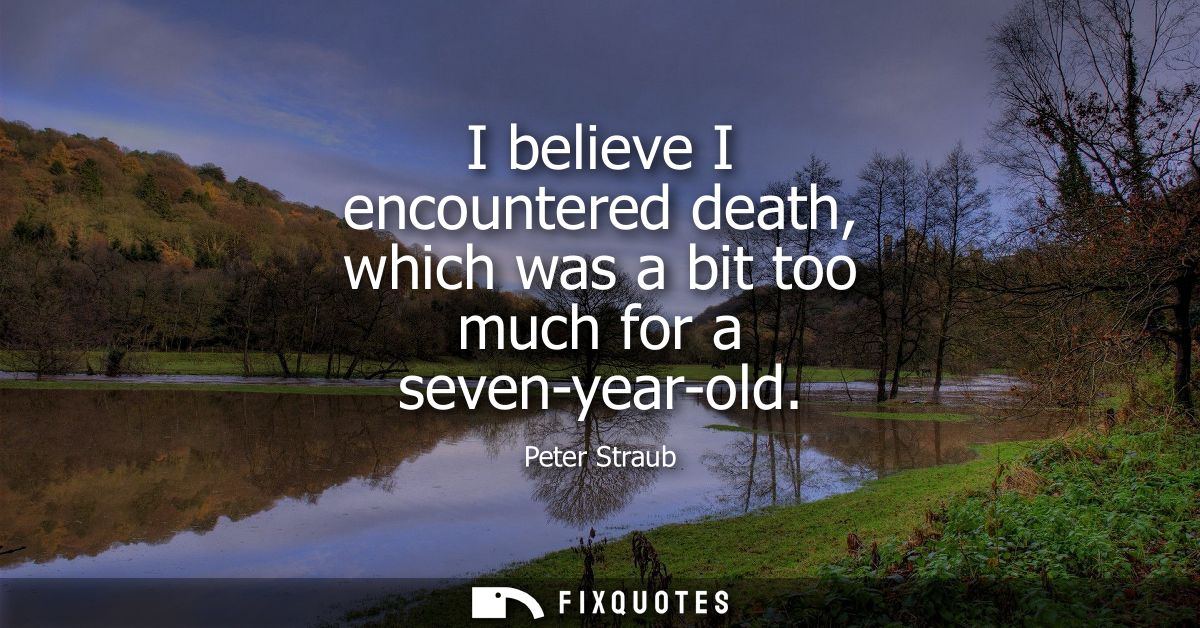
"I believe I encountered death, which was a bit too much for a seven-year-old"
About this Quote
There is something almost politely understated about “a bit too much,” and that’s the knife twist. Straub is naming a childhood brush with mortality without the melodrama you might expect, using a phrase that belongs to tea that’s gone strong or a movie that ran long. That mismatch is the point: when death enters a child’s world, it doesn’t arrive with adult-scale language. It arrives as sensory overload, as a glitch in the story a seven-year-old thought reality was telling.
Straub’s word choice is doing double duty. “Encountered” frames death not as an abstract idea but as a presence, a figure you meet on the path. It suggests proximity, a face-to-face moment, and in horror fiction that matters: fear becomes compelling when it feels like contact, not concept. “I believe” adds a faint haze of uncertainty, the way childhood memories stay vivid in feeling but slippery in detail. It reads like someone still negotiating what happened, still translating a primal shock into narrative.
Contextually, this is the kind of origin story horror writers often carry: not a taste for gore, but an early rupture in the safety contract. The subtext is that the encounter didn’t just scare him; it reorganized his imagination. If death can step into your life at seven, then the world is porous. The everyday becomes a thin set, and the job of the writer is to keep pressing on the weak spots until the audience feels that same terrible, formative leak.
Straub’s word choice is doing double duty. “Encountered” frames death not as an abstract idea but as a presence, a figure you meet on the path. It suggests proximity, a face-to-face moment, and in horror fiction that matters: fear becomes compelling when it feels like contact, not concept. “I believe” adds a faint haze of uncertainty, the way childhood memories stay vivid in feeling but slippery in detail. It reads like someone still negotiating what happened, still translating a primal shock into narrative.
Contextually, this is the kind of origin story horror writers often carry: not a taste for gore, but an early rupture in the safety contract. The subtext is that the encounter didn’t just scare him; it reorganized his imagination. If death can step into your life at seven, then the world is porous. The everyday becomes a thin set, and the job of the writer is to keep pressing on the weak spots until the audience feels that same terrible, formative leak.
Quote Details
| Topic | Mortality |
|---|
More Quotes by Peter
Add to List