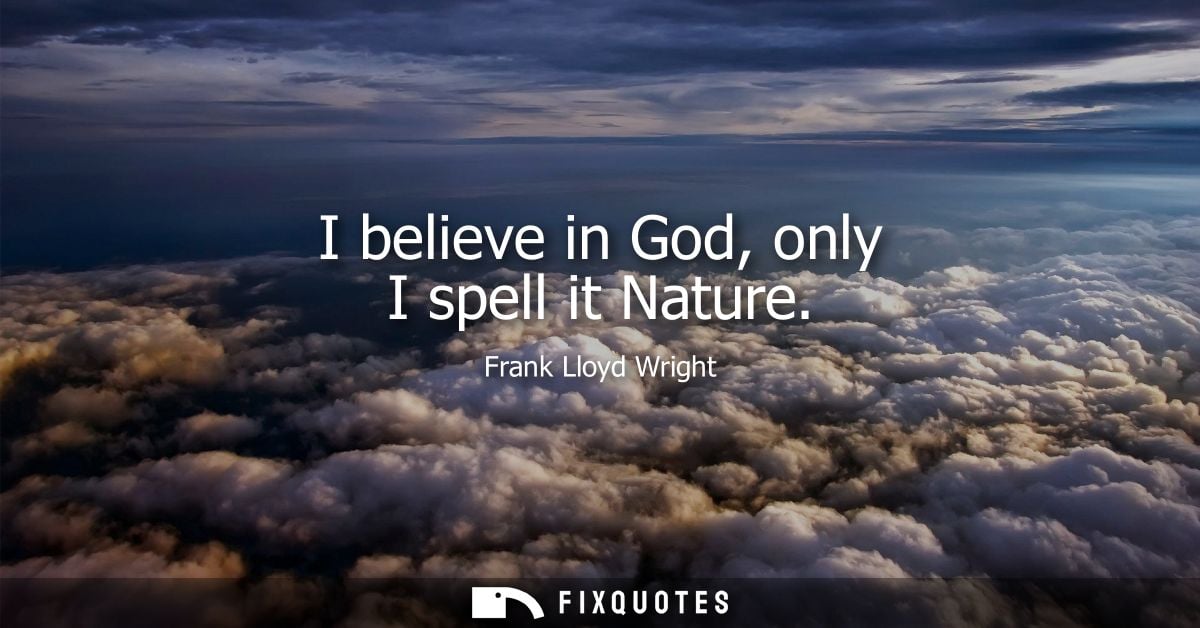
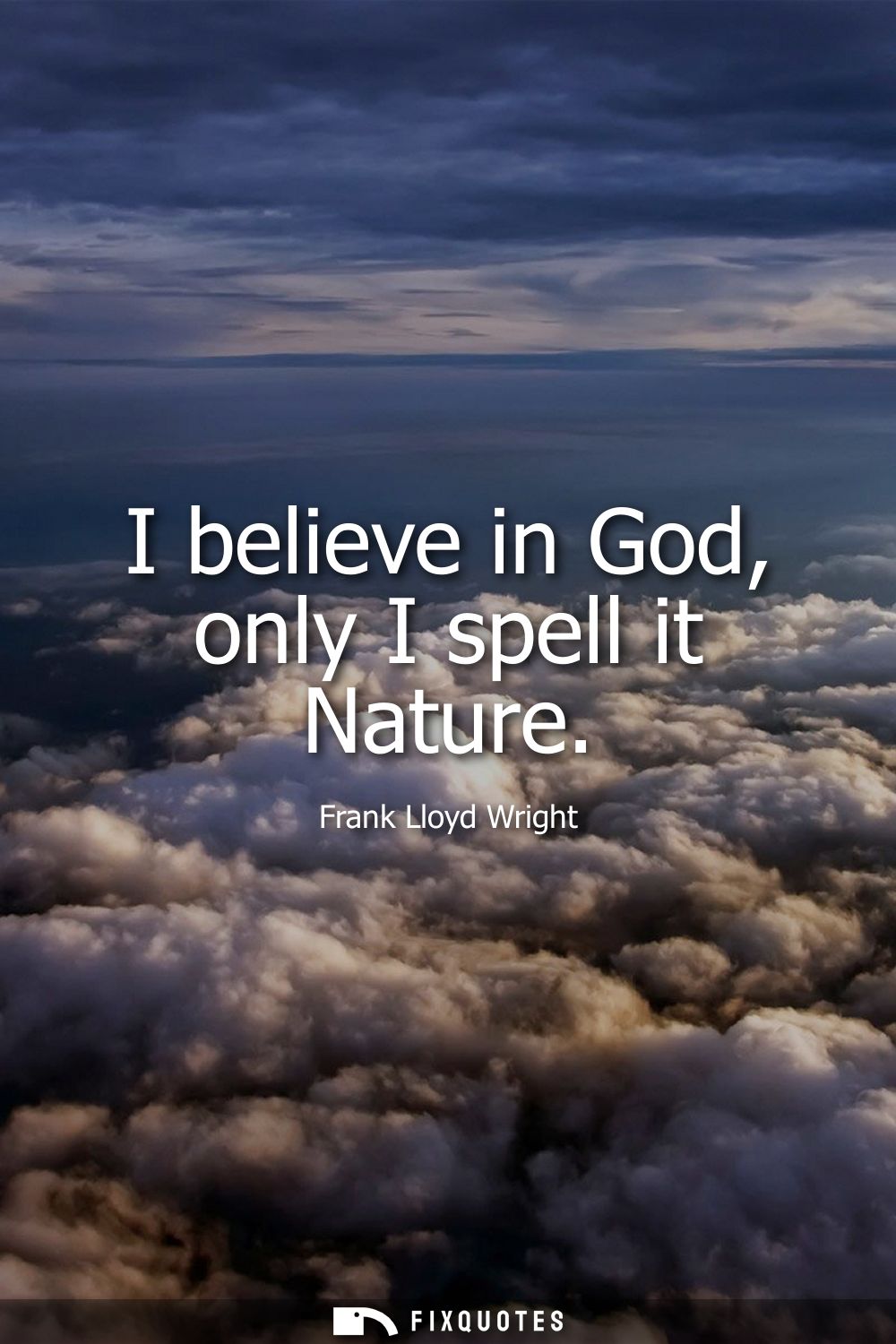
"I believe in God, only I spell it Nature"
About this Quote
Wright’s line is a quiet provocation dressed up as a confession: he keeps the emotional gravity of “God” while swapping out the church for the landscape. It’s not atheism so much as a jurisdictional dispute. The divine, he implies, isn’t a person with opinions; it’s a system with laws. Spell it Nature and you get something you can study, align with, and build alongside.
The intent is also reputational. Wright spent a career positioning himself as both artist and prophet, someone whose buildings weren’t just stylish but morally and cosmically “right.” By redefining God as Nature, he claims spiritual authority without submitting to religious authority. The subtext is a subtle rebuke to dogma: stop looking upward for answers; look outward and pay attention to the grain of wood, the path of light, the lay of land.
Context matters. Wright’s “organic architecture” wasn’t a vague love of trees; it was a design ethic insisting that form grows from site, climate, materials, and human use. In an industrializing America of standardized parts and speculative development, “Nature” becomes both muse and critique: a counterweight to mechanized sameness, a reminder that good design is not imposed but negotiated.
Rhetorically, the sentence works because it steals the warmth of belief and redirects it toward observation. It flatters the modern mind (faith without superstition) while still offering what religion often supplies: meaning, order, and awe. That’s Wright’s real architecture here: a bridge between the sacred and the practical, built out of a single, brazen spelling change.
The intent is also reputational. Wright spent a career positioning himself as both artist and prophet, someone whose buildings weren’t just stylish but morally and cosmically “right.” By redefining God as Nature, he claims spiritual authority without submitting to religious authority. The subtext is a subtle rebuke to dogma: stop looking upward for answers; look outward and pay attention to the grain of wood, the path of light, the lay of land.
Context matters. Wright’s “organic architecture” wasn’t a vague love of trees; it was a design ethic insisting that form grows from site, climate, materials, and human use. In an industrializing America of standardized parts and speculative development, “Nature” becomes both muse and critique: a counterweight to mechanized sameness, a reminder that good design is not imposed but negotiated.
Rhetorically, the sentence works because it steals the warmth of belief and redirects it toward observation. It flatters the modern mind (faith without superstition) while still offering what religion often supplies: meaning, order, and awe. That’s Wright’s real architecture here: a bridge between the sacred and the practical, built out of a single, brazen spelling change.
Quote Details
| Topic | God |
|---|---|
| Source | Later attribution: Frank Lloyd Wright (Frank Lloyd Wright) modern compilation
Evidence:
quotations 1982 by jonathon green i believe in god only i spell it nature as qu |
| Cite |
Citation Formats
APA Style (7th ed.)
Wright, Frank Lloyd. (2026, February 17). I believe in God, only I spell it Nature. FixQuotes. https://fixquotes.com/quotes/i-believe-in-god-only-i-spell-it-nature-14504/
Chicago Style
Wright, Frank Lloyd. "I believe in God, only I spell it Nature." FixQuotes. February 17, 2026. https://fixquotes.com/quotes/i-believe-in-god-only-i-spell-it-nature-14504/.
MLA Style (9th ed.)
"I believe in God, only I spell it Nature." FixQuotes, 17 Feb. 2026, https://fixquotes.com/quotes/i-believe-in-god-only-i-spell-it-nature-14504/. Accessed 23 Mar. 2026.
More Quotes by Frank
Add to List